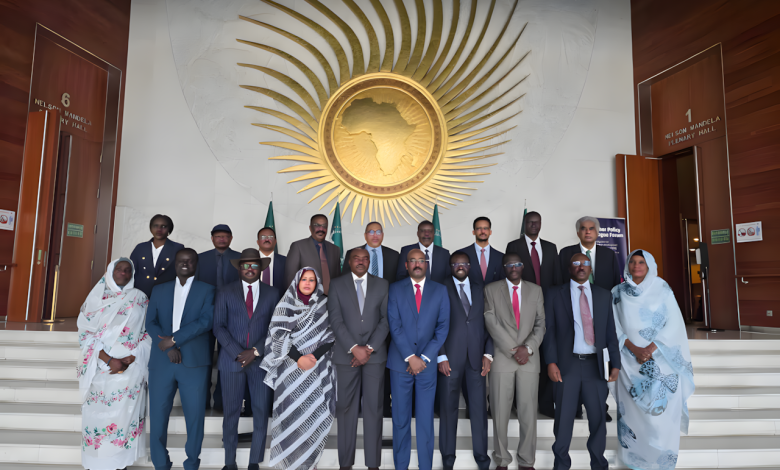
The Sudan Founding Alliance (TASIS) confronted members of the five-party mechanism overseeing efforts to resolve Sudan’s conflict on Wednesday, presenting evidence of what it described as institutional and diplomatic bias towards the SAF government during consultations at the African Union headquarters in Addis Ababa.
The TASIS delegation, headed by al-Tahir Abu Bakr Hajar, presented statements attributed to senior African Union (AU) and Intergovernmental Authority on Development (IGAD) figures before international envoys, including representatives of the United Nations and European Union.
The alliance questioned the credibility and impartiality of the mechanism, arguing that the positions adopted by several of its members undermined efforts to establish an inclusive political process capable of ending Sudan’s devastating war.
TASIS insisted that the consultations address the concerns raised in its July 2026 correspondence, which prompted the alliance to suspend its participation in exploratory meetings on ending the conflict.
Among its principal objections was the mechanism’s continued refusal to recognise any parallel government, despite what TASIS described as the illegitimacy of the Islamist-backed SAF government.
The alliance also demanded clarification over whether the five-party mechanism considered itself a mediator or merely a facilitator of negotiations between Sudanese parties.
TASIS challenges AU and Arab League impartiality
In its opening address, published by Sudanese newspaper Al-Sayha, TASIS singled out African Union Commission Chairperson Mahmoud Ali Youssouf, accusing him of promoting the Sudanese dialogue initiative launched by the SAF government.
The delegation also cited documented remarks attributed to Mohamed Belaiche, head of the AU Liaison Office in Sudan, describing his positions as even more openly partisan.
According to TASIS, Belaiche praised purported military victories by forces aligned with Sudan’s Islamist movement, characterised the alliance as a rebellion and called for its defeat.
The delegation similarly accused the Arab League of aligning itself with Islamist-backed authorities, while criticising the mechanism for interfering in the composition of the TASIS delegation and attempting to impose an agenda on the consultations.
The five-party mechanism, also known as the Quintet, comprises the African Union, United Nations, European Union, Arab League and IGAD.
Wednesday’s address was directed at Quintet chairman Mohamed Ibn Chambas, IGAD special envoy Lawrence Korbandy, UN envoy Pekka Haavisto, EU Special Representative for the Horn of Africa Annette Weber and other international diplomats.
Alliance demands clarity on Quad roadmap
TASIS also questioned the Quintet’s collective position on the September 12, 2025, peace roadmap announced by the United States, United Arab Emirates, Saudi Arabia and Egypt.
The alliance described the Quad initiative as an objective and acceptable framework upon which a credible political process could be established.
The roadmap envisages an initial three-month humanitarian truce, followed by a permanent ceasefire and a nine-month political transition towards civilian-led governance.
TASIS called for Wednesday’s discussions to concentrate on its six substantive objections, arguing that they raised fundamental questions about the Quintet’s neutrality and ability to oversee a credible peace process.
Commitment to a secular, democratic Sudan
Despite its criticism of the international mechanism, TASIS reaffirmed its commitment to a negotiated political settlement addressing the historical roots of Sudan’s recurring conflicts.
The alliance accused Sudan’s Islamist movement and its allies within the military and security establishment of igniting a war that has displaced millions, devastated infrastructure, threatened regional security and pushed communities towards famine.
TASIS reiterated its commitment to Sudan’s territorial integrity and voluntary unity, advocating the establishment of a secular, democratic and decentralised state founded on freedom, justice, equality and recognition of the country’s ethnic and cultural diversity.
The delegation stressed that its participation demonstrated its willingness to engage constructively with regional and international initiatives genuinely committed to achieving a comprehensive and sustainable peace.
TASIS renews support for Ethiopian initiative
The alliance also renewed its endorsement of Ethiopian Prime Minister Abiy Ahmed’s initiative to convene an inclusive Sudanese dialogue aimed at ending the war and opening the way towards a democratic transition.
TASIS described the Ethiopian initiative as a historic opportunity to achieve a just and comprehensive peace, expressing its readiness to cooperate with all relevant parties to ensure its success.
The declaration came as the SAF government rejected Ethiopia’s initiative on Wednesday, accusing Addis Ababa of lacking the neutrality required to facilitate Sudanese negotiations.
There was no response from the Quintet to Wednesday’s specific allegations in the initial report.