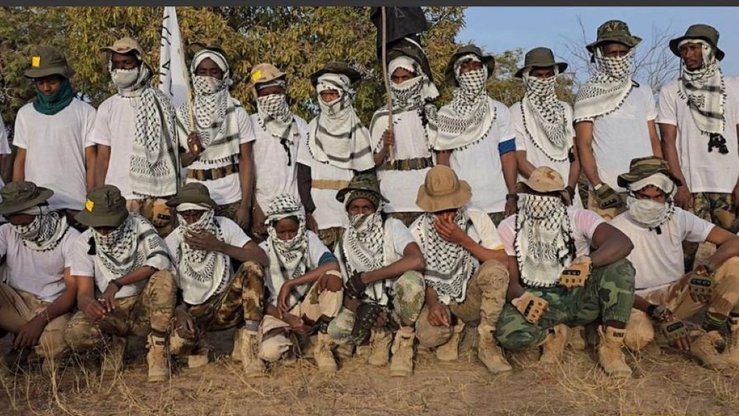
An Al-Qaeda-linked armed group has begun establishing checkpoints and collecting payments from motorists and residents in disputed areas along the Mali-Burkina Faso border, according to a report published Wednesday.
Jama’at Nusrat al-Islam wal-Muslimin (JNIM) is seeking to consolidate its territorial gains following clashes with fighters affiliated with Islamic State (IS) in the Sahel, Erem News reported, citing an informed source.
The source, who requested anonymity, said JNIM was imposing taxes and protection payments on local communities while expanding its control over roads and commercial routes.
The measures have reportedly become widespread around Arbinda and Tin-Akoff in northern Burkina Faso, where recent fighting between the rival organisations has left JNIM in control of much of the contested territory.
The source said the payments were generating substantial revenue for the group, although no financial estimates were provided.
Authorities in Mali and Burkina Faso have not publicly responded to the latest developments, amid unconfirmed reports that the two countries are considering a joint military operation against JNIM.
Armed group establishes parallel authority
The expansion comes as governments across the Sahel struggle to contain armed organisations operating across remote border regions.
Military and political analysts warn that JNIM is increasingly moving beyond conventional insurgent operations, attempting to establish administrative and economic control over areas where government authority has weakened.
African security analyst Amr Diallo told Erem News that the organisation had become a major force in the region’s security landscape.
He said its latest activities suggested an effort to establish parallel governing structures in territories brought under its control.
According to Diallo, the group’s ability to provide protection and secure passage for commercial convoys could further undermine public confidence in central governments.
He warned that communities dependent on JNIM-controlled transport routes might increasingly regard the organisation as a source of local authority, particularly where state security forces have limited access.
However, Diallo questioned whether the group could translate its military gains into lasting political control.
He said such an outcome would depend on securing broader public acceptance and developing a political programme capable of attracting support beyond its existing networks.
Taliban model raises concerns
Analysts have also drawn comparisons between JNIM’s strategy and the Taliban’s rise to power in Afghanistan.
Led by Iyad Ag Ghaly, the Al-Qaeda-linked coalition has adopted rhetoric opposing foreign military involvement in Mali, Burkina Faso and Niger.
Political analyst Mohamed al-Hajj Othman told Erem News that JNIM was attempting to wage a psychological campaign against the military-led governments of the Sahel.
However, he argued that the organisation lacked the public support necessary to replicate the Taliban’s military and political success in Afghanistan.
Othman said Ag Ghaly had expressed admiration for the Taliban’s ability to force a United States military withdrawal before defeating Afghanistan’s former government forces.
Despite those ambitions, he said JNIM remained unable to convince significant sections of the Malian and Burkinabe populations to support its political project.
Rivalry over territory and revenue
The latest developments follow months of confrontations between JNIM and IS-affiliated fighters competing for influence over strategic areas linking Mali, Burkina Faso and Niger.
Both organisations have sought to control important trade corridors, informal commercial networks and routes used by local communities.
Control over these areas provides opportunities to collect payments, obtain supplies and finance further military operations.
The rivalry has intensified insecurity in communities already affected by years of armed conflict, displacement and economic disruption.
JNIM’s reported establishment of checkpoints represents a further attempt to convert battlefield gains into sustained territorial control, raising concerns about the ability of regional governments to restore authority in contested border regions.