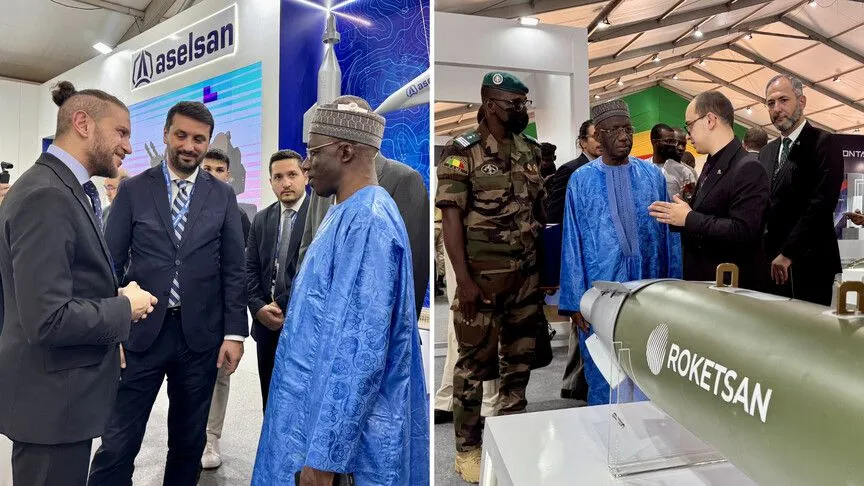
Turkish defence technology, particularly unmanned aerial vehicles, could play a crucial role in strengthening Mali’s military capabilities as the country struggles with personnel shortages and security threats across its vast territory, a senior Malian official said.
Yamoussa Camara, permanent secretary of Mali’s National Security Council, said advanced military technology would help the armed forces improve their operational effectiveness despite limited manpower and financial resources.
Speaking to Anadolu on the sidelines of the BAMEX 2026 defence exhibition in Bamako, Camara said Mali faces significant challenges in securing its 1.24 million square kilometres of territory with its existing military resources.
The retired major general stressed that integrating modern defence systems, particularly Turkish-made drones, could help bridge the gap between the country’s security requirements and the capabilities of its armed forces.
Turkish drones seen as vital to Mali’s security
Camara highlighted Turkey’s growing expertise in military technology, describing closer defence cooperation between Ankara and Bamako as essential to addressing Mali’s security challenges.
He identified unmanned aerial vehicles (UAVs) as particularly valuable assets, offering capabilities that could compensate for personnel shortages and improve military operations across difficult terrain.
Mali has increasingly sought technological solutions to strengthen its armed forces as it confronts persistent security challenges across the Sahel.
Sahel alliance urged to strengthen cooperation
Camara also called for greater military coordination among members of the Alliance of Sahel States (AES), comprising Mali, Burkina Faso and Niger.
He acknowledged that existing joint security initiatives had fallen short of the three countries’ requirements, particularly in the Liptako-Gourma region, where their borders converge.
The region’s vast geographical expanse presents considerable challenges for security forces attempting to monitor territory and coordinate operations, he said.
Camara argued that closer cooperation and the wider deployment of advanced military technology would be necessary to overcome those limitations.
He urged the three Sahel countries to pool additional resources, strengthen their collective security arrangements and deepen defence partnerships with Turkey.
The remarks underscore the importance Malian security officials place on Turkish defence technology as they seek to modernise military capabilities and improve regional security cooperation.