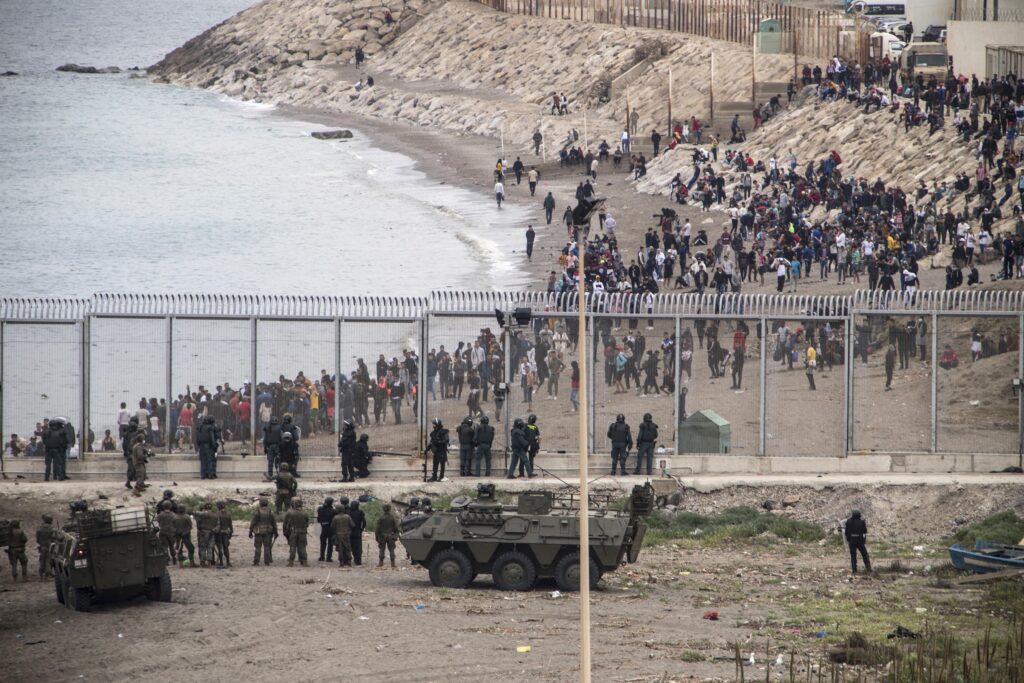
Italy suspended passport-free travel arrangements with Spain on Friday in response to the mass arrival of migrants in the Spanish enclave of Ceuta from neighbouring Morocco.
The decision temporarily restores passport checks for passengers travelling between Italy and Spain by air or sea, despite the two countries not sharing a land border.
Italy’s Interior Ministry also said Rome had agreed with France to reinforce controls along the French-Italian border to prevent undocumented migrants from entering Italian territory.
The move is expected to strain relations with Madrid and has drawn criticism from opponents of Prime Minister Giorgia Meloni’s right-wing government, who described it as largely symbolic.
Critics said there was no evidence that migrants who entered Ceuta intended to travel onward to Italy and accused the government of using the crisis to appeal to anti-immigration voters at home.
Italy announced the suspension after Spanish authorities said they had brought the situation in Ceuta under control. Most of the more than 50,000 people who entered the North African enclave had reportedly returned voluntarily to Morocco.
Meloni’s coalition came to power in 2022 after promising to curb irregular migration but has recently faced growing competition from a new far-right movement led by former army general Roberto Vannacci.
With migration again dominating political debate, the Italian government has sought to project a tougher approach to border security.
Piero De Luca, a senior lawmaker from the centre-left Democratic Party, accused the government of pursuing a populist measure aimed at competing with Vannacci rather than offering a practical solution.
“This is a purely demagogic proposal, designed for domestic consumption and to compete with Vannacci, without solving anything,” De Luca said.
The Schengen Area normally allows people to travel without passport checks across 29 European countries. Member states may, however, temporarily restore border controls when they cite threats to security or public order.