Liberian authorities have seized nearly four metric tonnes of cocaine believed to be destined for Europe, in one of the largest drug busts ever recorded in the West African country, the national police chief said.
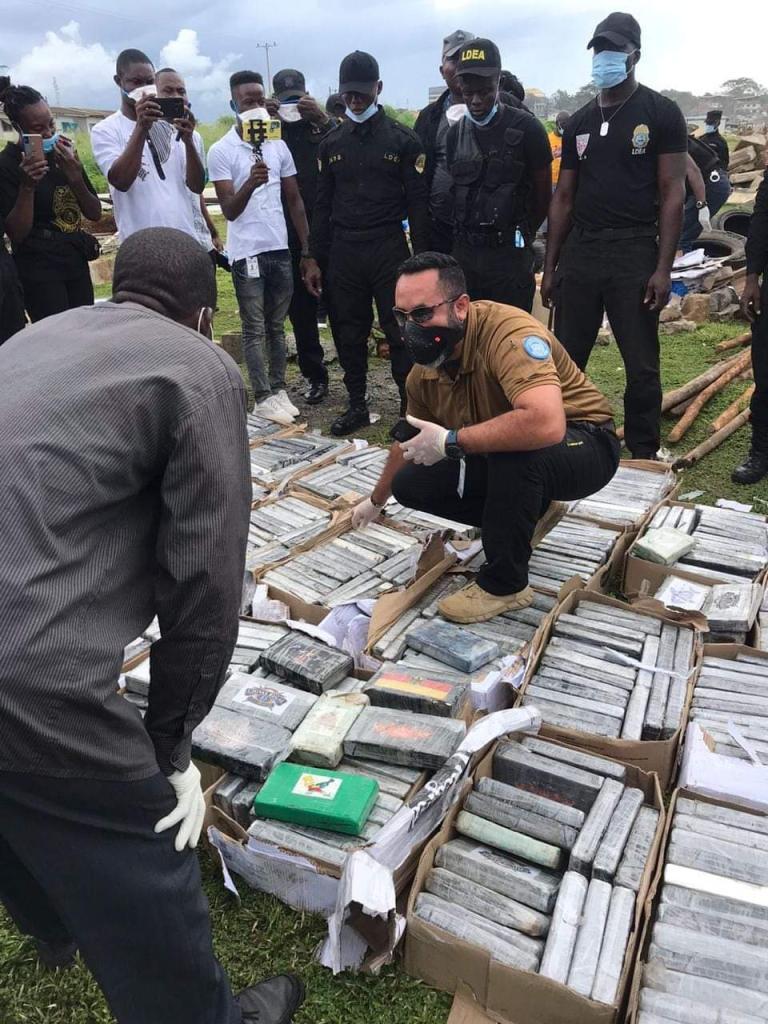
Police officers discovered 3,971 kilograms of cocaine on Tuesday at a property in Duazon, east of the capital Monrovia, according to Gregory Coleman, inspector general of the Liberian National Police.
The seized drugs were estimated to have a street value of about $317 million.
Two suspects were arrested during the operation. One was carrying Spanish and Colombian passports, while the other held a Serbian passport, Coleman said.
Footage and photographs released by police showed a house packed with cardboard boxes and suitcases wrapped in plastic. Some of the packages were marked with the words “Coco” and “Poseidon”.
Authorities have not yet determined where the cocaine originated. Coleman said chemical testing and an examination of the markings on the packages would be required to establish the source of the shipment.
West African countries are frequently used as transit hubs by trafficking networks transporting large quantities of cocaine from South America to European markets.
The latest seizure follows another major operation last month, when Liberian authorities intercepted 237.6 kilograms of cocaine at Roberts International Airport outside Monrovia.
That shipment, valued at more than $19 million, had arrived from Sierra Leone and was reportedly intended for Britain.
Coleman said the airport shipment had been linked to Dutch alleged cocaine trafficker Jos Leijdekkers, although he declined to provide further details. Reuters previously reported that Leijdekkers, one of Europe’s most wanted fugitives, had found refuge and high-level protection in Sierra Leone.
Police have not established any connection between the two seizures and believe the shipments originated from separate sources.
François Patuel, head of research for West and Central Africa at the United Nations Office on Drugs and Crime, said the Liberian seizures reflected broader changes in global cocaine trafficking.
Trafficking organisations are increasingly diversifying their routes while moving larger quantities of drugs, he said.
Lucia Bird Ruiz-Benitez de Lugo, director of the Observatory of Illicit Economies in West Africa, said some of the world’s most sophisticated cocaine trafficking networks were operating in the region and using it to store large shipments before moving them onward.