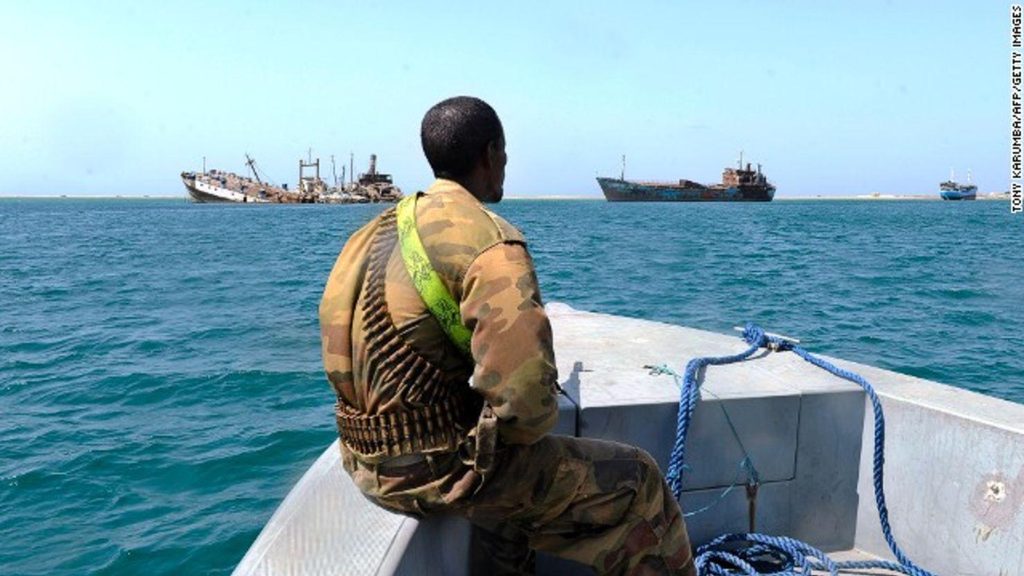
Somali pirates holding a cargo ship carrying Turkish weapons and military communications equipment have reportedly demanded around $2 million for its release, days after the vessel was hijacked off Somalia’s Puntland coast.
The Cameroon-flagged M/V LUTUF was seized on August 17 about 3.5 nautical miles off Marraya in Puntland’s Eyl district, according to Somali officials cited by the Associated Press.
The vessel was carrying Turkish weapons, communications equipment and satellite systems destined for a Turkish military training facility in the Somali capital, Mogadishu, the official said.
The unusually sensitive nature of the LUTUF’s cargo has also raised questions over whether the pirates had advance information about the vessel’s route and shipment. Puntland’s Security Ministry has separately alleged that “external forces” are behind the broader resurgence of piracy in the region, although it has not identified any country or provided evidence linking a foreign actor to the LUTUF seizure.
The circumstances have fueled speculation among some Turkish social media users that Israel may have provided intelligence or targeting information that helped the pirates identify the vessel, particularly because the ship was carrying weapons, communications systems and satellite equipment destined for Turkey’s military facility in Mogadishu.
However, no evidence has emerged linking Israel or Israeli intelligence to the hijacking, and no Somali or Puntland authority has publicly accused Israel of involvement. The pirates are instead believed to belong to an established Somali group linked to the earlier hijacking of the M/V Sward in April.
Eight armed pirates reportedly boarded the vessel and steered it toward the Nugaal coast. Authorities suspect the group may be linked to pirates involved in the earlier hijacking of the M/V Sward in April.
The LUTUF had 10 people aboard, including six Indian crew members, one Turkish national, one Georgian national and two Serbian security guards.
Despite the presence of armed security personnel, the pirates managed to take control of the ship.
Pirates reportedly demand $2 million
Somali media reported on August 23 and 24 that the group holding the LUTUF had demanded approximately $2 million in ransom for the vessel’s release.
It remains unclear whether formal negotiations have begun or whether the shipowner, insurers or other parties have agreed to make any payment.
Puntland authorities have meanwhile warned that ransom payments could revive the financial networks that sustained Somali piracy at its peak and encourage further attacks along the country’s coastline.
Turkish vessels and aircraft monitor hijacked ship
Two Turkish-owned vessels later approached the hijacked ship, while helicopters and drones were reported operating in the area, according to the Somali official cited by AP.
The increased aerial activity has attracted particular attention following a series of deadly and still-unexplained airstrikes near areas where the pirates were believed to be operating.
A small boat carrying two people reportedly approached the LUTUF after the hijacking and delivered khat to those aboard before returning to shore.
An airstrike was carried out shortly afterwards, killing four people and wounding two, according to AP.
It has not been independently established who conducted that strike or whether those killed were involved in the hijacking.
Second strike reported near pirate-held ship
A further airstrike was reported on August 23 in the Jiifle coastal area of Puntland’s Nugaal region, near where the LUTUF had reportedly been taken.
Maritime tracking service VesselTracker reported that at least nine people were killed in the strike, while Puntland authorities said they had opened an investigation.
Separate Somali reporting has put the combined death toll from the coastal strikes at at least 13.
No government has publicly claimed responsibility.
Turkey has not formally confirmed involvement in the attacks. When its Foreign Ministry was reportedly asked by BBC Somali about the strikes, Ankara said it had “no information” about the operation — a response that neither confirmed nor explicitly denied Turkish involvement.
There is currently no independently verified evidence establishing that Turkish forces carried out the strikes.
Wider resurgence in Somali piracy
The seizure of the LUTUF is part of a broader resurgence of piracy in waters around Somalia, the Gulf of Aden and the western Indian Ocean.
Three days after the LUTUF was taken, Somali pirates hijacked the Eritrean-flagged oil tanker M.T. Sibu 1 about 136 nautical miles east of Yemen’s Al Mukalla.
That brought the number of commercial vessels hijacked by Somali pirates since April to six, according to maritime officials.
Previous seizures included the MT Honour 25, M/V Sward, MT Eureka and MT Asana.
By late July, several hijacked vessels were reportedly being held close together in Somali territorial waters along with dozens of crew members.
The International Maritime Organization had already warned of a sharp increase in piracy and armed robbery incidents in the Red Sea and Gulf of Aden region.
The new wave has revived fears of a return to the ransom-driven piracy networks that plagued shipping off Somalia more than a decade ago.
At the height of Somalia’s piracy crisis, hundreds of millions of dollars were paid in ransoms, helping finance networks of armed groups, negotiators, financiers and logistics operators.
The reported $2 million demand for the LUTUF suggests that model may be re-emerging as Somali pirate groups again demonstrate the ability to seize guarded commercial vessels and operate far beyond the immediate coastline.