South Sudan has assumed full control of its national airspace for the first time since independence, ending nearly 15 years of reliance on Sudan to manage high-altitude air traffic and collect overflight fees.
The transition marks a significant step in Juba’s efforts to strengthen its sovereignty and aviation infrastructure more than a decade after the country seceded from Sudan in July 2011.
According to South Sudan’s Civil Aviation Authority, the handover was completed in two stages. The first came on May 18 with the launch of the country’s first national air traffic management system and a new control tower at Juba International Airport.
The process was completed on June 30 after the International Civil Aviation Organization approved the creation of the Juba Flight Information Region, separating South Sudanese airspace from the Khartoum Flight Information Region.
Ending dependence on Khartoum
When South Sudan became independent in 2011, it lacked the trained personnel and technical infrastructure needed to manage upper-level air traffic. Khartoum therefore continued providing navigation and air traffic control services for aircraft crossing South Sudanese territory.
In 2016, the two countries signed an interim arrangement backed by ICAO allowing Sudan to continue managing South Sudan’s upper airspace while Juba developed its own systems and trained air traffic controllers.
The arrangement was initially expected to end in 2019, but remained in place as infrastructure projects and staff training took longer than planned.
South Sudan began developing its new air traffic management system in July 2020, with construction largely completed by December 2023. Full operations were delayed while equipment was tested, personnel were trained and coordination procedures were finalised with neighbouring countries and international aviation bodies.
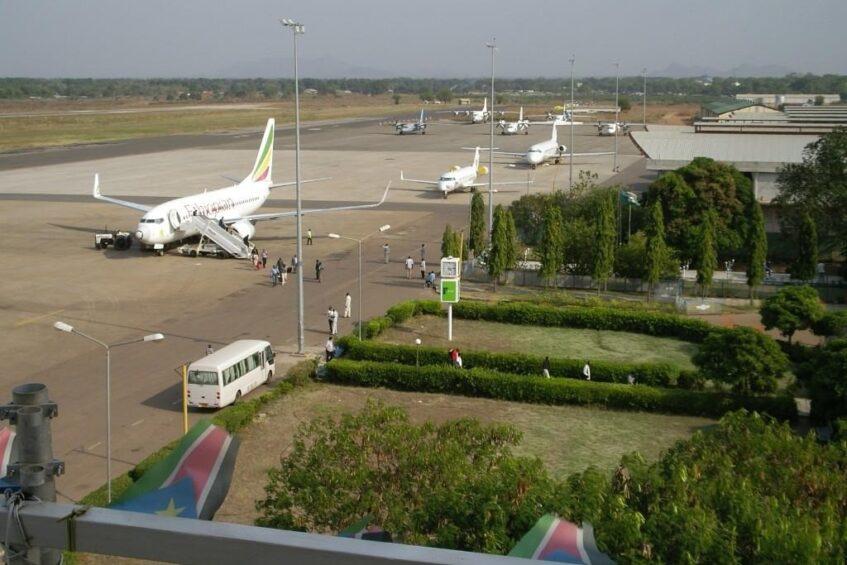
The project included a new control tower at Juba International Airport as well as radar, communications and navigation systems allowing South Sudanese authorities to track aircraft, manage flight paths and issue landing, departure and overflight clearances.
Around 24 South Sudanese aviation personnel were trained in China to operate the system, according to the country’s transport ministry. The infrastructure project was carried out by China Harbour Engineering Company.
The Civil Aviation Authority now says it can provide round-the-clock air traffic control, flight information, meteorological support, navigation assistance and emergency coordination services.
New source of revenue
Direct management of the country’s airspace also allows South Sudan to collect navigation and overflight fees from airlines using its skies.
Those revenues had previously been administered through Khartoum under the temporary arrangement.
For South Sudan, which remains heavily dependent on oil income, aviation charges could provide an additional source of government revenue while giving Juba greater control over flight routes, airline regulation and aviation safety.
Transport officials have said the new system allows South Sudan to monitor aircraft operating at altitudes of roughly 6,000 metres and above, ending the technical arrangement under which Sudan controlled that section of its airspace.
Aviation sector remains limited
Despite taking control of its skies, South Sudan still lacks a stable national carrier.
Several small private airlines emerged after independence to operate domestic and regional services. Among the most prominent was South Supreme Airlines, which began operations in 2013 with flights from Juba to domestic destinations and Entebbe in Uganda.
The airline suspended operations in 2015 amid a shortage of foreign currency before later returning under the name South Sudan Supreme Airlines.
Its safety record came under scrutiny after several accidents, including a 2017 crash at Wau airport in which there were no fatalities and a March 2021 crash shortly after takeoff from Pieri that killed all 10 people on board.
President Salva Kiir subsequently ordered the suspension of the airline’s operating licence.
The company announced plans earlier this year to resume services, but South Sudan’s aviation regulator said at the time that it had not yet received approval to restart operations.
Plans for a state-owned national carrier, South Sudan Airways, have also remained largely on paper. The government allocated funds in the 2019-2020 budget for aviation policy development and a feasibility study, but the proposed airline has yet to become operational.
International travel from Juba therefore continues to depend largely on foreign and regional airlines, alongside a limited number of private domestic and charter operators.
South Sudan’s takeover of its airspace nevertheless represents one of the most important institutional milestones in the country’s aviation sector since independence, giving Juba direct control over both air traffic management and revenues generated by aircraft crossing its territory.