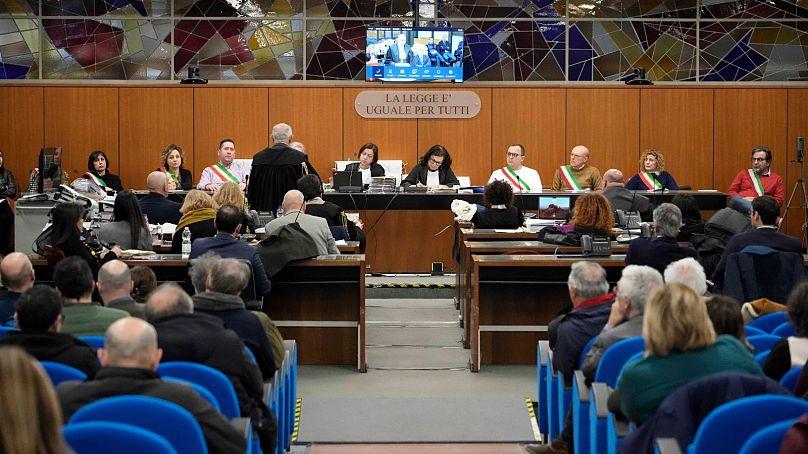
An Italian court on Monday sentenced three Egyptian security officials to 10 years in prison for the kidnapping of Italian researcher Giulio Regeni, whose tortured body was discovered in Cairo in 2016, in a landmark ruling in a case that has strained relations between Rome and Cairo for more than a decade.
The three officials were convicted in absentia of aggravated kidnapping, while a fourth defendant was acquitted. The court also dismissed a charge of conspiracy to commit aggravated murder against one of the convicted men.
Regeni, a 28-year-old postgraduate student at Britain’s Cambridge University, disappeared in the Egyptian capital on January 25, 2016. His body was discovered nearly a week later, bearing extensive signs of torture.
Italian investigators concluded that Regeni had been targeted by Egyptian security officials over his research into independent trade unions, a politically sensitive subject in Egypt.
Egypt has consistently denied any state involvement in his death, maintaining that a criminal gang was responsible.
Three officials convicted, fourth acquitted
The Rome court found Major Magdi Sharif of Egypt’s General Intelligence Service, Cairo police investigations chief Colonel Ather Kamal and police Colonel Hisham Helmy guilty of aggravated kidnapping.
Major General Tarek Sabir, the former head of state security, was acquitted of the same charge. The court also dismissed the murder-related charge against Sharif.
Prosecutors had sought a life sentence for Sharif and prison terms of 17 years and six months for each of the other defendants.
All four men were tried in absentia under Italian legislation allowing the prosecution of crimes committed abroad against Italian citizens.
Italian authorities have been unable to establish the defendants’ whereabouts, making it unlikely that the convicted officials will be extradited to serve their sentences.
The Egyptian embassy in Rome and Egypt’s foreign ministry did not immediately respond to requests for comment on Monday. None of the defendants has publicly addressed the accusations.
Regeni family welcomes verdict
The ruling was welcomed by Regeni’s family, which has spent more than a decade campaigning for accountability over his disappearance, torture and killing.
Alessandra Ballerini, the family’s lawyer, described the verdict as an important victory against impunity.
“From today, people around the world can feel safer,” she said, adding that democracies could impose limits on arbitrary power.
The court also ordered the three convicted officials to pay damages to Regeni’s family and the Italian state.
Ballerini called on the Italian government to demand payment and sever diplomatic relations with Egypt.
Rome Chief Prosecutor Francesco Lo Voi acknowledged the difficulties investigators had faced in pursuing the case.
“We achieved this result despite what can be described as less than wholehearted cooperation from the Egyptian authorities,” he said.
Lo Voi said prosecutors would examine the judgment before deciding whether to appeal.
Decade-long dispute over accountability
Regeni’s killing triggered a diplomatic crisis between Italy and Egypt, with Rome demanding answers about the circumstances of his disappearance and death.
Italian and Egyptian prosecutors initially conducted a joint investigation but eventually reached sharply different conclusions.
Egyptian authorities attributed the killing to a criminal gang whose members were subsequently killed in a police shootout.
Italian investigators rejected that account, alleging that Egyptian security officials had abducted and tortured Regeni because of his academic work on independent labour organisations.
The trial began in 2021 but was repeatedly delayed by legal disputes over whether the defendants had been properly informed of the proceedings.
Italian prosecutors told the court that authorities had made approximately 30 attempts through diplomatic and government channels to obtain the suspects’ addresses, without receiving a response from Egypt.
Italy’s highest court eventually ruled that the Egyptian authorities’ failure to cooperate should not prevent the prosecution from proceeding.
The decision allowed the trial to move forward despite the defendants’ absence.
Although diplomatic relations between Rome and Cairo have gradually recovered in recent years, Regeni’s family and human rights organisations have continued to demand justice.
Monday’s verdict represents a significant judicial development in the case, although the court’s dismissal of the murder-related charge leaves questions about accountability for Regeni’s killing unresolved.