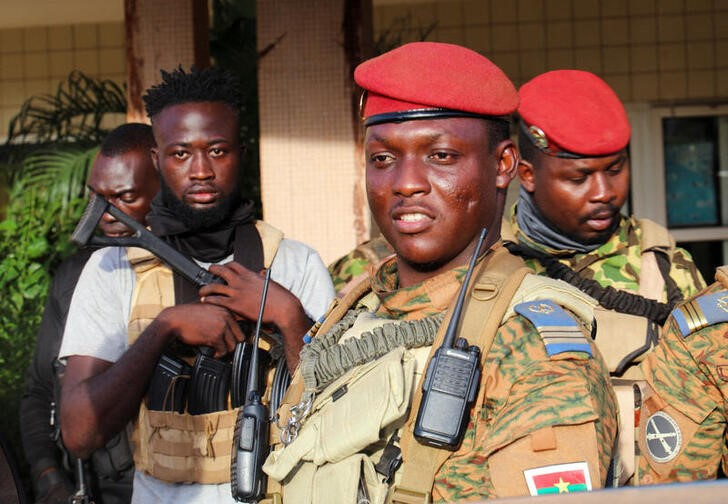
Burkina Faso’s military leader Ibrahim Traore has announced plans for a new constitution that would fundamentally reorganise the country’s political system, signalling a potentially far-reaching transformation of the state four years after he seized power.
Traore said during a televised interview marking four years in power that Burkina Faso would need an entirely new constitution rather than amendments to the existing charter, arguing that the country’s political system should be “totally reorganised.”
The announcement points to a broader effort to redefine the role of political parties, opposition groups and state institutions as Traore’s government increasingly promotes a model centred on state control, national sovereignty and what it calls a “popular progressive revolution.”
Traore has criticised conventional party politics and suggested that future political representation should extend beyond political parties to include trade unions, farmers and community organisations.
He has also cited political and economic systems in countries including China and Russia while arguing that Burkina Faso should develop institutions suited to its own priorities rather than reproduce political models inherited from the country’s Francophone past.
Political researcher Said Berkenane told Erem News that the proposed constitution should be viewed as part of a broader attempt to rebuild the state around new geopolitical and economic priorities rather than simply as a legal requirement of Burkina Faso’s military-led transition.
Berkenane said the process could move Burkina Faso further away from the representative political system traditionally associated with Francophone West Africa and towards a more centralised state in which the government takes a stronger role in economic development.
Traore has already pursued greater state involvement in strategic sectors and promoted domestic control over natural resources. His government inaugurated Burkina Faso’s first gold refinery this week as part of efforts to process more of the country’s mineral wealth domestically.
The constitutional proposal also comes after authorities dissolved political parties earlier this year, following a prolonged suspension of political activity under military rule. Rights groups and critics have said the measures have narrowed political and civic space, while Traore’s government argues that fundamental political restructuring is necessary to break with the country’s previous system.
Hamadi Diallo, a researcher specialising in Sahel affairs, told Erem News that Traore’s remarks remain an expression of intent rather than a completed constitutional project.
He said Traore had spoken broadly about reorganising state institutions, changing the relationship between the government and opposition and reducing the dominance of political parties, but had yet to provide details on how the new system would operate.
Burkina Faso’s existing constitution dates back more than three decades and has been amended several times.
Traore’s government has simultaneously strengthened relations with Russia and deepened cooperation with Mali and Niger through the Alliance of Sahel States, as the three military-led governments seek greater political, security and economic independence from former Western partners.
The eventual constitutional text — and particularly how it deals with political participation, civilian rule and the powers of the presidency — will determine how far Traore intends to reshape Burkina Faso’s system of government.