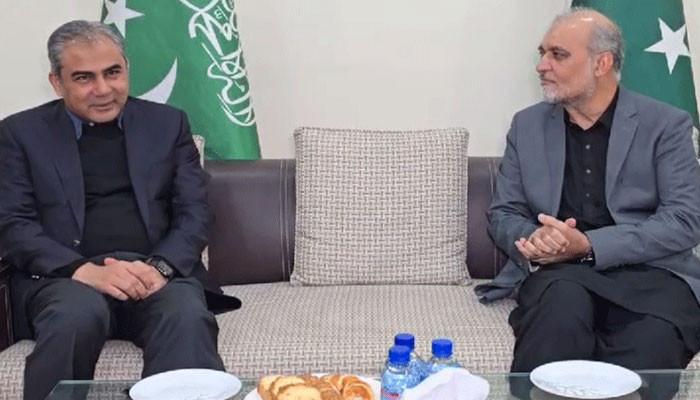
Deepening divisions within Egypt’s Muslim Brotherhood have resurfaced following a meeting in Istanbul between a senior leader of its London-aligned faction and the head of Pakistan’s Jamaat-e-Islami, highlighting an intensifying struggle for influence, international recognition and control over the organisation’s overseas networks.
The November 2 meeting brought together Salah Abdel Haq, acting supreme guide of the Brotherhood’s London-aligned faction, and Hafiz Naeem ur Rehman, leader of Jamaat-e-Islami Pakistan.
Both sides announced plans to strengthen political, organisational and ideological cooperation, including exchanging expertise in political activism, institution-building and leadership development.
The meeting also addressed developments in the Middle East, regional conflicts and challenges facing Islamic political movements, according to an official statement from Jamaat-e-Islami. Jamaat-e-Islami
However, the gathering comes amid a prolonged leadership dispute within the Egyptian Brotherhood, with Abdel Haq’s faction competing against a rival leadership headed by Mahmoud Hussein, whose supporters maintain a significant presence in Turkey.
Rival factions compete for international recognition
A European source familiar with Islamist organisations and their international networks told Erem News that the meeting’s significance lay primarily in its timing and the identity of the Egyptian representative.
According to the source, Abdel Haq’s participation reflects an attempt by the London-aligned faction to strengthen its international standing despite continuing disputes over the Brotherhood’s leadership, institutions and financial resources.
The source said the Pakistani leader had already been in Istanbul for political and intellectual engagements, including meetings with Turkish figures, before holding talks with Abdel Haq.
Those existing connections could offer the London faction an opportunity to expand its external relationships and demonstrate that it remains capable of engaging influential Islamic movements.
The source also highlighted the Pakistani organisation’s decision to identify Abdel Haq as the Brotherhood’s supreme guide in its official statement.
That designation, the source argued, could strengthen Abdel Haq’s claim to legitimacy at a time when Hussein’s faction continues to challenge his authority and rejects his claim to represent the wider organisation.
The Brotherhood’s leadership crisis intensified following the death of Ibrahim Munir in November 2022.
Since then, competing factions have struggled over appointments, institutional control, financial resources and international representation, preventing the organisation from establishing a broadly accepted leadership structure.
Foreign alliances become another battleground
American researcher Kyle Shideler, who specialises in Muslim Brotherhood networks, told Erem News that the Istanbul meeting reflected the Egyptian organisation’s internal difficulties rather than evidence of renewed strength.
Shideler said rival leaders were increasingly turning to international relationships to compensate for declining organisational cohesion and the absence of a unified leadership.
He argued that the meeting allowed Abdel Haq’s faction to project political influence beyond Egypt while simultaneously exposing the Brotherhood’s inability to resolve disputes over its leadership and organisational authority.
The competition has increasingly extended into the Brotherhood’s foreign relationships, with rival factions seeking recognition from established Islamic political movements.
Pakistan’s Jamaat-e-Islami, which has decades of experience in electoral politics, community organisations and institutional management, represents a potentially valuable partner for a faction attempting to rebuild its organisational capabilities.
Concerns over deeper organisational cooperation
The Pakistani organisation’s statement outlined plans for cooperation extending beyond political dialogue to include organisational development and ideological training.
According to the European source cited by Erem News, such cooperation could provide Egyptian Brotherhood figures with access to institutional expertise, youth mobilisation strategies and established networks of political and religious organisations.
The source said these areas deserved particular scrutiny given the setbacks suffered by the Brotherhood’s organisational structures in recent years.
Shideler similarly warned that the implications of the relationship would become more significant if political contacts developed into sustained institutional cooperation.
He identified educational institutions, media organisations, charitable associations and intellectual platforms as potential channels through which participating groups could exchange organisational expertise and expand their influence.
The researcher said the central question was whether the Istanbul meeting would produce a structured partnership with identifiable leadership responsibilities and funding arrangements.
He also called for greater scrutiny of the institutions involved, noting that overlapping political, charitable and educational activities across national borders could complicate efforts to establish organisational and financial accountability.
No specific financial commitments or binding implementation agreements were disclosed following the meeting.
Istanbul remains central to Brotherhood rivalry
The latest developments also underscore Istanbul’s continuing importance as a centre for political activity involving Egyptian Muslim Brotherhood figures and other Islamist organisations.
The city has hosted leaders associated with competing Brotherhood factions, as well as conferences and meetings bringing together Islamic movements from across the Middle East, Africa and Asia.
Rehman’s visit included participation in a gathering organised by the International Union of Muslim Scholars, where he called for greater coordination among Islamic movements and religious leaders. Jamaat-e-Islami
For Abdel Haq’s faction, the meeting offered an opportunity to demonstrate international relevance and strengthen its claim to leadership.
However, with the dispute between the London and Turkey-aligned factions unresolved, the latest diplomatic outreach may deepen competition over representation rather than bring the Brotherhood closer to reunification.
The extent to which the proposed cooperation will develop into a lasting institutional partnership remains unclear.