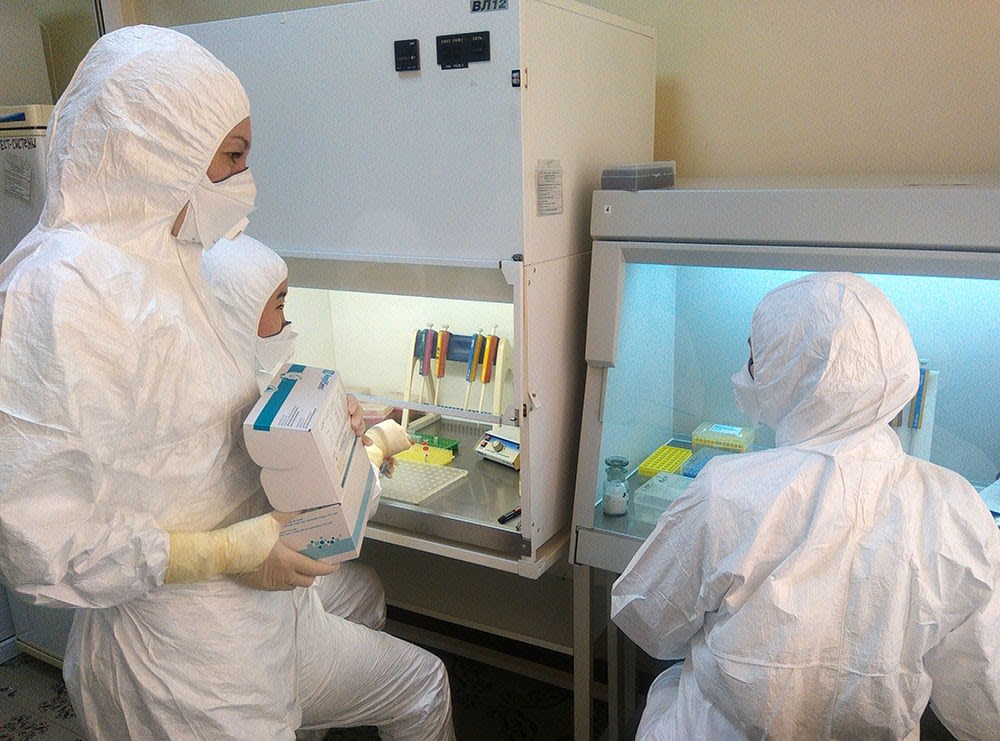
An investigation by independent Siberian journalists has uncovered new details about the research, Soviet-era connections and restricted operations of a Russian anti-plague laboratory at the centre of an unexplained death that triggered widespread quarantines earlier this month.
The investigation, published Monday by People of Baikal, examines the Irkutsk Anti-Plague Research Institute of Siberia and the Far East, where 28-year-old laboratory employee Darya Shipilova worked before dying on October 2 from what Russian authorities have described as pneumonia of undetermined origin.
Journalists Anastasia Ivanova and Margo Fogel examined the institute’s scientific publications, laboratory safety requirements, historical records and public statements, raising fresh questions about the facility’s activities and the circumstances surrounding Shipilova’s death.
Despite an extensive emergency response that saw approximately 200 people placed in isolation and several hospitals subjected to quarantine measures, Russian authorities have not publicly established what caused the young scientist’s fatal illness.
Research involving dangerous pathogens
The Siberian investigation found that the Irkutsk institute conducts research involving some of the world’s most dangerous infectious agents, including plague, anthrax, cholera and tularemia.
A scientific publication from 2024 documented cooperation between Russian and Mongolian researchers involving the isolation of three strains of Yersinia pestis, the bacterium responsible for plague.
However, the journalists said the publication did not establish where every stage of the laboratory work involving those strains was carried out.
The institute operates under Rospotrebnadzor, Russia’s federal health watchdog, and is one of five specialised anti-plague research institutes in the country’s public health system.
Its responsibilities include monitoring natural reservoirs of dangerous infections, developing diagnostic methods, studying pathogens and responding to potential epidemics across Siberia and Russia’s Far East.
The facility occupies a building dating to 1939 in a residential part of Irkutsk, surrounded by security barriers and guarded entrances. A kindergarten, hospital, shops and residential buildings are located nearby.
According to People of Baikal, access to its working laboratories is strictly controlled, and employees approached by journalists declined to explain the internal arrangements or specific protective systems.
As a result, the investigation could not independently establish what safety equipment was operating in the laboratories where Shipilova worked.
Soviet biological research connections
The investigation also traced the institute’s history to Soviet-era research associated with protection against biological weapons.
Citing research published in 2006 by American biological warfare historian Raymond Zilinskas, the journalists reported that the Irkutsk institute had participated in work linked to a Soviet programme known as Problem-5.
The programme involved research into protection against biological weapons, although the historical evidence indicates that Irkutsk played a relatively limited role.
The institute was also directed between 1957 and 1964 by microbiologist Igor Domaradsky, who later became involved in Soviet biological weapons research elsewhere.
During his time in Irkutsk, Domaradsky established biochemical and pathophysiological laboratories and investigated the effects of plague toxins.
The journalists stressed that the historical connections do not establish that offensive biological weapons were developed at the Irkutsk institute.
Nevertheless, the findings provide a closer examination of the institution’s involvement in Soviet biological-defence research and its continuing work with dangerous pathogens.
Laboratory safety remains under scrutiny
The investigation examined Russian safety regulations governing laboratories handling especially dangerous biological agents.
Such facilities are required to maintain multiple layers of protection, including controlled laboratory zones, specialist ventilation, biological safety cabinets, protective clothing and procedures for reporting potential exposure.
In certain high-risk operations, regulations also require personnel to work under additional supervision and observe strict decontamination procedures.
However, People of Baikal found that the institute’s actual protective arrangements could not be independently verified because employees declined to discuss laboratory operations.
Questions about those safeguards have become particularly significant following allegations that Shipilova may have accidentally broken a container holding plague bacteria before falling ill.
The alleged accident has not been independently established.
Russian authorities maintain that two biological safety investigations detected no accidents involving dangerous microorganisms at the facility.
Yet the exact cause of Shipilova’s death remains undisclosed, leaving the central question of whether her illness was connected to her work unresolved.
Major plague conference planned despite death
Another finding concerns preparations for a major international conference on plague and other dangerous infectious diseases, scheduled to take place in Irkutsk on October 21–22.
The institute is involved in organising the event, which will bring together specialists from countries of the Commonwealth of Independent States to discuss disease surveillance, pathogen monitoring and biological safety.
According to procurement records examined by the Siberian journalists, an organisational contract worth 13.15 million roubles has been awarded for the gathering.
Preparations include arrangements for visiting delegates and associated conference activities.
The conference had been planned before Shipilova’s death, and the journalists found no public announcement that it had been cancelled.
Its planned continuation comes as the institute faces growing scrutiny over the death of an employee working in a laboratory system specifically designed to detect and contain highly dangerous infections.
Institute silent over scientist’s death
The investigation also highlighted the absence of a public announcement about Shipilova’s death on the institute’s official website.
Irkutsk Governor Igor Kobzev announced the lifting of quarantine measures and said the region had completed its preventive response.
However, his public statement did not identify Shipilova by name or explicitly mention that she had died.
Instead, he referred to an infected or ill employee, saying she had been vaccinated and possessed immunity against dangerous infections encountered during her work.
The journalists pointed out that vaccination does not necessarily provide complete protection against infection.
Russian authorities have repeatedly denied evidence of a plague outbreak and maintain that safety inspections uncovered no laboratory accident.
But their statements have not publicly identified the pathogen responsible for Shipilova’s fatal pneumonia.
The World Health Organization, in an October 10 assessment, said it had found no evidence of ongoing transmission but could not completely exclude a laboratory-related exposure.