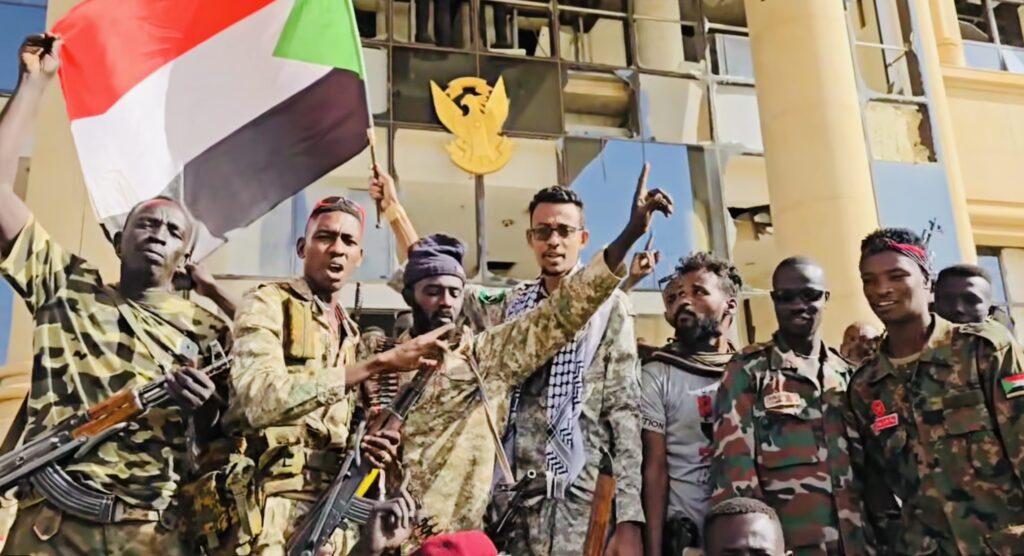
Sudanese security sources say fighters from the US-designated Al-Baraa Bin Malik Brigade have been pulled from battlefronts inside Sudan and redeployed across the Horn of Africa and neighboring states as part of an alleged effort to rebuild the regional reach of Sudan’s Islamist movement.
If substantiated, the reported deployments would mark a significant shift for Al-Baraa from a militia fighting alongside the Sudanese Armed Forces into a cross-border network involved in intelligence, logistics and potentially covert operations across East Africa.
The allegations come against a backdrop of increasingly documented international concern over the brigade’s relationship with Iran.
The US Treasury sanctioned Al-Baraa in September 2025, saying the Islamist militia had contributed more than 20,000 fighters to Sudan’s war and had used training and weapons supplied by Iran’s Islamic Revolutionary Guard Corps. Washington said Sudanese Islamist groups were cultivating ties with Tehran and receiving technical support from the IRGC.
The United States went further in March 2026, formally linking Al-Baraa to the Sudanese Muslim Brotherhood and placing the organization under US terrorism sanctions. US authorities describe Al-Baraa as the armed wing of the Sudanese Muslim Brotherhood.
The European Union has also sanctioned Al-Baraa commander Abu Zaid Talha al-Misbah, citing his command responsibility for summary executions of civilians attributed to the brigade in Khartoum North and Gezira.
Alleged regional deployment
Sudanese security sources told Erem News that Al-Baraa had recently obtained substantial financial and military backing from an unidentified party supporting the Sudanese Muslim Brotherhood, while another regional actor allegedly provided intelligence coordination.
The sources claimed coordination meetings had taken place in the Eritrean capital Asmara involving Salah Abdallah Gosh, the former head of Sudan’s National Intelligence and Security Service, as well as intelligence officers from an unnamed regional state.
They further alleged that the discussions included contacts with Somalia’s al-Shabaab and armed movements operating elsewhere in the region.
Gosh’s reported presence in Eritrea has some independent support. Earlier this month, the Ayin Network reported, citing three sources familiar with the matter, that the former Sudanese intelligence chief had relocated from Cairo to Asmara amid increasingly close links between the Port Sudan authorities and Eritrea. That reporting does not, however, independently confirm the meeting described by Erem’s sources.
Fighters allegedly moved into seven countries
According to Erem’s security sources, Al-Baraa members who had previously received advanced training in Iran were withdrawn from Sudanese battlefronts and redeployed between June and August 2026.
The sources named Somalia, Djibouti, Ethiopia, Kenya, Uganda, South Sudan and Chad as destinations, claiming the fighters had been assigned intelligence and logistical tasks.
They alleged that the wider objective was to establish a network capable of carrying out operations inside and outside Sudan while creating leverage over governments whose positions on the Sudan war are regarded as hostile by the Islamist movement.
Those specific deployment claims have not been independently verified.
A Sudanese military source close to the Sudan Founding Alliance, TASIS, also acknowledged that precise locations, routes and destinations of the alleged Al-Baraa deployments had not been established.
The source nevertheless claimed the regional arrangements extended beyond Sudanese Islamist fighters.
Houthi link alleged in Eritrea
The TASIS-linked source alleged that technical personnel associated with Yemen’s Houthi movement had participated in coordination activities around the Eritrean port of Massawa.
According to the source, the personnel were involved in technical preparations connected with the broader network.
The source did not identify the alleged Houthi operatives, specify their number or provide evidence establishing whether the reported cooperation involved logistics, training, technology transfers or weapons components.
Erem has previously reported allegations of growing contacts linking Al-Baraa, the Houthis and al-Shabaab through weapons-smuggling and logistics networks around the Red Sea and Horn of Africa. Those reports have also relied heavily on security and regional sources whose claims could not be independently verified.
Pressure mounting on Sudan’s Islamists
Sudanese analyst Al-Hadi Ibrahim told Erem that the reported cross-border activity should be viewed against mounting international pressure on Sudan’s Islamist movement and the authorities based in Port Sudan.
That pressure has intensified significantly over the past year.
The United States formally determined that the Government of Sudan had used chemical weapons in violation of international law and subsequently imposed sanctions. Washington announced additional measures in 2026 after determining that Sudan had failed to meet conditions set under US chemical-weapons legislation. Those additional sanctions took effect on July 20.
Ibrahim argued that internal tensions within the Port Sudan camp, combined with growing Western pressure on Islamist organizations, were pushing armed factions to look increasingly beyond Sudan’s borders for financing, influence and strategic depth.
The emergence of an organized Al-Baraa network across the Horn of Africa would therefore represent far more than another development in Sudan’s civil war.
With the brigade already formally designated under US terrorism authorities and its IRGC relationship publicly documented by Washington, evidence that its fighters were establishing operational networks from Eritrea to Somalia, Kenya, Uganda and Chad would transform the group from a largely Sudan-focused Islamist militia into a potentially significant regional security actor.
For now, however, the most explosive elements of that picture — the claimed seven-country deployment, coordination with al-Shabaab and alleged Houthi involvement in Massawa — remain allegations requiring independent corroboration.