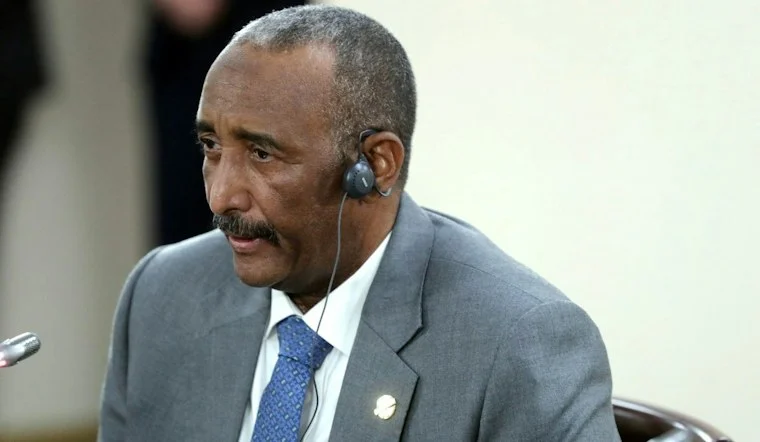
Sudanese army chief Abdel Fattah al-Burhan has been prevented from attending the United Nations General Assembly in New York after the United States withheld his entry visa, as Washington intensifies diplomatic pressure on Sudan’s warring parties over a proposed humanitarian ceasefire and a transition to civilian rule.
Burhan, who was sanctioned by Washington in January 2025 over atrocities attributed to forces under his command, was denied the visa amid longstanding US accusations of war crimes against the Sudanese military. The US State Department previously determined that members of the Sudanese Armed Forces had committed war crimes and accused troops under Burhan’s leadership of targeting civilians, carrying out executions and obstructing humanitarian aid.
The visa dispute has become the centre of a wider diplomatic confrontation involving Washington’s rejection of the legitimacy of Sudan’s rival military leadership, growing international support for a nationwide arms embargo and renewed demands for an end to foreign military assistance sustaining the war.
The developments unfolded over three days of high-level diplomacy at the UN, where the Port Sudan authorities have sought to defend their international representation while resisting elements of the US-backed peace initiative.
Burhan had been expected to lead Sudan’s delegation and address the General Assembly on Thursday, but Foreign Minister Mohieddin Salem instead headed the delegation and attended the opening session on Tuesday.
The delegation also includes Darfur Governor Minni Arko Minnawi and Sudan’s permanent representative to the UN, Al-Harith Idriss.
AFP reported on Tuesday that Washington had refused to issue Burhan a visa, citing diplomatic sources who said the decision was linked to his refusal to accept a three-month humanitarian truce.
Reuters separately reported that the visa appeared to have been made conditional on Burhan accepting a 90-day ceasefire proposal advanced by US presidential adviser for Arab and African affairs Massad Boulos.
The State Department has not publicly confirmed that the visa was conditional on the ceasefire or disclosed the reasons for its decision.
The dispute prompted UN Secretary-General António Guterres to intervene, expressing deep concern that Burhan had not received the necessary travel documents.
UN spokesman Stéphane Dujarric said the organisation had raised the matter directly with US authorities and urged Washington to fulfil its obligations under the agreement governing the UN headquarters in New York.
The agreement requires the United States, as host country, to facilitate access for representatives of UN member states attending UN meetings.
Washington rejects military rule in Sudan
The visa confrontation coincided with a September 22 State Department statement declaring that neither the Sudanese Armed Forces (SAF) nor the Rapid Support Forces (RSF), or their respective leaders, represented legitimate constitutional governance in Sudan.
State Department spokesman Tommy Pigott said both sides were governing through military force and accused them of failing to make serious commitments to an immediate humanitarian truce.
Washington said the rival factions had instead intensified military operations and drone strikes that were killing civilians.
The United States reiterated its demand for a humanitarian ceasefire without preconditions, followed by an inclusive political dialogue leading to civilian government.
It also warned that it would increase pressure on the warring parties and the networks supplying them with the resources needed to continue fighting.
The statement followed months of American efforts to secure agreement on a ceasefire, with Washington increasingly expressing frustration over the failure of negotiations.
Burhan has resisted elements of the proposed truce, arguing that previous ceasefires allowed the RSF to regroup and that any settlement must address the force’s continued control of territory.
The Port Sudan-based foreign ministry responded on Wednesday by rejecting Washington’s position and insisting that any peace initiative must respect Sudan’s sovereignty, territorial integrity and national institutions.
It also objected to political arrangements that would place the RSF on an equal footing with Sudanese state institutions, while maintaining that it remained willing to engage with international peace efforts.
Rubio warns external actors are prolonging war
US Secretary of State Marco Rubio added to the diplomatic pressure on Wednesday, criticising foreign powers for continuing to support Sudan’s rival military factions.
Speaking to reporters on the sidelines of the General Assembly, Rubio said repeated diplomatic efforts had failed because the warring parties withdrew from commitments whenever they believed they could gain a military advantage.
He said outside powers supplying the rival factions needed to use their influence to ensure that ceasefire commitments were honoured.
Rubio did not identify specific countries but said the continued involvement of external actors was preventing meaningful progress towards ending the conflict.
He also highlighted the need for immediate humanitarian access, warning that aid organisations remained unable to reach civilians trapped in active combat zones.
UN backs wider arms embargo as no-fly-zone debate continues
The diplomatic confrontation comes as the United States presses the UN Security Council to expand the existing Darfur arms embargo across Sudan, including restrictions on military drones and associated technology.
UN spokesman Dujarric expressed support for the proposal in an interview with The National published on September 21, warning that continued weapons supplies were helping sustain the conflict.
He acknowledged that expanding the embargo faced political obstacles within the Security Council, where members remain divided over the scope of sanctions against Sudan.
Washington presented its proposal to the Security Council in August, arguing that the current restrictions were insufficient to address a war involving increasingly widespread drone attacks and foreign military assistance.
Russia and China have opposed extending the embargo beyond Darfur, while France and Britain have supported broader restrictions.
The Security Council adopted Resolution 2828 on September 11, renewing the existing sanctions until October 9 and extending the mandate of the UN Panel of Experts on Sudan until November 9.
The short extension allows further negotiations over Washington’s proposed nationwide embargo.
The dispute has also renewed attention on earlier reports of possible restrictions on military aviation over Sudan.
Burhan previously dismissed discussion of an aviation ban, while the Sudan Founding Alliance, TASIS, expressed support for nationwide restrictions on weapons and military aviation, provided they applied equally across the country.
However, the proposed arms embargo and a no-fly zone are separate measures. The Security Council has not authorised a nationwide aviation ban, and Washington has not publicly confirmed a formal proposal to establish one.
The existing Darfur arms embargo therefore remains in force while negotiations continue over extending restrictions across Sudan.
Chemical weapons allegations add to scrutiny
The UN has also expressed its readiness to investigate allegations of chemical weapons use by Sudan’s armed forces, provided it receives a formal mandate.
Dujarric told The National that the organisation would be prepared to examine the allegations through the appropriate international mechanisms.
His remarks follow earlier US accusations that SAF used chemical weapons during the conflict, allegations rejected by the Sudanese military authorities.
Washington has imposed sanctions over the alleged use of prohibited weapons, adding another source of tension to its relationship with the army-backed administration.
The diplomatic developments come as Sudan’s war, which erupted in April 2023, continues to devastate the country, displacing more than 14 million people and creating one of the world’s largest humanitarian emergencies.
With Burhan absent from New York, Sudan’s foreign minister has been left to represent the Port Sudan authorities at a General Assembly overshadowed by the US visa dispute, disagreements over the humanitarian ceasefire and the continuing Security Council debate over restricting the weapons fuelling the conflict.