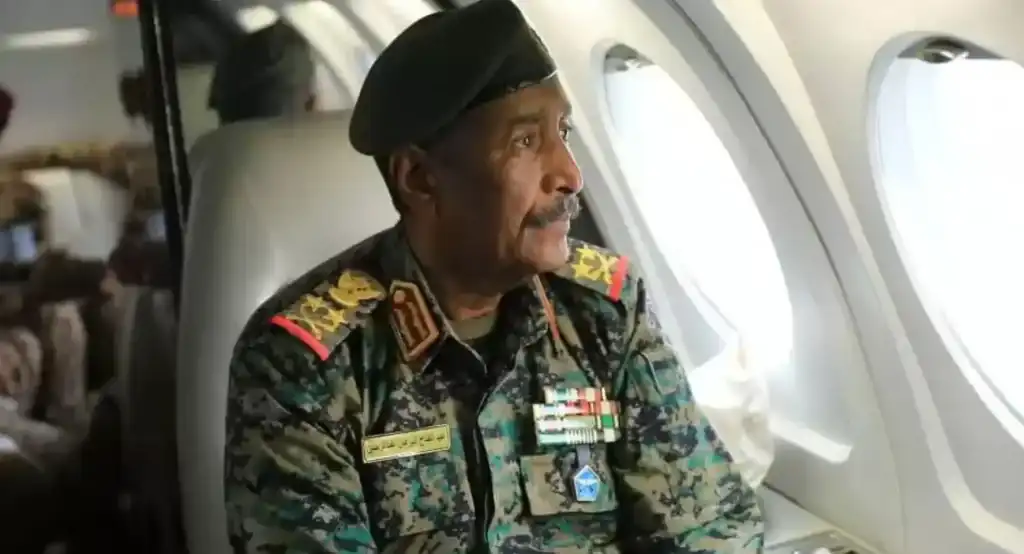
Sudan’s army chief Abdel Fattah al-Burhan has yet to receive an official US decision on his visa application, according to a senior adviser, as a diplomatic dispute over his exclusion from the UN General Assembly continues.
Sudan’s army-aligned government has received no formal notification from Washington regarding Abdel Fattah al-Burhan’s visa application, while his passport remains at the US embassy in Cairo, a senior Sudanese official said.
Amjad Farid, political adviser to Burhan, told Al Arabiya that Sudanese authorities were still awaiting an official response from the United States, despite the army chief being unable to attend the United Nations General Assembly in New York.
Farid described the dispute as a legal matter between Washington and the United Nations, saying Sudan had lodged a formal protest with the UN Secretariat over the handling of Burhan’s application.
He said the response received by Sudanese authorities indicated that the visa restrictions were unacceptable and inconsistent with the agreement governing the UN headquarters in New York.
The adviser argued that Washington was legally obliged to facilitate the entry of representatives of UN member states attending General Assembly proceedings.
Visa dispute linked to US ceasefire proposal
Farid also addressed reports that Washington was using Burhan’s visa application to pressure Sudan’s army-aligned government into accepting a proposed 90-day humanitarian ceasefire.
Reuters reported on September 22 that the visa appeared to have been made conditional on Burhan accepting a truce proposed by Massad Boulos, US senior adviser for Arab and African affairs, citing a Sudanese diplomatic source and a Western analyst familiar with the discussions.
Farid criticised the reported use of participation in the General Assembly as a means of diplomatic pressure, arguing that the annual gathering should not be used to advance bilateral political demands.
However, he denied that Sudan’s army-aligned government had rejected the American ceasefire initiative outright, saying it had instead submitted observations on the proposal.
He maintained that negotiations could not begin while Sudanese civilians continued to face what he described as a threat of genocide.
Farid expressed hope that Washington would reconsider its approach to Sudan’s conflict and adopt what he described as a more constructive position.
The United States has called on both the Sudanese Armed Forces and the Rapid Support Forces to accept an immediate humanitarian ceasefire without preconditions and commit to an inclusive political process leading to civilian rule. Washington has also said that neither armed faction represents legitimate constitutional governance in Sudan.