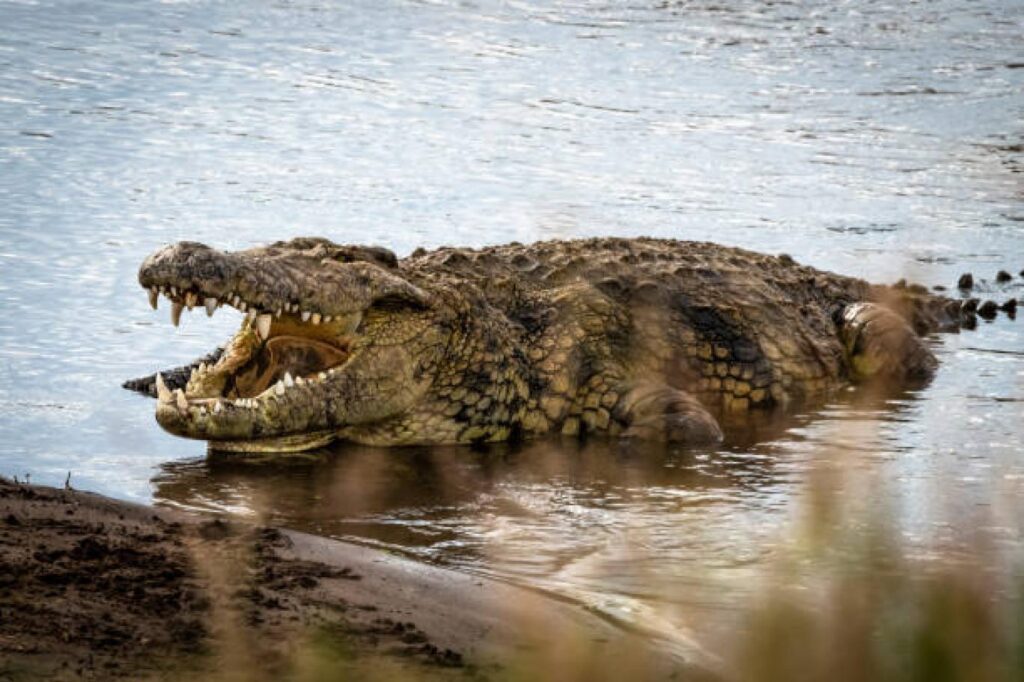
An unusual surge in Nile crocodile sightings has alarmed communities along Sudan’s riverbanks, with fatal attacks and repeated encounters adding a new layer of danger to a population already enduring war, displacement and collapsing public services.
Residents in several areas along the Nile have reported seeing large numbers of crocodiles close to villages, farms and water collection points. Sightings have been recorded not only in Northern State and around Dongola, but also in areas near the capital, including Kalakla in southern Khartoum.
Crocodiles have inhabited the Nile for centuries, but local residents say their recent appearance in unusually large numbers and close proximity to populated areas has created an immediate threat, particularly for farmers and families who depend on the river for water.
Fatal attack on Sai Island
Fears intensified after a young farmer, Omar Mohammed Abdel Khaliq, was reportedly killed by a large crocodile on Sai Island in northern Sudan.
Witnesses said the crocodile attacked him while he was working near the riverbank, dragged him into the water and disappeared before residents could intervene.
The incident revived memories of previous crocodile attacks on the historic island, where children have reportedly survived similar encounters. Residents have also raised concerns over sightings of large snakes and other dangerous wildlife.
Climate conditions and changing water levels
Experts have offered several possible explanations for the growing number of crocodile encounters, including changing Nile water levels, climate pressures, agricultural expansion and human activity along the river.
Dam engineer Mohammed Hafez said low water levels linked to El Niño conditions had exposed water intakes and altered river conditions, comparing the current situation with similar problems recorded in July 2020.
Hafez also argued that operations at Ethiopia’s Grand Ethiopian Renaissance Dam had increased the impact of low-water conditions in Sudan.
He said closer coordination between Sudan and Ethiopia over water releases during periods of drought or El Niño could help reduce the effects of sudden changes in river levels.
His comments reflect one interpretation of the situation, although a direct causal link between the dam and the reported rise in crocodile sightings has not been independently established.
Hafez also said Sudan’s ongoing conflict had weakened the authorities’ ability to respond effectively or seek coordinated international assistance.
Loss of natural habitats
Mohammed al-Makki Ali al-Badawi, a lecturer in wildlife studies at the University of Sennar, said crocodiles were not necessarily becoming more aggressive.
Instead, he linked their movement towards populated riverbanks to environmental changes, including the loss of traditional basking areas, expanding farmland, noise from irrigation pumps and sudden fluctuations in Nile water levels.
He also said muddy water during the rainy season makes it easier for crocodiles to remain concealed near the shore.
Breeding season increases sightings
The rise in sightings may also be connected to the crocodile breeding cycle.
Female Nile crocodiles usually lay eggs between March and May, while hatchlings emerge around the period of rising river levels and may spread into shallow waters close to riverbanks.
Al-Badawi said humans were not part of a crocodile’s normal diet, but attacks could occur when the animals defended nests, mistook people for prey in murky water or became accustomed to observing people repeatedly visiting the same locations.
He called for scientifically managed responses, including safe water collection points, warning signs and public awareness campaigns.
He also warned against indiscriminate killing, saying crocodiles play an important role in maintaining the ecological balance of the Nile.
Wildlife authorities issue warning
Sudan’s Wildlife Protection Forces have warned residents against swimming or approaching riverbanks during the current period.
Officials said patrols were being deployed along islands and riverbanks, while awareness campaigns were under way to encourage safer coexistence between communities and wildlife.
The authorities also suggested that crocodile breeding could eventually be developed as a regulated economic activity, although Sudan’s continuing conflict and institutional collapse would make such projects difficult to implement.
Dangerous encounters shared online
Videos circulating on Sudanese social media have further fuelled concern.
One widely shared clip reportedly showed a man in River Nile State standing extremely close to a large crocodile and touching it as the animal remained motionless.
Wildlife experts warned that such behaviour was highly dangerous, stressing that a crocodile’s apparent calm should not be interpreted as a sign of safety.
They said crocodiles often remain still before launching a sudden attack, leaving victims little chance to escape.
The video prompted widespread criticism and calls for people not to imitate such actions, particularly as crocodiles are increasingly being reported close to farms, villages and water points.
For Sudanese communities already struggling with war, hunger, displacement and the collapse of basic services, the growing threat from wildlife has become another reminder of how environmental disruption is intensifying daily hardship.