A wave of drone attacks attributed to the Rapid Support Forces struck military targets across several army-held cities in Sudan on Wednesday, in one of the broadest coordinated aerial operations reported in recent weeks.
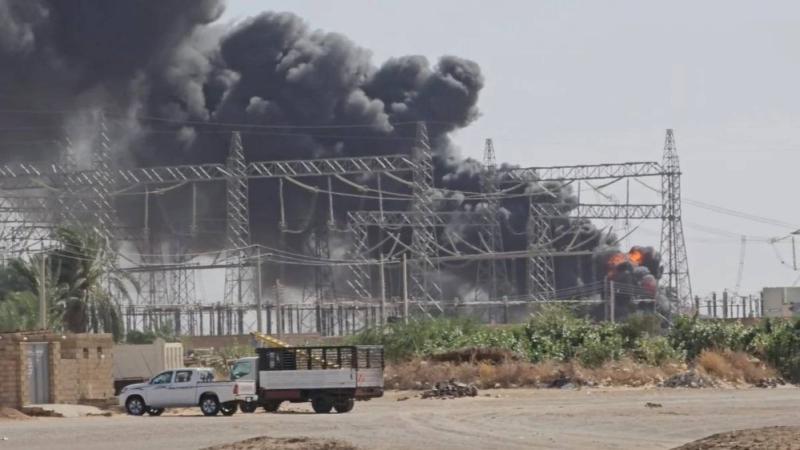
Drones were reported over Khartoum, Omdurman and Khartoum Bahri, as well as Atbara and Al-Damer in River Nile state, with residents reporting repeated explosions and sustained anti-aircraft fire around military installations.
Witnesses said the attacks began before dawn, with explosions heard around 5 a.m. in the capital. Air-defence systems based around military positions in northern Omdurman were activated as drones approached targets across the metropolitan area.
In Atbara and Al-Damer, residents also reported drones overhead followed by explosions. Both cities lie deep inside territory controlled by the Sudanese Armed Forces and host military and logistical infrastructure important to the army’s operations.
Several Sudanese and regional reports attributed the attacks to the RSF, although the group had not issued a formal statement claiming the entire operation at the time of publication.
Separate reports said drones also targeted military facilities around Kenana in White Nile state, potentially widening Wednesday’s operation across a vast geographical area stretching from central Sudan to the River Nile north of Khartoum.
The scale and apparent coordination of the attacks suggest an attempt to simultaneously pressure SAF command, logistics and air-defence infrastructure far from the main ground frontlines.
The strikes come amid a broader surge in operations by forces aligned with the Sudan Founding Alliance, or TASIS.
A day earlier, TASIS announced that its forces had taken control of the strategic town of Qeissan in Sudan’s Blue Nile region after heavy fighting with the army.
TASIS said its forces captured military positions inside Qeissan and seized large quantities of weapons and military equipment, while pursuing withdrawing SAF units. Videos circulated by platforms sympathetic to the alliance showed fighters inside parts of the town.
Qeissan lies close to Sudan’s border with Ethiopia and around 170 kilometres southeast of Damazin, giving the town strategic importance for movement and supply routes across southern Blue Nile.
The Qeissan offensive involved RSF forces alongside the Sudan People’s Liberation Movement-North faction led by Abdelaziz al-Hilu, according to multiple reports.
Wednesday’s drone wave therefore marks another front in a rapidly expanding military campaign, combining ground offensives in Blue Nile and Kordofan with long-range aerial attacks against SAF-held cities hundreds of kilometres from the frontline.
The attacks also underline the RSF’s increasingly sophisticated use of long-range drones.
The force has dramatically expanded its drone capability during the war, allowing it to strike military bases, airports, power infrastructure and logistical hubs well beyond territory under its direct control.
Long-range strike drones previously documented near RSF-controlled Nyala were assessed as potentially having ranges approaching 2,000 kilometres, putting virtually every major military target in Sudan within reach.
There were no immediately verified casualty figures from Wednesday’s attacks, and the extent of damage to the targeted military installations remained unclear.
The Sudanese army said its air defences confronted drones over several locations, but battlefield claims from both sides could not immediately be independently verified.
The attacks come as fighting intensifies simultaneously in Blue Nile and Kordofan, suggesting the conflict is entering another phase in which long-range drone warfare is increasingly being used alongside territorial offensives to stretch SAF forces across several fronts.