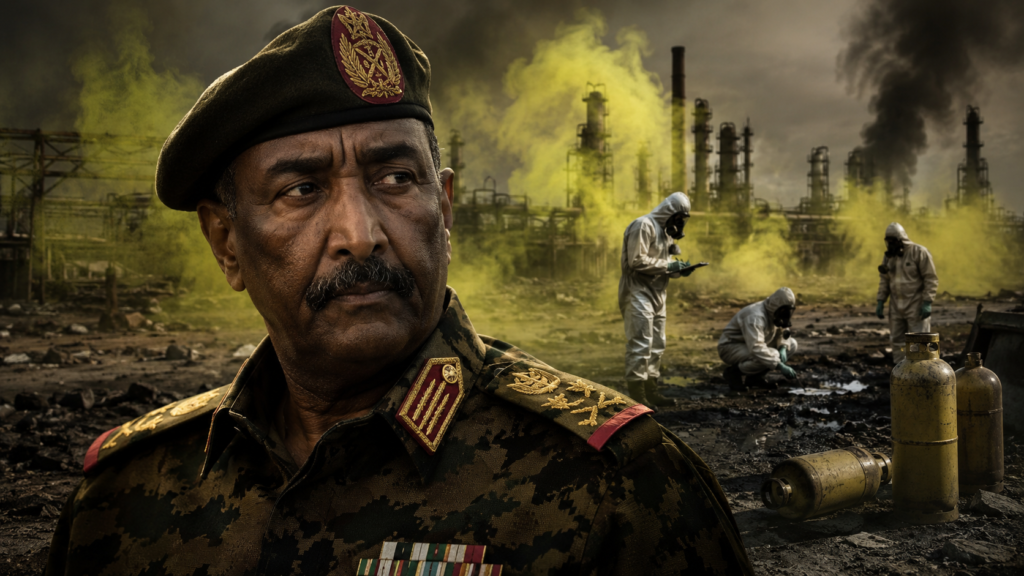
SAF chief Abdel Fattah al-Burhan is facing mounting international pressure over allegations that his forces used chemical weapons, as Washington demands unrestricted inspections and a comprehensive declaration of Sudan’s chemical programmes, facilities and materials.
The latest United States intervention has shifted the scandal beyond political accusations and sanctions into the international system responsible for enforcing the global ban on chemical warfare.
In a statement before the 112th session of the Executive Council of the Organisation for the Prohibition of Chemical Weapons in The Hague, Washington said the Sudanese Armed Forces used chemical weapons during 2024 and remained in non-compliance with the Chemical Weapons Convention during 2025.
The United States called on the Port Sudan junta to submit a comprehensive and accurate declaration to the OPCW Technical Secretariat and provide inspectors with transparent and unimpeded access to relevant locations.
The demand leaves Burhan with narrowing options. He can open military sites, procurement records and command structures to international scrutiny, or continue obstructing an investigation while evidence and international pressure accumulate around his SAF.
Refusing inspections would not, by itself, constitute proof that chemical weapons were used. But after years of denials, sanctions, investigative findings and unresolved allegations, further obstruction would deepen suspicions that the SAF leadership is protecting more than its reputation.
Political denials meet technical scrutiny
The Port Sudan authorities have repeatedly dismissed the chemical weapons allegations as politically motivated and accused Washington of attempting to undermine the SAF.
Urwa al-Sadiq, a senior figure in Sudan’s National Umma Party, said the junta had tried to move the debate away from technical evidence and into the arena of its political confrontation with the United States.
“Since the accusations first emerged, the Port Sudan authority has attempted to shift the discussion from the technical track to its political dispute with Washington,” al-Sadiq told Al Ain News.
He said that approach might produce propaganda gains among SAF supporters but becomes less effective when the file reaches specialised international institutions, where evidence is examined through technical verification procedures.
The OPCW Executive Council is responsible for supervising the organisation’s Technical Secretariat and promoting compliance with the Chemical Weapons Convention. Sudan is one of the convention’s 193 member states and is prohibited from developing, producing, acquiring, stockpiling or using chemical weapons.
Washington has called on regional governments and other states party to the convention to support demands for an immediate and transparent investigation.
The latest statement means the issue is no longer confined to relations between Burhan and the United States. It has entered a multilateral process involving the OPCW and governments responsible for defending the international prohibition against chemical warfare.
A formal US determination
The American case against SAF is not merely an allegation made by an official during a press conference.
On April 24, 2025, the United States formally determined under the Chemical and Biological Weapons Control and Warfare Elimination Act that the Government of Sudan had used chemical weapons in violation of international law.
The determination resulted in sanctions restricting US arms sales, military financing, government credit and exports of national-security-sensitive goods and technology to Sudan. Washington announced the measures publicly in May 2025.
The United States has not published the classified intelligence underpinning the determination, creating an opening that the Port Sudan junta has repeatedly exploited in its public denials.
Human Rights Watch has also called on Washington to release the evidence supporting its conclusion.
But the allegations no longer rest exclusively on secret American intelligence.
They are increasingly supported by an independent body of publicly available material, including geolocated images, witness accounts, identifiable chlorine cylinders, shipping records and corporate links connecting the supply chain to an SAF-affiliated industrial group.
A France 24 investigation examined two alleged chemical attacks carried out in September 2024 near the al-Jaili oil refinery and the Garri military base north of Khartoum.
Evidence emerges from al-Jaili
The attacks reportedly occurred while SAF was attempting to regain control of the strategic refinery area from the Rapid Support Forces.
Images and videos analysed during the investigation showed industrial chlorine containers near impact locations and a yellow-green cloud consistent with the appearance of chlorine gas.
Human Rights Watch said it independently verified the geolocation of videos connected to the investigation. The organisation described the reports as disturbing and renewed calls for an independent OPCW inquiry.
Chlorine has legitimate civilian and industrial uses, including water treatment. Possession of chlorine cylinders alone therefore does not establish that a chemical weapon was deployed.
However, the location of the containers, their proximity to alleged impact sites and the appearance of the cloud raised questions about whether industrial chlorine had been deliberately weaponised.
Those questions became more serious when researchers began tracing the cylinders’ international supply chain.
Supply chain leads towards SAF-linked companies
The Center for Advanced Defense Studies, known as C4ADS, worked with France 24 to examine trade records and corporate connections linked to the chlorine seen in Sudan.
The organisation traced a supply chain from an Indian manufacturer through a UAE-linked intermediary to Ports Engineering Company in Sudan.
Ports Engineering is majority-owned by GIAD Industrial Group, an industrial conglomerate sanctioned over its affiliation with SAF.
C4ADS said identifying markings on a chlorine cylinder corresponded with containers shown in the visual evidence examined by investigators. It said the trade and corporate records increased the likelihood that chlorine had been diverted to one of Sudan’s warring parties.
The organisation stopped short of claiming that its findings alone constituted definitive proof that SAF had deployed chlorine as a weapon.
Nevertheless, the investigation provided a possible procurement route linking an international chlorine shipment to a company within the SAF’s industrial network.
That development weakens the Port Sudan junta’s attempt to portray the entire case as an accusation manufactured solely by Washington.
Burhan is now confronted by two separate evidentiary tracks: the unpublished intelligence behind the formal US determination and publicly available visual, geolocation, corporate and trade evidence examined by independent investigators.
The shadow of Jebel Marra
The allegations surrounding al-Jaili do not emerge in a historical vacuum.
They reopen a chemical weapons file that has followed Sudan’s military establishment since the rule of Omar al-Bashir.
In September 2016, Amnesty International said it had gathered credible evidence strongly suggesting that Sudanese government forces repeatedly used chemical agents during a major offensive in Jebel Marra, Darfur.
The organisation documented at least 30 suspected chemical attacks between January and September 2016 and estimated that between 200 and 250 people may have died from exposure, many of them children.
Witnesses described victims suffering respiratory failure, bloody vomiting, blindness, blistering, skin loss and other severe injuries.
Amnesty said the alleged attacks were part of a wider campaign involving air and ground assaults against villages and civilian areas. It repeatedly called on the OPCW to conduct a proper international investigation.
The Bashir government denied the accusations and restricted access to parts of Jebel Marra. No conclusive OPCW attribution followed.
But the absence of a completed investigation did not resolve the allegations. It left Sudan’s military establishment with an unanswered chemical weapons file that has now resurfaced under Burhan.
A general forged in Bashir’s wars
There is no publicly established evidence that Burhan personally ordered or supervised the suspected 2016 chemical attacks.
However, he cannot plausibly present himself as an outsider to the military system accused of carrying them out.
Burhan was a career officer who served Bashir’s government for decades and rose through the ranks during Sudan’s wars in South Sudan and Darfur. He held senior positions in the ground forces before becoming SAF chief and later seizing control of the state.
His record binds him institutionally and politically to the military establishment constructed under Bashir and Sudan’s Islamist movement.
The latest allegations therefore raise a larger question than whether an individual SAF unit used chlorine near al-Jaili.
They raise the possibility that methods associated with the former regime’s wars in Darfur survived Bashir’s fall and remained available to the SAF under Burhan’s command.
For the Port Sudan junta, the chemical weapons scandal threatens to expose the continuity between the old Islamist security state and the military order Burhan now represents.
Possible war crimes
Sudanese lawyer Mohammed Salah, a member of the Emergency Lawyers’ executive office, said proven chemical weapons use would constitute a grave breach of the Chemical Weapons Convention and could amount to a war crime.
International humanitarian law prohibits the use of poison and poisoned weapons, while the Chemical Weapons Convention bans the use of toxic chemicals as weapons under any circumstances.
Salah said political statements and exchanges of accusations could not substitute for an independent investigation based on scientific and technical evidence.
Such an investigation would require Sudanese authorities to provide documentation, facilitate the collection of samples and give experts access to military locations and other relevant sites.
He said accountability should extend to both the individuals who carried out any prohibited attacks and the military or political officials who authorised, facilitated or concealed them.
The question of command responsibility would therefore become central if investigators established that chemical agents had been deliberately deployed.
Burhan’s shrinking room for manoeuvre
The Port Sudan junta could agree to full OPCW cooperation and attempt to demonstrate that the US determination and investigative findings are wrong.
It could provide import records, military inventories, operational orders and access to the locations identified in the allegations.
Such cooperation would not guarantee that the pressure disappears, but it would provide an opportunity for the SAF’s denials to be tested through an internationally recognised technical process.
Partial cooperation would be far more damaging.
Attempts to dictate where inspectors may go, delay the collection of samples, restrict interviews or withhold procurement and command records would strengthen allegations of non-compliance.
Experience from other chemical weapons investigations has shown that procedural delays and arguments over access often amplify suspicion rather than contain it.
Burhan now confronts a scandal that reaches beyond the conduct of individual soldiers.
As commander-in-chief, he presides over the chain of command, military procurement system and state institutions whose cooperation would be required to establish how chlorine entered Sudan, where it was transferred and who authorised its alleged use.
The SAF chief cannot erase that responsibility with another political denial.
He can either release the records, grant inspectors unrestricted access and expose those responsible—or deepen the perception that the Port Sudan junta is protecting a prohibited weapons programme inherited from the darkest years of Bashir’s rule.