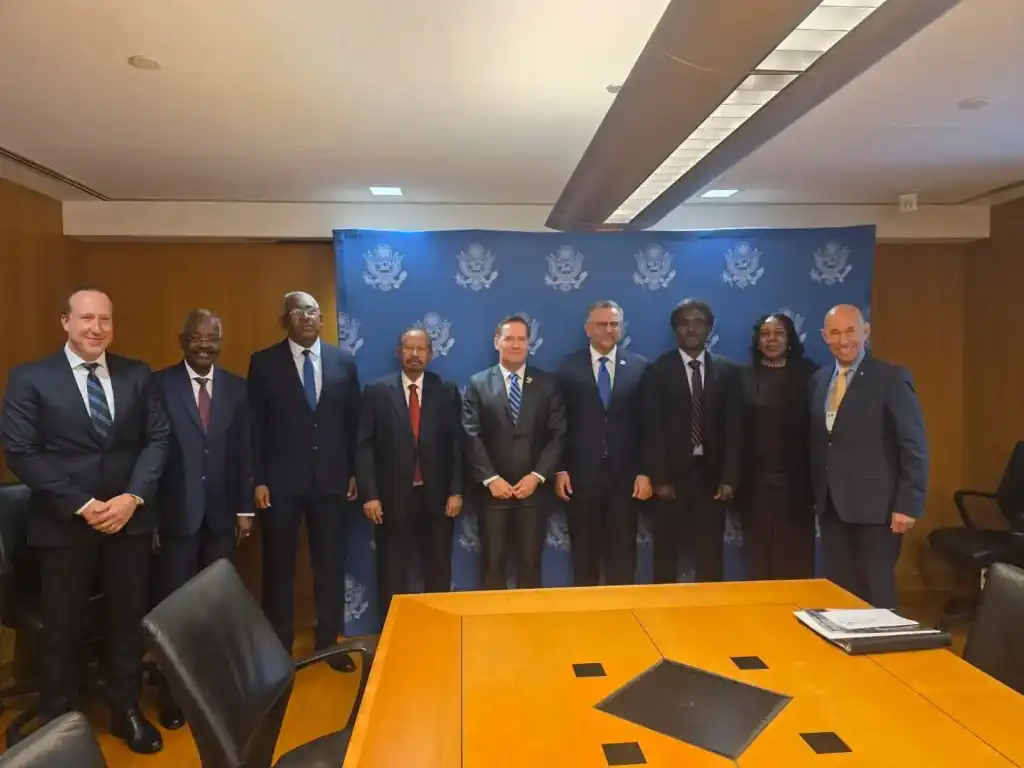
A Sudanese civilian delegation led by former Prime Minister Abdalla Hamdok held high-level talks with US officials on Monday, with Washington signalling its willingness to increase pressure on Sudan’s warring parties through additional sanctions and a proposed nationwide arms embargo.
The delegation met Assistant Secretary of State for African Affairs Frank Garcia, President Donald Trump’s senior adviser for Arab and African affairs Massad Boulos, and US Ambassador to the United Nations Mike Waltz at the State Department.
The talks focused on international efforts to end Sudan’s war, secure an unconditional humanitarian truce and strengthen restrictions on weapons entering the country, according to a statement issued by the delegation.
Washington considers further sanctions
Garcia told the delegation that Washington would continue coordinating with its partners in the Quad, which includes the United States, Saudi Arabia, Egypt and the United Arab Emirates.
He said the US was prepared to use additional diplomatic pressure to help end the conflict, including expanding sanctions if necessary.
The delegation welcomed Washington’s position that neither the Sudanese Armed Forces (SAF) nor the Rapid Support Forces (RSF) represents legitimate constitutional governance in Sudan.
It also backed an immediate humanitarian truce without preconditions, describing it as a necessary first step towards ending the fighting and addressing the country’s worsening humanitarian emergency.
The US State Department has previously accused both warring parties of failing to demonstrate a serious commitment to a ceasefire, while calling for an inclusive political process that would return authority to Sudanese civilians.
US presses for nationwide arms embargo
Waltz told the civilian delegation that he would continue working with UN Security Council members to secure approval for expanding the existing arms embargo on Darfur to cover the whole of Sudan.
According to the delegation’s statement, the proposed resolution would also strengthen mechanisms for monitoring and enforcing the restrictions.
Waltz said Trump had directed his administration to pursue efforts to end the war and protect civilians from violations committed by both sides.
The discussions come as Washington seeks international agreement on extending the embargo beyond Darfur, arguing that existing restrictions are inadequate to address the flow of foreign weapons sustaining the conflict.
The United States and Britain have been working with other Security Council members on the proposal, but differences over its scope have delayed agreement.
Washington accepted a temporary extension of the existing Darfur sanctions earlier this month to allow further negotiations.
Diplomatic coordination expands
Boulos described the recent joint meeting of the Quad and Quint on the sidelines of the UN General Assembly in New York as positive, saying it had strengthened coordination among international partners seeking to end Sudan’s war.
He said the diplomatic effort also involved Britain, Norway, Switzerland and Qatar, alongside the countries and international organisations participating in the two mechanisms.
The Quint brings together the United Nations, African Union, Arab League, European Union and the Intergovernmental Authority on Development (IGAD).
The discussions form part of Washington’s broader efforts to secure a humanitarian ceasefire and establish an internationally supported political process.
Hamdok’s meeting with US officials followed a public forum in Washington on Sunday, where he and other Sudanese civilian representatives presented their roadmap for ending the war .
The former prime minister, who leads the Sumoud civilian coalition, has been holding meetings with international officials to seek support for a political settlement and a transition to civilian government.
The latest talks brought the delegation’s proposals directly to senior US officials involved in Washington’s diplomatic and Security Council initiatives on Sudan.