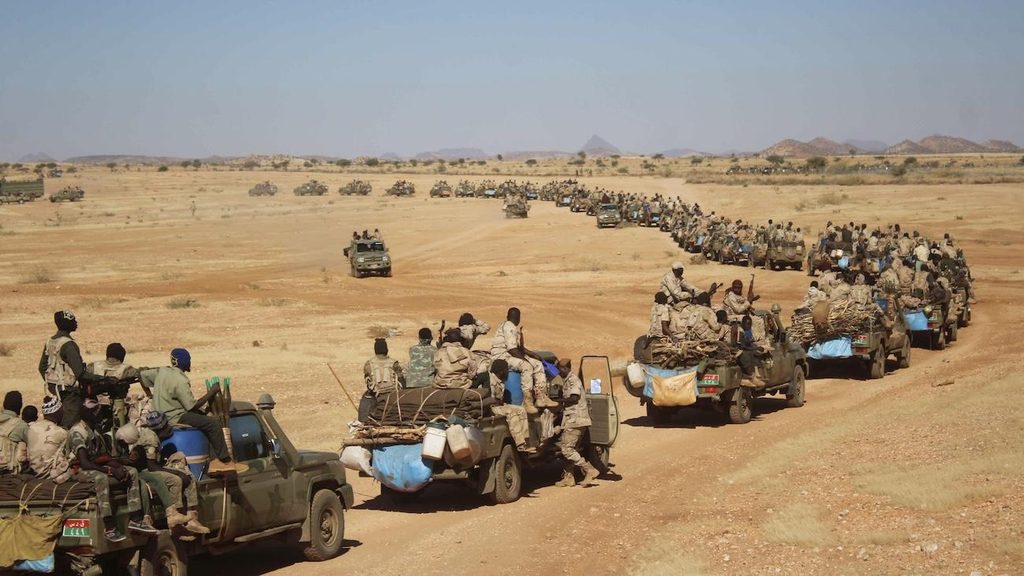
Kordofan is rapidly emerging as one of the most consequential theatres in Sudan’s war, as escalating battles between the Sudanese Armed Forces (SAF) and the Rapid Support Forces (RSF) place strategic towns, roads and supply corridors at the centre of the struggle.
More than three years into the conflict, the vast central region is no longer simply another contested front. Its location between SAF-held areas in northern and central Sudan and RSF-controlled territory in Darfur means that the outcome of the fighting could shape both the next phase of the war and the country’s eventual political map.
Kordofan acts as a geographic hinge between Sudan’s centre and west. Roads crossing the region connect major population centres, military positions and logistical hubs, giving whichever side controls them greater freedom to move troops, weapons and supplies.
The battle is therefore about far more than capturing individual towns. Both sides are seeking to establish durable corridors connecting their respective zones of influence while disrupting those of their opponent.
For the SAF, maintaining routes through Kordofan is essential to protecting its positions in central Sudan and projecting military power westward. The RSF, meanwhile, needs secure lines across the region to preserve the territorial continuity of its strongholds in Darfur and support operations farther east.
This makes control of a major road potentially more valuable than the temporary seizure of an isolated military position. A battlefield gain becomes strategically significant only when it can be converted into a reliable route for reinforcements, supplies and further advances.
That explains the intensity of the fighting around transport corridors and key junctions. Raising a flag over a town may carry symbolic value, but the greater prize is the ability to move forces through it—and deny the same freedom to the enemy.
From tactical gains to strategic control
Sudan’s battlefield balance has shifted repeatedly since the war began in April 2023, without either side achieving a decisive nationwide victory. As the conflict drags on, attention is increasingly turning toward areas where battlefield gains could create lasting strategic advantages.
Kordofan is especially important because a major breakthrough there could isolate opposing forces, sever supply routes or open new pathways toward Darfur, White Nile state and central Sudan.
A broad RSF advance could strengthen the connection between Darfur and areas farther east, reinforcing the territorial foundation of the Sudan Founding Alliance, or TASIS, which includes the RSF and allied armed and political movements.
Conversely, a sustained SAF advance could interrupt that connection, contain RSF expansion and preserve the army’s ability to reach the western front.
Developments in Kordofan will consequently affect the course of the war well beyond the region itself. They could influence the balance of power in Darfur, where the RSF retains its principal military base, and across central Sudan, where the SAF is attempting to protect its institutions, supply networks and remaining corridors to the west.
A contest over territorial continuity
The Sudan war is no longer focused primarily on control of Khartoum. It has increasingly become a struggle to build and defend viable zones of authority across different parts of the country.
That transformation has raised the strategic value of regions lying between the rival centres of power. Kordofan is now central to the contest over whether those territories can be joined together or kept apart.
If neither side achieves a decisive breakthrough, prolonged fighting could entrench Sudan’s geographic fragmentation. Kordofan could then become a militarised buffer separating rival administrations and spheres of influence rather than serving as a bridge between different regions of the country.
Such an outcome would deepen concerns that the war is producing a de facto partition, even without any formal declaration dividing Sudan.
A different scenario would emerge if one side secured a wide and durable advance. Control of the region’s main roads and population centres could alter the military balance, enable new offensives and strengthen that side’s position in any future negotiations.
The decisive question is therefore no longer simply which side controls a particular town. It is which side can connect, supply and defend the territories under its authority while restricting the movement of its opponent.
The road to Sudan’s future
Daily claims and counterclaims about battlefield control often obscure Kordofan’s broader importance. Individual victories matter principally when they change supply lines, force troop redeployments or establish a new geographic reality.
Kordofan may ultimately prove to be the theatre in which the SAF and RSF test whether they can move beyond a grinding war of attrition and impose a new strategic order.
If Sudan’s postwar future is determined by the territorial map that emerges from the conflict, Kordofan will be one of its most important pieces.
The battle is not only for the region’s land. It is for the roads, corridors and connections that could determine who holds power—and what kind of Sudan remains when the fighting ends.