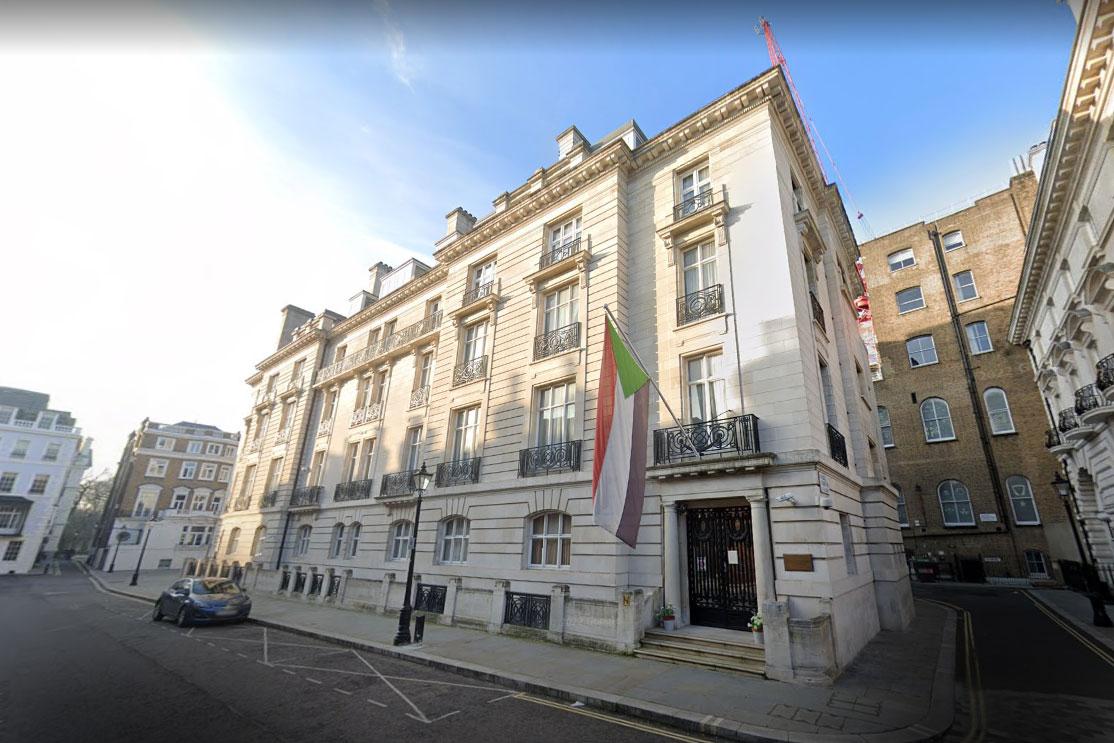
British security authorities are reportedly scrutinising activities linked to Sudan’s embassy in London amid allegations that the diplomatic mission has become involved in intelligence and political operations tied to Sudan’s ongoing war, according to claims circulating among Sudanese media figures, diaspora activists and online intelligence-monitoring accounts.
The allegations, which have not been officially confirmed by British authorities, claim the UK’s domestic intelligence agency, MI5, has increased monitoring of individuals and networks associated with the embassy following recent tensions surrounding Sudanese political activism in Britain.
A Sudan-focused intelligence tracking account on X, SigintMap, circulated claims that the embassy had become a centre for “operational” activity linked to Port Sudan authorities and alleged that British security services were closely monitoring developments. The original post could not be accessed at the time of publication.
No public statement has been issued by MI5, the UK Home Office, or London’s Metropolitan Police regarding the claims.
The reports emerged after confrontations outside events linked to Port Sudan-appointed Prime Minister Kamil Idris during his visit to Britain, including protests near Oxford involving Sudanese anti-war activists and diaspora groups.
Videos circulated online showing heated altercations between protesters and men accused by activists of having ties to Sudanese embassy staff. Some activists alleged individuals involved were connected to Islamist factions aligned with General al-Burhan’s SAF, including the Al-Baraa Bin Malik Brigade, though those claims remain unverified.
Sudanese opposition figures and pro-TASIS activists have increasingly accused diplomatic missions aligned with Port Sudan authorities of attempting to monitor dissidents abroad, pressure activists and organise political networks inside Europe.
The Sudan Founding Alliance and affiliated activists have repeatedly criticised what they describe as the growing influence of Islamist-aligned figures within Sudan’s diplomatic and political structures overseas.
The allegations also come amid broader concerns in Britain and Europe over what rights groups describe as “transnational repression” — efforts by foreign governments or affiliated actors to intimidate political opponents, journalists and dissidents living abroad.
A previous Freedom House report noted that British authorities have expanded monitoring of foreign-state intimidation and covert political activity conducted on UK soil.
London hosts one of the largest Sudanese diaspora communities in Europe and has become a major centre for anti-war activism, lobbying campaigns and political mobilisation linked to Sudan’s conflict.
Britain has also played an increasingly active diplomatic role on Sudan, hosting international discussions and repeatedly calling for accountability over atrocities committed during the war.
At the time of publication, neither Sudan’s embassy in London nor British authorities had publicly responded to the latest allegations.