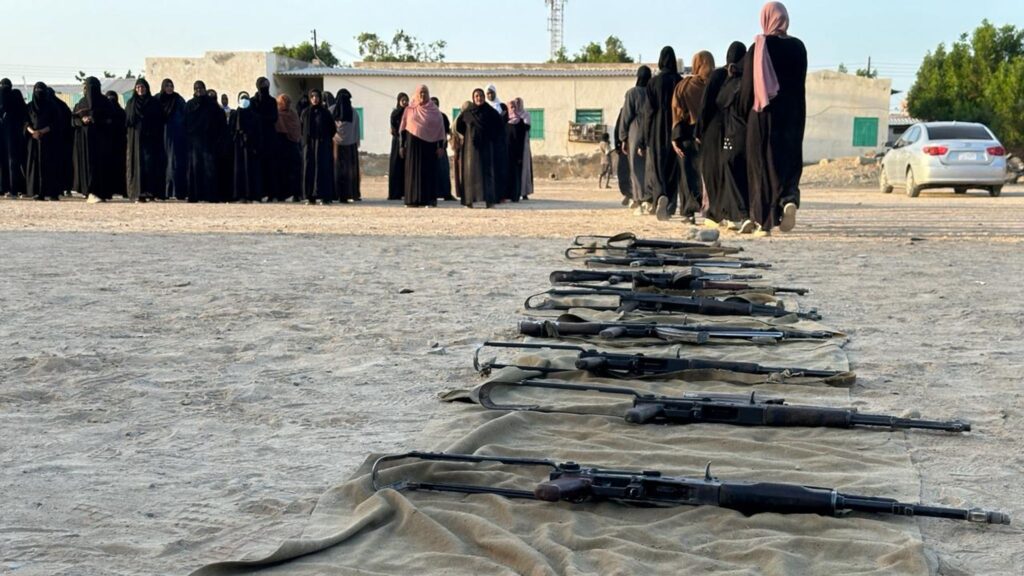
The expansion of military training and recruitment programmes targeting civilian women in areas controlled by the Sudanese Armed Forces has sparked growing political and human rights concerns as the country’s war continues into its third year.
Reports circulating in Sudan indicate that the Port Sudan authorities have recently expanded military training camps and popular mobilisation programmes for women across several states.
According to the reports, women’s participation is no longer limited to logistical support or humanitarian work, with some recruits allegedly being trained for direct combat roles, including sniping and battlefield assistance.
The Sudanese National Observatory for Human Rights said it had obtained photographs that it claimed showed civilian women being recruited into Popular Resistance formations linked to the SAF in Khartoum.
The group described the involvement of civilian women in combat as a dangerous development and said it could violate international humanitarian law and protocols intended to protect women during armed conflicts.
It held the Port Sudan authorities responsible for what it described as the growing militarisation of women and civilians.
The observatory said military training programmes for women had expanded significantly in Port Sudan and other army-controlled states, with mobilisation camps being opened under the banner of the Popular Resistance and military support initiatives.
It added that the expansion had coincided with official announcements by state institutions encouraging female professionals and other women to join the programmes.
Sudanese journalist Aza Ira also renewed her opposition to military training camps for women, saying she had publicly rejected the initiatives from the outset.
Ira said she had faced criticism and threats from groups she described as benefiting from the continuation of the war and the increasing militarisation of civilian society.
She argued that expanding the involvement of women and other civilians in the conflict would not help end Sudan’s crisis but would instead deepen its political, social and psychological consequences.
According to Ira, women in Sudan have historically played a central role in maintaining family and community cohesion. She said directing women towards weapons training rather than empowering them in humanitarian relief, psychological support and peacebuilding risked damaging future generations.
She also warned that the spread of weapons among civilians could entrench a culture of violence within families and local communities, leaving consequences that could continue long after the current war ends.
The proliferation of weapons in residential neighbourhoods and homes could also complicate future disarmament efforts and undermine attempts to restore social stability, she said.
Ira called for resources to be directed towards rehabilitation centres, psychological support programmes and community development projects rather than expanding military mobilisation camps.
“Sudanese women are makers of life, not machines of war,” she said.
The controversy comes amid renewed calls from activists and rights organisations to protect civilians, keep women and children away from combat zones and prioritise a political process aimed at ending the war rather than broadening civilian participation in it.