Turkey and Sudan’s army leadership are moving toward deeper military cooperation as SAF intensifies air operations against Rapid Support Forces supply routes in western Sudan, although claims that Ankara has already approved a new package of advanced weapons have not been independently confirmed.
Sudanese sources said Friday that Turkey had approved a list of advanced weapons requested by SAF Chief of Staff Yasser al-Atta following his visit to Ankara and that implementation of the request had already begun.
The sources also claimed discussions covered wider defence cooperation and the possible localisation of Turkish weapons production in Sudan.
Those specific claims have not been publicly confirmed by the Turkish government.
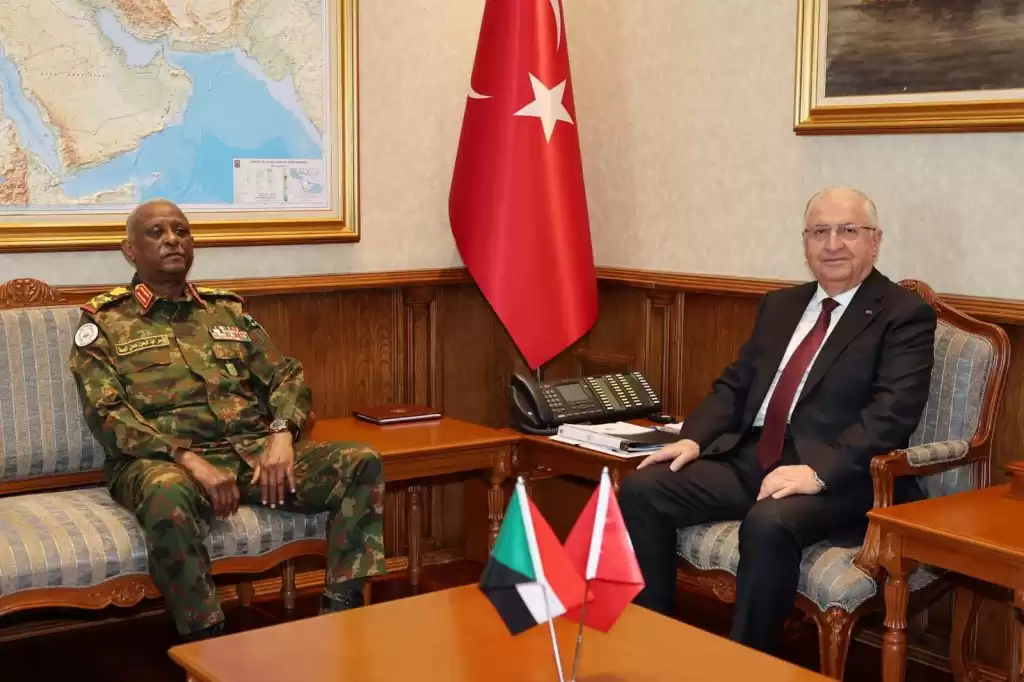
What is confirmed is that al-Atta travelled to Ankara on August 17 at the invitation of Turkish Chief of General Staff Selçuk Bayraktaroğlu.
Turkey’s official Anadolu news agency said al-Atta held talks with Bayraktaroğlu on military relations between the two countries before meeting Turkish Defence Minister Yaşar Güler.
The visit represented one of the clearest recent signs of expanding military contacts between Ankara and the SAF leadership.
Sudan’s army has already relied extensively on Turkish defence technology during the war, particularly unmanned aircraft, while previous investigations have documented significant transfers of Turkish drones and munitions to SAF.
The latest reports emerged as Sudanese military aircraft reportedly launched a series of strikes against RSF-linked convoys near the remote border zone connecting Sudan, Libya and Chad.
Sudan News, citing field sources, said Friday’s strikes hit a military convoy carrying combat vehicles, ammunition and fuel.
The sources claimed dozens of vehicles and fuel tankers were targeted and that several were destroyed or set ablaze.
The scale of the reported losses could not be independently verified, and neither the RSF nor the Sudan Founding Alliance, known as TASIS, had issued a detailed public response to the reported attack at the time of publication.
SAF-aligned sources said the latest strikes were part of a wider campaign aimed at cutting western supply routes and preventing military equipment, fuel and ammunition from reaching RSF fronts in Darfur and Kordofan.
The RSF and TASIS, meanwhile, have continued to project a sharply different battlefield narrative.
In recent statements, the Sudan Founding Alliance has highlighted its territorial gains in Blue Nile, including Qaisan, Kurmuk, Amora and Agro, portraying the advances as evidence that its forces are expanding the war beyond their traditional western strongholds.
TASIS statements have described the Blue Nile campaign as part of a wider offensive against SAF and have repeatedly accused the army leadership of relying on Islamist-aligned forces, foreign military assistance and aerial bombardment.
No publicly available TASIS or RSF statement reviewed by The Sudan Times directly addressed the reported Turkish weapons approval or Friday’s alleged destruction of the border convoy.
The two developments nevertheless point toward a widening military contest.
While TASIS forces have recently opened new pressure axes in Blue Nile and maintained extensive territory across Darfur, SAF appears increasingly focused on using air power and foreign defence partnerships to disrupt the RSF’s logistical depth and strengthen its position on multiple fronts.
Al-Atta has publicly advocated simultaneous operations across Sudan and has said the army intends to advance on several axes rather than concentrate on a single front.
If the reported Turkish weapons package is eventually confirmed, it could represent a significant new phase in Ankara’s military involvement in the Sudan war, particularly if it includes additional drones, air-defence systems, electronic warfare equipment or precision munitions.
For now, however, the existence and contents of the alleged weapons list remain based on Sudanese source claims rather than an official Turkish announcement.