An investigation has alleged that Saudi Arabia’s role in Sudan’s war extended beyond diplomatic mediation to include a network of political, military, logistical and economic support that strengthened the Sudanese Armed Forces and the Port Sudan authorities.
The investigation, published by the Global Institute for Strategic Studies, or GISS, said the alleged support network helped enhance the army’s operational capabilities and ability to continue fighting.
Saudi Arabia has publicly presented itself as a mediator in the conflict, jointly hosting ceasefire negotiations with the United States in Jeddah and supporting efforts to facilitate humanitarian access.
However, the investigation claimed there was a contradiction between Riyadh’s declared diplomatic role and what it described as a sustained support structure benefiting Sudan’s military leadership.
The report said its conclusions were based on an analysis of international trade records, maritime shipping documents, flight-tracking data, corporate registrations, re-export routes and financial transactions.
It said the evidence pointed not to isolated incidents, but to an interconnected network linking Riyadh with the military-led authorities based in Port Sudan.
Executive flights between Riyadh and Sudan
The investigation documented what it described as a continuing air bridge between Riyadh and Port Sudan involving non-commercial executive aircraft commonly used to transport senior officials, government delegations, financial assets, documents and sensitive equipment.
Among the flights cited was a Gulfstream G550, registered as HZ-SK5 and operated by Alpha Star Aviation and Sky Prime Aviation, which travelled to Sudan in December.
Less than two weeks later, a Badr Airlines Mitsubishi CRJ-200LR, registered as ST-BAT, reportedly flew from Port Sudan to Riyadh.
The report also cited a Gulfstream G450, registered as HZ-A22, which flew on January 7, and a Cessna Citation Latitude, registered as HZ-A26, which travelled on February 14. Both aircraft were said to have been operated by Alpha Star Aviation.
The February flight took place one day after Intelligence Online published a report alleging that Saudi Arabia had transferred M777 artillery systems to the Sudanese army.
Other flights cited included a Bombardier Global 5000, registered as TC-RMS and operated by Bonair Havacilik, which departed Riyadh for Khartoum on June 22 after arriving in Saudi Arabia from Istanbul.
The HZ-SK5 aircraft was also tracked returning to Riyadh after a stop in Port Sudan lasting less than four hours.
The investigation argued that the aircraft types, frequency and timing of the journeys suggested a sustained channel that went beyond conventional diplomatic activity.
It said the brief stop by HZ-SK5 was consistent with a rapid, purpose-specific mission rather than a routine commercial operation.
The available flight records do not, by themselves, establish what or whom the aircraft were transporting.
Alleged transfer of M777 artillery
Citing a report by Intelligence Online, the investigation said Saudi Arabia had transferred three batteries of 155-millimetre M777 howitzers to the Sudanese Armed Forces, together with compatible ammunition.
The alleged arrangement also included training Sudanese personnel to operate the weapons, manage artillery fire and follow safety procedures.
The claim was reportedly based on documents, photographs, videos and intelligence sources. It has not been independently verified.
The investigation said Saudi Arabia possesses more than 100 artillery systems of this type and that Port Sudan was selected to receive the weapons because they could be unloaded, stored and distributed to front-line units with a reduced risk of interception.
It alleged that the operation was coordinated through channels linked to Saudi and Sudanese military intelligence.
Neither Saudi Arabia nor the Sudanese Armed Forces was quoted responding to the allegations.
Chlorine shipment passed through Jeddah
The investigation also examined what it described as a maritime supply route involving a shipment of 17 chlorine gas cylinders imported from India by the Sudanese Ports Engineering Company.
The shipment reportedly originated with India’s Chem Trade International and passed through Jeddah Islamic Port before reaching Port Sudan.
According to the investigation, the Sudanese importer has links to the military and is headed by a serving officer, placing it within the army’s procurement, storage and distribution system.
The report alleged that the chlorine was unloaded, stored and later distributed through military-controlled logistical channels.
It further claimed that the material subsequently appeared near the Al-Jaili oil refinery, where the Sudanese army has faced allegations of carrying out a chemical attack.
The investigation said researchers and independent specialists had traced the shipment from India to Sudan.
However, it acknowledged that the cargo’s transit through a Saudi port did not, by itself, prove that Saudi authorities knew of its alleged final use.
The report nevertheless described Saudi Arabia as an important logistical transit point in the shipment’s supply chain.
Explosives and ammunition supply chain
The investigation said the alleged support network also involved commercial shipments of materials used in the production of ammunition and explosives.
It highlighted Target Multi Activities Company, or TMAC, which it said is linked to Sudan’s defence-industrial system through the Giad Group.
According to the report, TMAC plays a role in securing raw materials used by companies associated with the Sudanese military’s ammunition and explosives production.
The investigation identified SPL Energy as a principal supplier to the network since 2024.
It said SPL Energy accounted for 314 of 477 recorded shipments to TMAC, while IDL Explosives supplied 147 shipments. Ashoka Manufacturing reportedly supplied eight shipments and CDET Explosive Industries supplied two.
The report argued that the number of suppliers indicated a stable and diversified procurement network designed to maintain the flow of explosive materials even if one supply route was disrupted.
It also documented a January 23 shipment classified under customs code HS 36020010, covering explosive products including Neo Gel 901 and Neo Prime in various sizes.
The cargo reportedly departed from India’s Kochi port, passed through Jeddah Islamic Port and arrived in Port Sudan.
The investigation alleged that the shipment subsequently entered the network of companies operating under Sudan’s military-industrial system.
As with the chlorine shipment, passage through Jeddah does not establish that Saudi officials were aware of the cargo’s intended end user or eventual use.
The investigation nevertheless argued that the Saudi port was a significant link in a broader supply chain that helped sustain Sudanese military production during the war.
Political and economic partnership
The report said relations between Riyadh and the Port Sudan authorities had also deepened politically and economically.
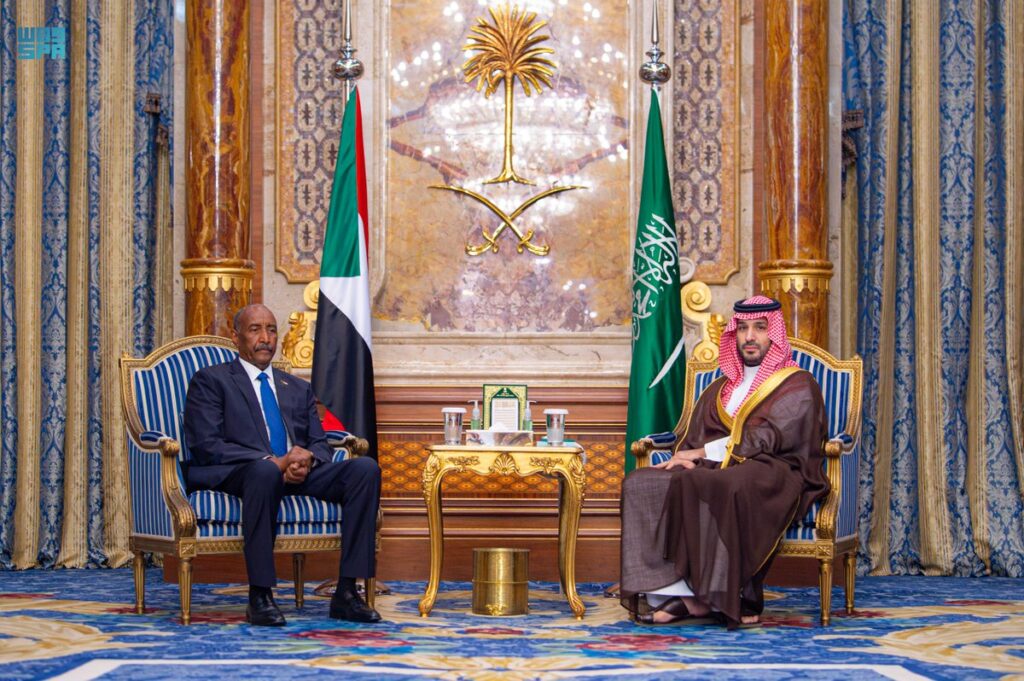
It cited an April 20 meeting in Jeddah between Saudi Crown Prince Mohammed bin Salman and Sudanese army chief Abdel Fattah al-Burhan.
The meeting coincided with intelligence reports alleging that a $1.5 billion Pakistani weapons package was being arranged for the Sudanese Armed Forces, potentially with Saudi financial or political backing.
The investigation said there was no publicly available proof that Saudi Arabia had financed the reported agreement, but argued that the timing raised questions about Riyadh’s role.
Saudi Arabia and Sudan later announced plans to establish a strategic cooperation council.
The report described the proposed council as evidence of a transition from temporary mediation towards a long-term institutional partnership covering political, economic and security affairs.
Saudi companies were also reportedly expected to receive priority in future reconstruction, infrastructure, ports, energy, agriculture and transport projects.
The investigation argued that these arrangements connected wartime political support with longer-term Saudi economic and strategic interests in post-war Sudan.
Support allegedly benefited army-allied factions
The report said military support for the Sudanese Armed Forces also indirectly strengthened armed factions fighting alongside the army, including the Al-Baraa Ibn Malik Brigade.
The United States has accused the Islamist-aligned group of committing violence against civilians, carrying out summary executions and obstructing efforts to reach a political settlement.
US authorities have also alleged that some members of the brigade received training and support from Iran’s Islamic Revolutionary Guard Corps.
The investigation said the alleged Saudi support network therefore raised legal and political questions about the responsibility of states providing military, financial, logistical or diplomatic assistance to parties involved in armed conflicts.
GISS concluded that Saudi Arabia had evolved from a diplomatic mediator into a significant political, security and logistical partner of the Sudanese Armed Forces and the Port Sudan authorities.
However, many of the investigation’s central claims, including the alleged weapons transfers and the purpose of the executive flights, remain based on intelligence reporting, trade data and circumstantial connections and have not been independently verified.