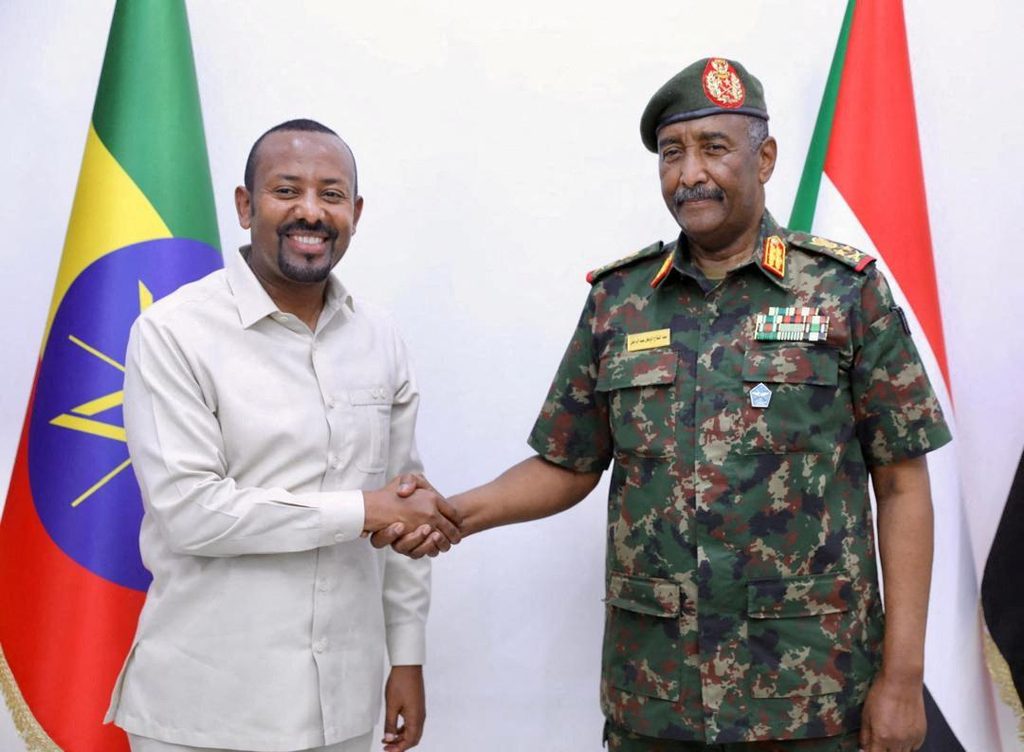
Sudanese opposition leader Mubarak al-Fadil al-Mahdi has accused Islamist figures within army chief Abdel Fattah al-Burhan’s administration of drawing Sudan into the escalating conflict between Ethiopia and Eritrea, warning that the move could threaten the country’s national security and territorial integrity.
In a detailed statement published on Thursday, the Umma Party leader alleged that Islamist officials had facilitated the involvement of Ethiopian Tigrayan fighters in military operations against the government of Prime Minister Abiy Ahmed, in coordination with Eritrea.
Al-Mahdi said the alleged intervention risked opening another military front along Sudan’s eastern border at a time when the country was already devastated by more than three years of war.
Allegations of military cooperation with Tigrayan forces
According to al-Mahdi, between 20,000 and 30,000 fighters affiliated with the Tigray People’s Liberation Front (TPLF) entered Sudan following Ethiopia’s 2020–2022 civil war, which ended with the Pretoria peace agreement.
He claimed that during a July 2024 visit to Port Sudan, Ethiopian Prime Minister Abiy Ahmed asked Burhan to facilitate the return of the fighters under the peace arrangements.
Although Burhan initially agreed to discuss their repatriation, al-Mahdi alleged that Sudanese military officials subsequently informed an Ethiopian delegation that the army needed the Tigrayan forces to support its operations against the Rapid Support Forces (RSF).
He said Tigrayan fighters subsequently participated in military operations alongside Sudan’s army in Khartoum, Al Jazirah and Blue Nile states.
Al-Mahdi further alleged that Burhan’s administration had assured Ethiopian officials that the fighters would not be used in military operations against Ethiopia.
However, he claimed that Islamist figures within the military establishment later facilitated the deployment of the Tigrayan 13th and 17th divisions against Ethiopian federal forces, in coordination with Eritrea.
The opposition leader said the operation violated assurances previously given to Addis Ababa.
He claimed that the 13th Division suffered a major defeat, with more than 1,000 fighters captured, while the 17th Division sustained heavy losses, forcing some of its members to retreat into Eritrea.
The specific troop numbers, battlefield losses and alleged coordination involving Sudanese officials could not be independently verified.
Islamists accused of pursuing regional ambitions
Al-Mahdi argued that Islamist networks associated with former President Omar al-Bashir were attempting to revive historical alliances with the TPLF as part of a broader effort to regain political and military influence.
He said some Islamist leaders appeared to believe they could help restore the TPLF to power in Addis Ababa, drawing on political relationships established during the 1990s.
However, he warned that the regional circumstances that enabled the TPLF and its allies to overthrow Ethiopia’s military government in 1991 no longer existed.
Al-Mahdi accused Islamist groups of exploiting Sudan’s civil war to reestablish themselves within the military administration and influence decisions affecting the country’s foreign relations.
He also alleged that Burhan had recently received Tigrayan commanders in Khartoum following their battlefield setbacks, despite warnings about the consequences of continued military cooperation.
Fears of renewed fighting along eastern border
The Umma Party leader warned that the alleged intervention could trigger Ethiopian retaliation along Sudan’s eastern frontier, particularly in the disputed agricultural region of Al-Fashaga.
He raised the possibility that Ethiopia could tolerate movements by Amhara’s Fano armed groups toward Sudanese territory, potentially reigniting longstanding border tensions.
Such a development, he warned, could place additional pressure on Sudan’s military, which is already engaged in fighting across several regions.
He also expressed concern about the security of Gedaref state, a major agricultural region bordering Ethiopia, amid the possibility of further RSF advances toward eastern Sudan.
The accusations come as diplomatic relations between Sudan and Ethiopia have deteriorated sharply.
On November 4, Ethiopia ordered the closure of Sudan’s consulate in Assosa and the departure of six Sudanese diplomats. Sudan subsequently closed Ethiopia’s consulate in Gedaref.
Both governments have accused one another of supporting armed groups operating across their borders.
Ethiopia has accused Sudan of backing Tigrayan rebels, while Sudanese military-aligned authorities have accused Addis Ababa of supporting the RSF. Both sides have denied the allegations against them.
Calls for African Union mediation
Al-Mahdi urged Burhan to immediately halt any military, logistical or political assistance to armed groups fighting the Ethiopian federal government.
He also called for the disarmament of Ethiopian fighters present in Sudan, with their status addressed through appropriate international legal and humanitarian mechanisms.
The opposition leader urged the African Union to mediate between Khartoum and Addis Ababa to prevent the dispute from escalating into an interstate conflict.
He further called on Sudan’s military leadership to engage directly with Abiy Ahmed to resolve outstanding security and border disputes.
Al-Mahdi said the escalating tensions demonstrated the dangers of allowing Islamist groups to shape Sudan’s military and foreign policy.
He maintained that his party supported preserving Sudan’s national army as a professional institution but opposed allowing military leaders to determine the country’s future without civilian oversight.
The opposition leader also renewed his demand for an immediate end to Sudan’s civil war, the removal of Islamist figures from positions of political influence and a negotiated settlement that would restore civilian authority.
He warned that Sudan could not afford another regional confrontation while its population continued to bear the devastating consequences of the existing conflict.