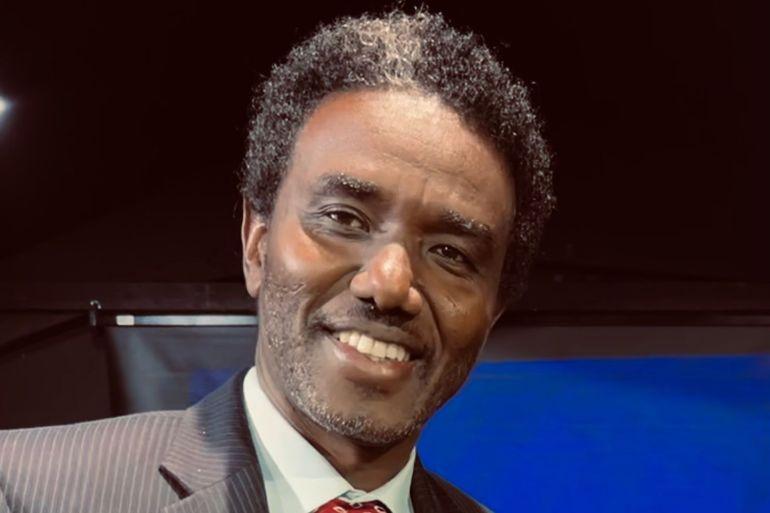
Bakri al-Jak, spokesperson for Sudan’s Civil Democratic Alliance for Revolutionary Forces, known as Sumoud, has accused army chief Abdel Fattah al-Burhan and his Islamist allies of prolonging the country’s war in pursuit of political power.
In an interview with Erem News, al-Jak said efforts to reach a political settlement have stalled not only because of what he described as attempts to flood the process with political fronts linked to Islamists, but also because of fundamental flaws in the design of the peace process.
He argued that political negotiations have not been directly tied to securing a ceasefire, allowing the Port Sudan authorities to continue pursuing a military solution rather than engaging seriously in a negotiated settlement.
“The continuation of the conflict serves an authoritarian alliance that includes Abdel Fattah al-Burhan and his Islamist allies, who see the war as a means of controlling power rather than a path toward peace and ending the conflict in Sudan,” al-Jak said.
He said greater international pressure was needed against actors obstructing peace efforts, arguing that Sudan’s political crisis had deepened because the popular will expressed during the 2019 uprising had been disregarded.
‘Political process is fundamentally flawed’
Al-Jak said Sudan’s political track is being managed by a five-party mechanism involving the African Union, United Nations, Intergovernmental Authority on Development, or IGAD, and the Arab League.
He said the shortcomings of the initiative went beyond the participation of political groups he described as fronts for Islamist forces.
“The approach designed for the political process is defective,” he said, adding that there was no effective link between political negotiations and efforts to halt the fighting.
According to al-Jak, this had reduced the political process to “an echo of the war” rather than a mechanism capable of compelling parties to observe a ceasefire.
Port Sudan authorities accused of rejecting political solution
Asked how the conduct of the Port Sudan authorities and Islamist groups had undermined prospects for peace, al-Jak said the de facto government continued to insist that Sudan’s crisis could only be settled militarily.
He accused the authorities of pursuing what he called the goal of a decisive and total military victory, believing that such an outcome would allow them to impose their political programme without negotiations.
“The Port Sudan authority essentially has no programme other than continuing the war,” he said.
Al-Jak argued that the main obstacle to peace was therefore not individual battlefield practices, but what he described as a broader refusal to accept a peaceful settlement.
Burhan accused of seeking sole rule
Al-Jak also accused Burhan of harbouring ambitions to emerge from the war as Sudan’s sole ruler.
He claimed Burhan’s preferred outcome was for the fighting to end only after his position as the country’s undisputed president had been secured.
Al-Jak said domestic initiatives presented as a “Sudanese-Sudanese dialogue” were, in his view, designed to reinforce that objective.
However, he stressed that the pro-war camp extended beyond Burhan.
He said armed groups that signed the 2020 Juba Peace Agreement also had political interests in maintaining arrangements that distributed power and wealth among signatories, while Islamist forces were similarly seeking a place in Sudan’s future political order.
“This is therefore a fully-fledged alliance for power,” al-Jak said. “For them, the war is a means of controlling power and remaining in power.”
2019 uprising ‘ignored’
Al-Jak said Sudan’s current crisis also reflected what he described as the systematic disregard of the Sudanese public’s political choices.
He pointed to the 2019 uprising that led to the removal of longtime president Omar al-Bashir and the establishment of a transitional government.
That transition was later disrupted by Burhan’s October 25, 2021 military takeover, which al-Jak argued helped create the conditions that ultimately led to the current war.
He criticised arguments that Sudan lacked a clear popular mandate and should simply move toward elections, saying such rhetoric was being used to legitimise the current authorities.
Al-Jak accused supporters of the Port Sudan administration of falsely portraying the de facto government as enjoying public acceptance because it provides a measure of security.
Sudan has remained engulfed in conflict since April 2023, with repeated regional and international initiatives failing to secure a lasting ceasefire or a comprehensive political settlement.