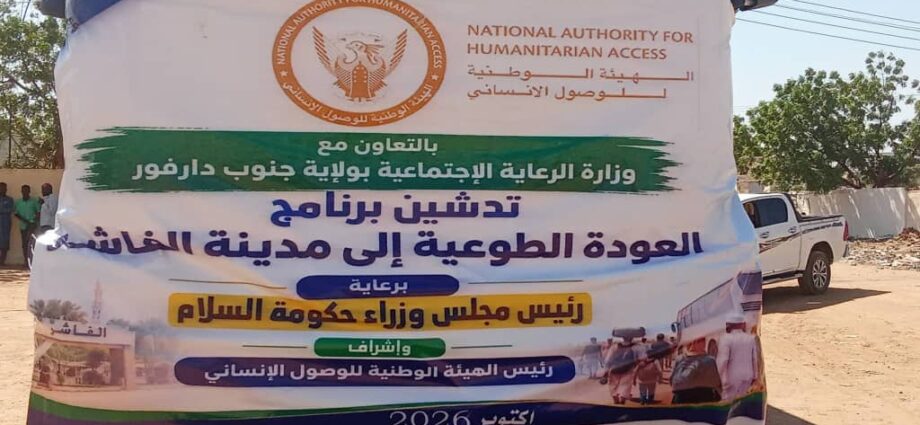
The Sudan Founding Alliance (TASIS) government has facilitated the return of approximately 135 displaced families from Nyala to El Fasher, the capital of North Darfur, as part of efforts to restore civilian life and essential services in the war-affected city.
The voluntary return programme was organised by South Darfur’s civil administration in cooperation with the National Humanitarian Access Authority of the TASIS-backed Government of Peace and Unity, according to a report published by Darfur24 on Thursday.
Halima Al-Mahdi Saleh, director-general of South Darfur’s Ministry of Social Affairs, said arrangements had been made to support returning families through the provision of healthcare, education and drinking water.
She said the authorities were also working to rehabilitate public facilities and improve services needed by residents returning after prolonged displacement.
The initiative follows earlier preparations by TASIS authorities to assess conditions in El Fasher and identify families willing to return from displacement shelters in Nyala.
A delegation from South Darfur’s civil administration previously visited the North Darfur capital to examine the arrangements needed to receive returning residents.
Among those participating in the programme was Nafisa Othman Azriq, who said her family had decided to return because the circumstances that originally forced them to leave had changed.
TASIS expands recovery efforts
The return programme forms part of broader efforts by the TASIS administration to restore public services and support civilian recovery in areas under its control.
El Fasher has suffered extensive damage to its infrastructure, residential neighbourhoods and public institutions following years of fighting.
Since the Rapid Support Forces (RSF) captured the city in October 2025, local authorities and community organisations have undertaken initiatives to reopen healthcare facilities, rehabilitate educational institutions and restore commercial activity.
TASIS officials have identified the voluntary return of displaced residents as a priority, alongside improvements to humanitarian access and essential services.
However, security concerns continue to complicate recovery efforts.
Darfur24 reported that some displaced families remain reluctant to return because of prevailing conditions and reports of arrests involving returnees.
Other displaced residents have travelled from shelters in Nyala to Tawila rather than returning to El Fasher.
The latest return programme nevertheless marks a new stage in TASIS’s efforts to facilitate civilian resettlement, although the sustainability of those returns will depend on security conditions and the availability of essential services.