The Sudan Founding Alliance, or TASIS, is increasingly establishing itself as an unavoidable participant in international efforts to end Sudan’s war, as mediators prepare a new round of political consultations in Addis Ababa.
The international Quintet mechanism is expected to convene Sudanese political and civilian forces in the Ethiopian capital from July 27 to 29, according to Sudanese media reports, although disagreements over representation could force a postponement.
The planned talks are expected to focus on efforts to secure a ceasefire, address Sudan’s humanitarian crisis and prepare for a broader Sudanese political dialogue.
The Quintet brings together the African Union, the United Nations, the European Union, the Intergovernmental Authority on Development and the Arab League.
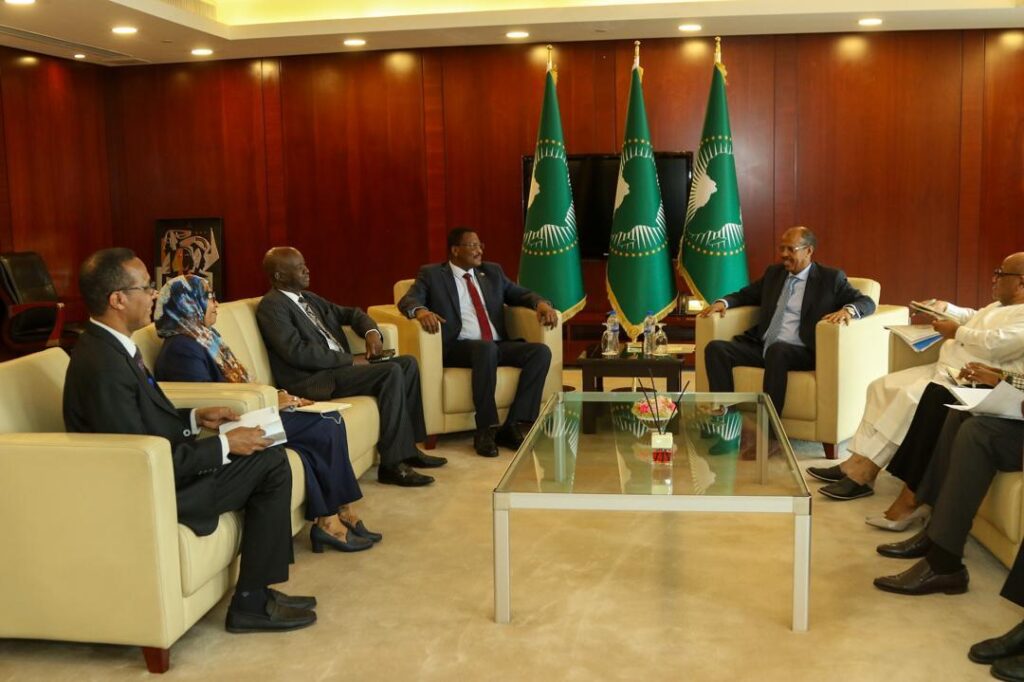
TASIS participated in the mechanism’s previous consultations in Addis Ababa in June, when a senior delegation held direct discussions with international mediators over the political process and proposals for ending the war.
The delegation included senior TASIS figures Mohamed Mukhtar, Nasredeen Abdulbari and Ibrahim al-Mirghani.
TASIS spokesman Ahmed Tugud said during the June meetings that any political process excluding the alliance would amount to little more than a public relations exercise, arguing that the coalition represents political and military realities that mediators cannot ignore.
The alliance also rejected reports that it was conducting direct negotiations with the Sudanese Armed Forces or the Port Sudan authorities, saying that any engagement would take place through internationally recognised peace mechanisms.
TASIS has called for an immediate humanitarian truce as the first stage of a wider settlement, followed by a permanent ceasefire and an inclusive political process. It has also insisted that the former ruling National Congress Party, the Islamic Movement and their affiliated groups should be excluded from Sudan’s future transition.
Its inclusion in the Addis consultations represents a significant diplomatic development for the alliance, which has faced sustained efforts by pro-army political factions to portray it solely as an extension of the Rapid Support Forces.
Several members of the Democratic Bloc refused to meet TASIS representatives during the June consultations, while a proposed encounter between TASIS and the Somoud civilian coalition also failed to take place.
Despite those divisions, the international mechanism met the TASIS delegation separately, effectively acknowledging that no credible settlement can be constructed without consulting the alliance and the constituencies it claims to represent.
The Quintet said after the June round that it had consulted a broad spectrum of Sudanese political and civilian stakeholders and was working toward the creation of a preparatory committee for an inclusive inter-Sudanese dialogue.
It said the consultations had been difficult but productive and that participants had submitted written proposals intended to form the basis of more substantive negotiations involving a wider range of Sudanese actors.
The mechanism has nevertheless maintained its opposition to parallel governing structures, warning that they risk further fragmenting Sudan.
That position places TASIS in a complicated diplomatic space. International organisations have not recognised its Government of Peace and Unity, but their willingness to repeatedly invite and consult the alliance gives it a degree of political legitimacy that its opponents have sought to deny.
TASIS established its governing institutions after adopting a transitional constitution and later formed a presidential council headed by Mohamed Hamdan Dagalo and a government led by Prime Minister Mohamed Hassan al-Taishi.
The alliance argues that the administration is necessary to deliver services and govern territories outside the control of the Port Sudan authorities. Its opponents accuse it of threatening Sudan’s unity by establishing a rival centre of power.
Tugud has played down the immediate importance of formal diplomatic recognition, saying TASIS already maintains extensive regional and international contacts.
He has also argued that the African Union remains an appropriate platform for dialogue, despite TASIS criticism of what it considers biased positions taken by some AU officials.
During the previous Addis round, Tugud said the alliance would not accept being marginalised by groups that lack comparable influence on the ground.
“Any dialogue or peace process without the participation of our coalition is nothing more than a public relations project,” he said, according to Sudan Tribune.
The June consultations exposed the depth of Sudan’s political fragmentation. TASIS did not join a common political document endorsed by Somoud and other participating forces, and no direct talks were held between the two alliances.
Members of the Democratic Bloc also reiterated their refusal to engage with TASIS, accusing it of being controlled by the RSF. TASIS dismissed the boycott and said the bloc’s position would not determine the shape of the peace process.
The next Addis round could therefore become an important test of whether international mediators can move beyond separate consultations and begin bringing Sudan’s rival civilian and political blocs into a single process.
It could also demonstrate how far TASIS has progressed from a coalition struggling for international acceptance into a political actor whose participation is increasingly regarded as necessary, even by institutions that remain opposed to its parallel government.
For TASIS, participation does not yet amount to formal recognition. But repeated invitations to international consultations strengthen its claim that efforts to determine Sudan’s political future cannot proceed without it.