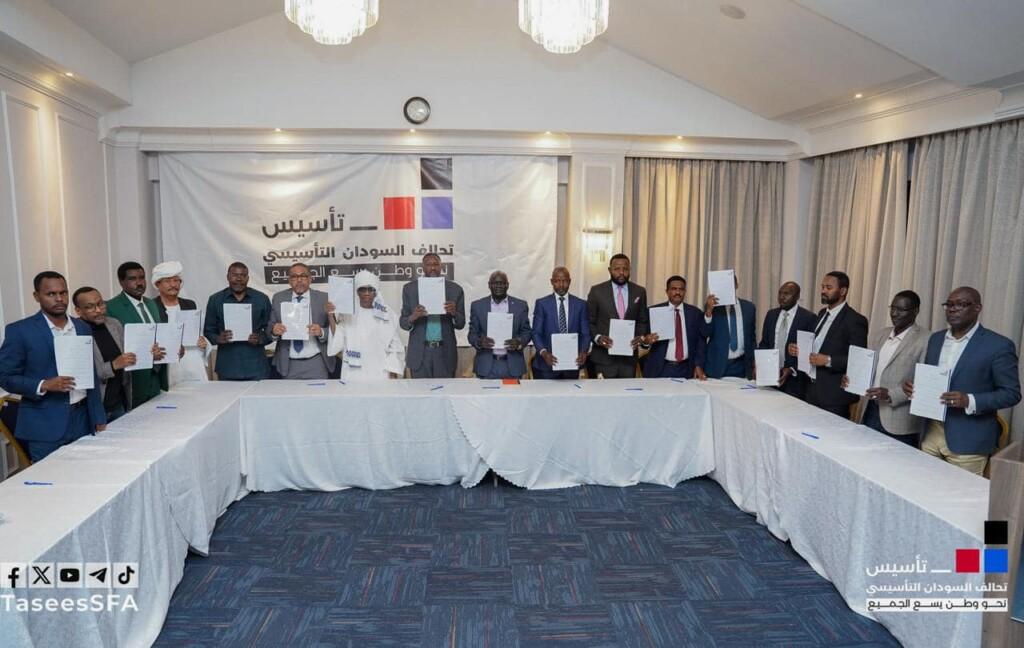
A senior Sudan Founding Alliance official has rejected claims that the alliance’s forces are retreating on Sudan’s battlefronts, saying TASIS remains strong while criticising the political dialogue backed by army chief Abdel Fattah al-Burhan.
Hasab al-Nabi Mahmoud, head of the Democratic Sudan Liberation Movement and a TASIS leadership figure, made the comments in an interview with Al Araby television from Paris published on Saturday.
Mahmoud disputed reports portraying recent battlefield developments as a broad collapse of the Rapid Support Forces.
He said the forces currently fighting should instead be viewed as belonging to the wider Sudan Founding Alliance and its Peace Government structures, which bring together the RSF and other military and political groups.
Mahmoud described TASIS as being at what he called the strongest stage in its political and revolutionary history and said alliance forces had achieved significant battlefield gains.
His assessment could not be independently verified and contrasts sharply with claims from Sudanese army officials and supporters who have portrayed recent fighting in Kordofan and Blue Nile as evidence that TASIS-aligned forces are losing ground.
Mahmoud nevertheless said the continuation of the war was unacceptable because of the suffering it was inflicting on Sudanese civilians, arguing that TASIS had been compelled to fight rather than choosing continued war as a political objective.
He also criticised the Sudanese-Sudanese dialogue process supported by Burhan.
Mahmoud said Burhan was not engaging with democratic political forces or the wider Sudanese public, but instead with what he described as the country’s pro-war camp.
A committee established to prepare the dialogue has said its political track will focus on political and community forces while keeping military negotiations separate.
Committee member Osman Mirghani told Al Araby that TASIS members could participate individually but said the alliance itself would not be accepted under a framework that, in his view, threatened Sudan’s unity.
The disagreement highlights the widening divide over who should participate in any political process aimed at ending the war.
TASIS figures have repeatedly argued that a settlement excluding the alliance and the forces it represents cannot produce a lasting political agreement, while Burhan and his allies have promoted a dialogue centred on political forces they regard as legitimate participants.
Sudan’s political process remains fragmented as fighting continues across Kordofan and Blue Nile and competing authorities consolidate their respective political and administrative structures.