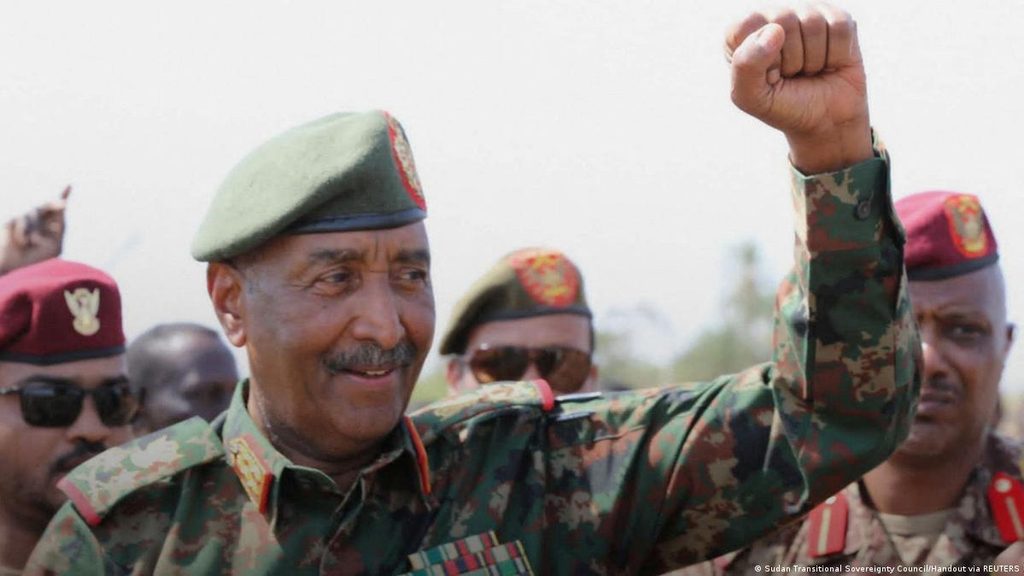
Sudan’s army chief Abdel Fattah al-Burhan has rejected participation by Rapid Support Forces commanders in a planned political dialogue in Khartoum, amid objections from TASIS and other Sudanese groups that the initiative would legitimise military rule rather than end the war.
According to Sudanese outlet Al Mashhad Al Sudani, Burhan said an unnamed intermediary had conveyed RSF leader Mohamed Hamdan Dagalo’s interest in attending and asked whether an amnesty would cover him.
The reported approach remains Burhan’s account. No independently verified confirmation from Dagalo, widely known as Hemedti, or a direct RSF response to the claim was located.
Dagalo heads the presidential council of the rival TASIS administration, whose alliance had already rejected the proposed dialogue. In a September 1 statement, TASIS accused Burhan of controlling the initiative’s committee, agenda and venue, arguing that it would legitimise his authority rather than deliver an independent peace process. Burhan’s claim that Dagalo wanted to attend has not been independently corroborated.
Burhan said the Khartoum gathering was intended for political forces and personalities, while negotiations with Dagalo as a military leader would require a separate venue and process.
He said his government would submit demands through a mediator, with further engagement dependent on Dagalo accepting them. The report did not specify those demands.
Although Burhan said Dagalo could attend as an ordinary citizen, he made clear that neither the RSF leader nor his commanders would be welcome in their military capacities.
The initiative had already faced explicit rejection from the RSF-aligned Sudan Founding Alliance, known as TASIS.
In a September 1 statement, TASIS spokesman Ahmed Tugod Lisan accused Burhan of determining the dialogue’s committee, agenda and location and seeking to control its outcome. The alliance condemned the African Union Commission’s endorsement, describing it as support for one side in the conflict.
TASIS advocated a political process free from either warring party’s control, prioritising an end to the fighting and the humanitarian crisis. It called for broad participation while excluding the former ruling National Congress Party, the Islamic Movement and their fronts. These positions preceded the latest report about Hemedti’s alleged interest in attending.
Opposition extends beyond TASIS. Sumood, the Arab Baath Party and the Sudan Liberation Movement/Army led by Abdel Wahid Mohamed al-Nur were among the forces rejecting the proposed dialogue in its current form, according to a September 1 report by Beam Reports.
Sumood figure Shihab al-Tayeb told the outlet that a credible process must be independent of both warring parties and begin with stopping the fighting and addressing civilian suffering. He rejected arrangements that would confer political legitimacy on the war and its consequences.
Popular Congress Party political secretary Kamal Omar likewise argued that the initiative would entrench Burhan’s authority. He said his party wanted talks leading to peace, a transitional constitution and civilian government.
A broader group of anti-war forces also lodged a formal complaint with African Union institutions over the commission’s welcome for the initiative, Darfur24 reported on September 2.
The complainants included the Forces of the Sudanese Declaration of Principles, the Umma Party, the Popular Congress Party, civil society organisations and women’s and youth networks.
They warned that talks held within territory controlled by one belligerent, without broad participation or a commitment to halt hostilities, could deepen Sudan’s division. They also criticised the commission’s statement for omitting a humanitarian truce and ceasefire, which they said should take priority.
The dialogue’s organisers maintain that the process is independent and that state institutions would provide protection without controlling its agenda or conclusions. Their opponents argue that those assurances fail to address the central problem: a political process unfolding under the authority of one of the forces fighting the war.