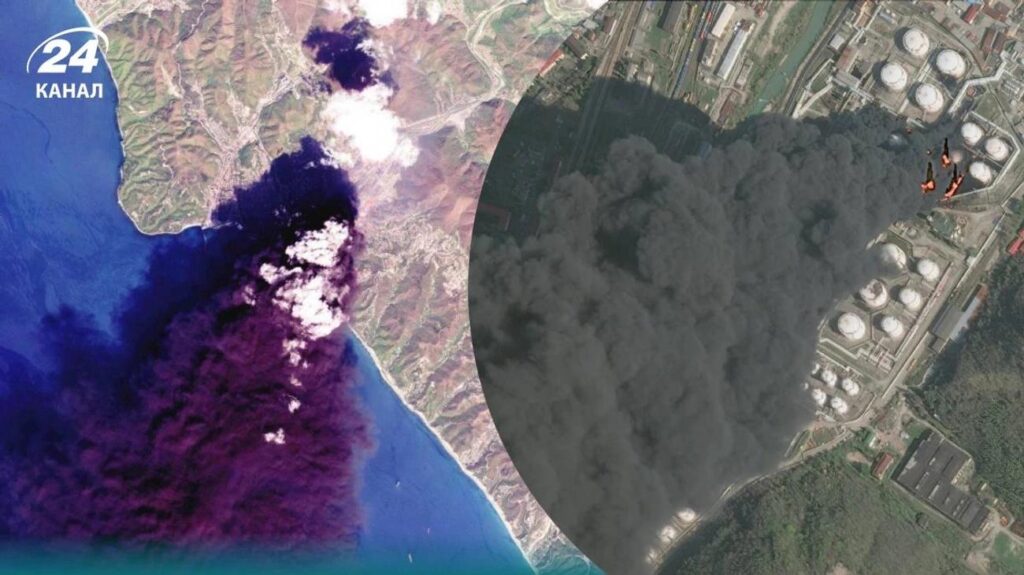
Satellite images showing vast smoke plumes rising from a Russian oil refinery have underscored the scale of an unfolding environmental crisis following repeated Ukrainian drone strikes on energy infrastructure deep inside Russian territory.
The attacks targeted the Tuapse oil refinery in Krasnodar Krai, a major Black Sea export hub operated by Rosneft, triggering large fires that burned for days and forced a halt to operations. The facility, which processes millions of tonnes of crude annually, is considered a key node in Russia’s fuel supply and export network.
Images captured by commercial satellites and circulated by international media showed thick columns of smoke stretching across the coastline and drifting inland, with the plume clearly visible from space.
On the ground, the impact has been severe.
Authorities warned of hazardous air conditions as fires released toxic substances including benzene, xylene and soot into the atmosphere. Residents reported breathing difficulties and a strong petroleum odor, while local officials urged people to remain indoors and limit exposure.
In several areas, rainfall mixed with combustion byproducts produced what residents described as “black rain,” coating streets, homes and vegetation in oily residue. Footage shared online showed cars and buildings stained dark by fallout from the fires.
The environmental damage extended beyond the air. Oil contamination was reported along sections of the Black Sea coast near Tuapse, with cleanup crews deployed to affected areas as concerns grew over marine pollution.
Russian authorities declared emergency measures in response to the strikes, shutting schools, advising against the use of tap water in some areas, and mobilising firefighting teams to contain repeated flare-ups at the site.
The refinery has been hit multiple times, with new strikes reigniting fires before earlier blazes were fully extinguished, compounding both industrial damage and environmental risk.
Satellite evidence and the “mega plume” claims
The scale of the disaster has been amplified by satellite imagery and viral content circulating on Telegram and social media platforms.
Posts widely shared online claim that a massive toxic cloud—stretching up to 400 kilometres and drifting toward Kazakhstan—has formed as a result of the refinery fires, with some warning of long-term carcinogenic fallout.
While satellite images do confirm a large and persistent smoke plume over the Tuapse region, there is no independent verification from official monitoring agencies or international observers supporting the existence of a cross-border cloud on that scale.
No public statements from Russian or Kazakh authorities have confirmed a plume reaching Kazakhstan, and no widely cited atmospheric data has substantiated the 400-kilometre claim.
However, experts note that fires involving النفط storage facilities can release significant quantities of toxic particulates and volatile organic compounds, posing real health risks even without long-distance dispersion.
War expands into environmental risk
The strikes form part of Ukraine’s broader campaign targeting Russian oil and fuel infrastructure, aimed at disrupting logistics and revenue streams tied to the war effort.
Analysts say such attacks are increasingly carrying secondary consequences beyond military and economic impact, particularly when they involve large industrial sites.
Sustained fires at refineries and النفط terminals can release hazardous pollutants into the air, contaminate water systems, and affect civilian populations far from the front lines.
What is unfolding in Tuapse reflects a growing pattern in the conflict: the expansion of long-range strikes into critical infrastructure, with environmental fallout becoming an increasingly visible—and potentially escalating—dimension of the war.
The reality behind the noise
Despite the surge of dramatic claims online, the verified picture is already serious.
Satellite imagery confirms a major plume.
Authorities confirm toxic emissions and degraded air quality.
Residents report contaminated rain and oil residue.
Emergency measures have been imposed.
The existence of a continent-spanning toxic cloud remains unproven.
But for those living under the smoke in Tuapse, the disaster is immediate—and real—without exaggeration.