A political alliance aligned with Sudan’s SAF has split sharply over participation in preparatory talks in Addis Ababa, exposing growing divisions among General Abdel Fattah al-Burhan’s civilian backers as international and regional actors push for a wider political process to end the war.
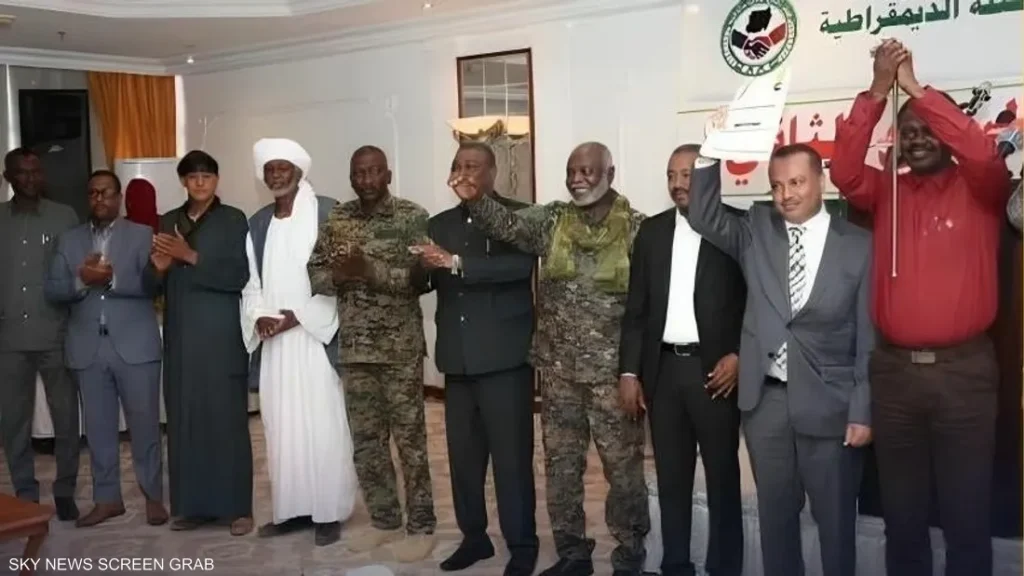
The rift emerged inside the Democratic Bloc, a coalition of armed movements, political groups, tribal figures and social forces that has been one of the SAF’s main political allies since the October 25, 2021 coup. One faction refused to attend the Addis Ababa meetings, while another arrived in the Ethiopian capital and said it was formally mandated to take part.
The faction rejecting participation is led by Democratic Bloc chairman Jaafar al-Mirghani, Justice and Equality Movement leader Jibril Ibrahim, and other figures including Mohamed al-Amin Turk, al-Tom Hajo, Mustafa Tambour, Musa Hilal and Nabil Adeeb.
The participating faction is led by Sudan Liberation Movement chief Minni Arko Minnawi, Social Alliance leader Mubarak Ardol and United Popular Front leader Al-Amin Daoud.
The group that refused to attend said its decision was prompted by the participation of the Sudan Founding Alliance, known as TASIS, which it described as the political wing of the Rapid Support Forces. It argued that TASIS’ presence blurred the line between the political and security tracks.
But the faction attending the talks issued a counter-statement saying Mirghani had been fully aware of the arrangements and had taken part in coordination with the relevant parties before the delegation’s approval was sent to the quintet committee.
The statement said Mirghani had been briefed on all political forces invited to the Addis Ababa meetings and had overseen final amendments before approval was submitted. It added that the delegation currently in Addis Ababa was “the only official delegation” authorised by the Democratic Bloc’s institutions to negotiate with the quintet committee and other relevant parties.
The participating faction also referred to “developments” over the past 72 hours, saying their nature and those behind them remained unclear.
A member of the delegation in Addis Ababa, speaking anonymously to Sky News Arabia, accused Burhan of trying to derail the meetings in order to pressure regional and international actors into accepting an internal political dialogue he recently announced.
Burhan, in an Eid al-Adha address, said arrangements were underway to launch a political dialogue from inside Sudan, claiming Sudanese people would not accept the outcome of conferences or talks held outside the country.
Taha Osman Ishaq, deputy head of political communication and external relations at the Civil Democratic Forces alliance, Sumoud, described Burhan’s call as another attempt to block international and regional efforts aimed at reaching a serious settlement to stop the war.
He said Burhan was trying to preserve the legacy of his coup and undermine any political process that did not guarantee his continued role in power or allow his Islamist allies to return to government.
The Addis Ababa meetings were called by the quintet committee, which includes the United Nations, the European Union, the African Union, the Intergovernmental Authority on Development and the Arab League.
The preparatory talks are aimed at narrowing differences between Sudanese parties and laying the groundwork for broader political negotiations, including coordination with other initiatives such as the Quartet track.
The meetings are expected to include Sumoud, the Sudan Liberation Movement led by Abdel Wahid al-Nur, TASIS, the Democratic Bloc and other Sudanese political forces.
The split inside the SAF-aligned Democratic Bloc adds another complication to the Addis Ababa process, as regional and international actors seek to build momentum for a credible Sudanese-led political settlement, expand humanitarian access and strengthen civilian protection.
The war in Sudan has created one of the world’s worst humanitarian crises, while repeated diplomatic efforts have struggled to bring the warring sides and civilian forces into a unified political framework.