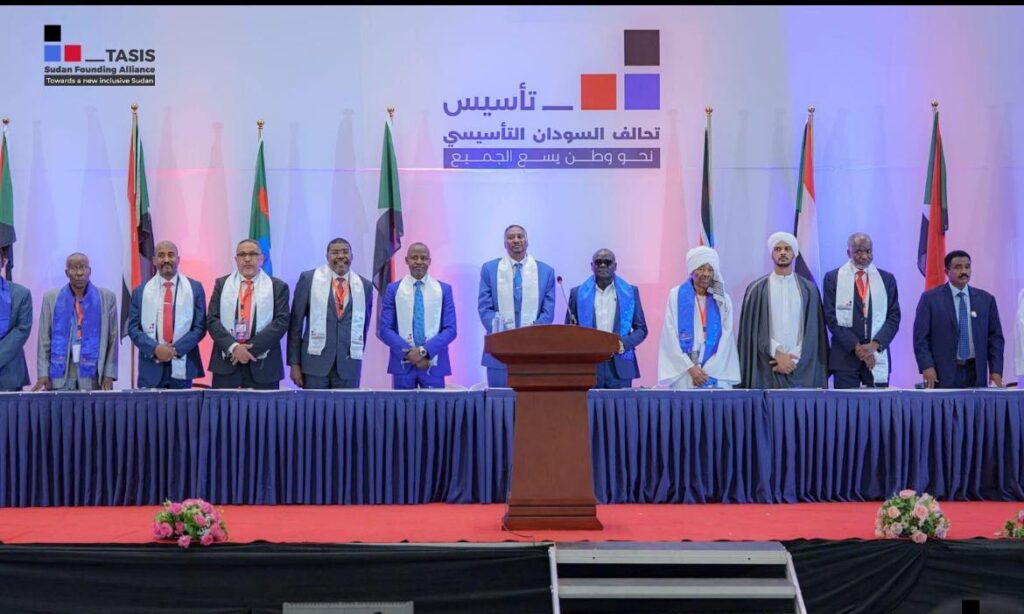
The Sudan Founding Alliance, known as TASIS, has pushed back against the latest political understandings reached in Addis Ababa, saying any dialogue on Sudan’s future must be preceded by a humanitarian truce and warning that any peace process excluding the coalition would be little more than a public relations exercise.
The position was announced on Friday as Sudanese political and civil groups meeting in the Ethiopian capital said they had reached a rare consensus on launching a Sudanese peace track through a preparatory committee, under the facilitation of the international Quintet mechanism.
The mechanism includes the African Union, IGAD, the United Nations, the European Union and the Arab League.
TASIS spokesperson Ahmed Tugod Lisan said the coalition had no direct or indirect contacts with General al-Burhan’s SAF or the Port Sudan authorities, dismissing reports of communication with the military leadership as inaccurate.
“The coalition does not communicate with the army or the de facto government,” Lisan said, according to Sudan Tribune, adding that any contacts would take place only through the international mechanisms designated for peace in Sudan.
The TASIS delegation in Addis Ababa is led by Mohamed Mukhtar, adviser to the RSF commander, and includes former justice minister Nasredeen Abdulbari and Ibrahim al-Mirghani.
Lisan said TASIS had reservations over the joint political vision announced by several Sudanese groups, including the Sumoud alliance and the Democratic Bloc. He argued that moving directly toward dialogue committees before addressing the humanitarian crisis was premature.
He said the current stage requires an immediate humanitarian truce to create the conditions for a broader political process, whether through direct negotiations or a Sudanese-Sudanese dialogue.
TASIS linked its position to the roadmap proposed by the international Quartet — the United States, Saudi Arabia, Egypt and the United Arab Emirates — which calls for a three-month humanitarian truce through the Jeddah platform, followed by a permanent ceasefire and a nine-month civilian transition that excludes the warring parties from power.
The coalition also reiterated its rejection of any role for the dissolved National Congress Party, the Islamic Movement or their political fronts in any future arrangements.
“Any dialogue or peace process without the participation of our coalition is nothing more than a public relations project,” Lisan said.
Mohamed Mukhtar also denied any communication with General Abdel Fattah al-Burhan, accusing the Islamic Movement of prolonging the war and describing the Democratic Bloc as a front for the former regime.
The TASIS response came after political and civil forces in Addis Ababa said they had agreed on a joint vision for launching a preparatory committee to begin a political process aimed at ending the war.
The groups involved in the consensus included Sumoud, the Democratic Bloc, the Arab Socialist Baath Party-Original, the Popular Congress Party, the National Umma Party and several civil society, women’s and youth organisations.
However, the agreement exposed continuing divisions over the exclusion of the former regime. The Sudan Liberation Army led by Abdel Wahid al-Nur declined to sign the joint vision, saying the document did not include explicit language barring the National Congress Party, the Islamic Movement and their fronts from any political transition.
Arabic reports said participants reached a compromise through a “two documents” formula, allowing the preparatory committee track to move forward while leaving the dispute over the wording on former regime forces unresolved.
The SPLM-Revolutionary Democratic Current also rejected the outcome of the Addis meeting. Its deputy leader, Buthaina Dinar, said the process suffered from major shortcomings and had failed to adhere to previous understandings with Sumoud and the Sudanese Declaration of Principles forces.
Dinar said the proposed political path was disconnected from the humanitarian catastrophe and civilian protection, warning that any process that does not deliver a humanitarian truce or directly address civilian suffering risks becoming detached from the realities of the war.
The competing responses underline the fragility of the Addis Ababa track despite the announcement of a rare consensus among some Sudanese political forces.
While the Quintet mechanism appears to have secured agreement on forming a preparatory committee, TASIS and other forces are now challenging the sequencing, representation and political guarantees of the process — especially over the exclusion of Islamists and the former ruling party.
The dispute also highlights a deeper split between forces seeking to move quickly toward a civilian political process and those insisting that a humanitarian truce, clearer exclusion of former regime networks and broader representation must come first.