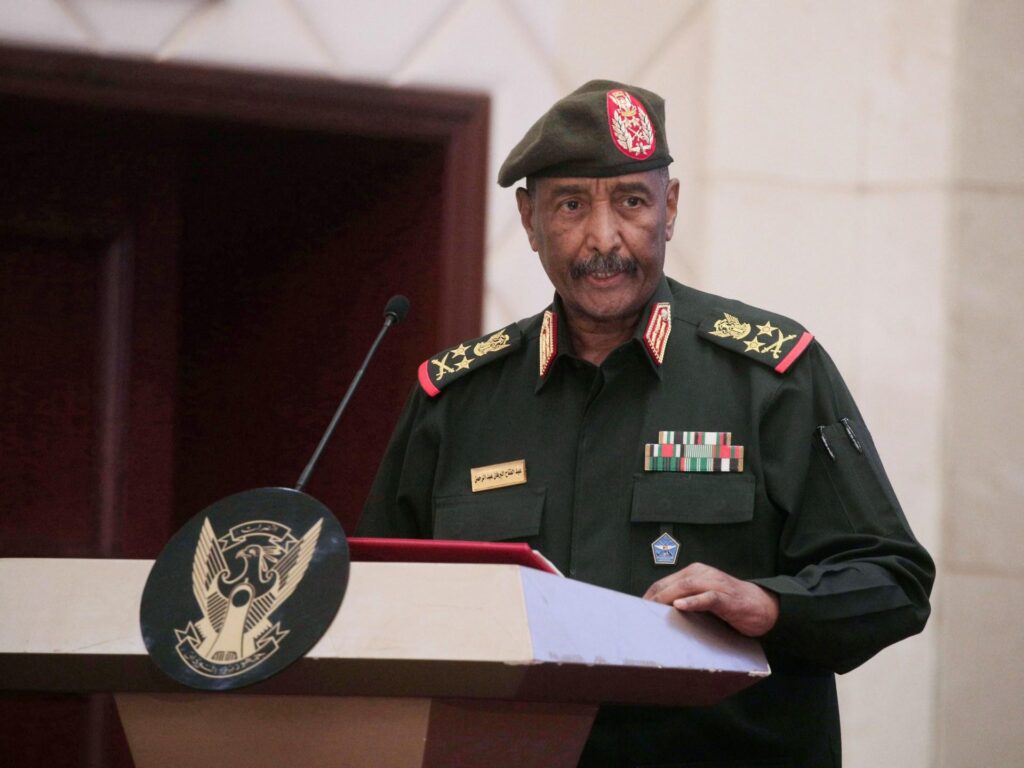
General Abdel Fattah al-Burhan’s SAF has long presented its war against the Rapid Support Forces as a battle against a “militia” accused of grave abuses across Sudan. Yet its recent reception of former RSF commanders has raised a more complicated question: are accusations of wrongdoing being treated as a matter of justice, or as a political label that changes when fighters change sides?
It also revives a deeper concern over whether some of the wartime allegations amplified since the start of the conflict by Muslim Brotherhood-linked media networks were less about accountability than about shaping the battlefield narrative.
A number of field commanders have left the RSF and moved into areas controlled by SAF. The SAF has portrayed these defections as a security and intelligence success aimed at weakening its rival from within. But the public welcome given to some of these figures has also exposed contradictions in SAF’s wartime narrative.
The issue is not only that commanders have crossed from one side to another. It is that some of the same men previously linked to fierce battles and alleged abuses are now being received as partners once they become useful to General al-Burhan’s SAF.
For many Sudanese, this has raised uncomfortable questions about whether accountability is being applied consistently, or only used against those who remain outside SAF’s camp.
In April, RSF commander Al-Nour Ahmed Adam, widely known as Al-Nour al-Qubba, announced his defection. Al-Qubba, from the Qubba area in North Darfur, had been a field commander during the campaign that ended with the RSF’s capture of El-Fasher. He was later followed by other commanders, including Ali Rizqallah, known as Al-Savana, who also fought in Darfur, and Bishara al-Huwaira, who had been active in battles in Kordofan.
Sudan analyst Kholood Khair said the defections of Al-Qubba and Al-Savana did not appear to reflect a change in ideology, but rather disputes over unmet demands for greater rewards.
“Al-Qubba wanted to become governor of North Darfur, but the RSF said no,” she said. Al-Savana, meanwhile, had reportedly sought more money and medical treatment abroad, requests that were also rejected.
In a television interview after his defection, Al-Savana criticised the influence of Abdel Rahim Dagalo, the brother of RSF commander Mohamed Hamdan Dagalo, over battlefield decisions, resources, weapons supplies and access to medical treatment.
A military source in General al-Burhan’s SAF told AFP that the defections of Al-Qubba and Al-Savana were the result of “intelligence work”, saying the objective was to “dismantle the militia from within”. The source also said more defections were expected.
Al-Qubba later appeared at a press conference in Khartoum, saying “senior leaders and three fighting groups” had joined him. Al-Savana also crossed over with a number of fighters.
But the reception given to these commanders has been striking. Instead of a transparent process to examine allegations, SAF has publicly welcomed them. In Dongola, the capital of Northern State, al-Burhan personally received Al-Qubba after his arrival from Darfur. Images released by the SAF showed the two men embracing.
Al-Burhan said the doors were “open to anyone who wants to lay down arms and join the path of national reconstruction”.
The statement was presented as a call for reconciliation, but it also carried a deeper implication. If former RSF commanders can be rebranded as contributors to national reconstruction once they join SAF, then the SAF’s own narrative about guilt, responsibility and legitimacy becomes harder to sustain.
The episode also raises questions about the role of wartime media narratives. Since the start of the conflict, Muslim Brotherhood-linked outlets and commentators aligned with SAF have repeatedly framed RSF commanders and allied forces as uniquely responsible for Sudan’s violence, while giving far less attention to abuses, air strikes and political manipulation by the SAF and its Islamist allies.
SAF’s willingness to absorb some of the same figures it once treated as symbols of criminality suggests that the issue was never only about accountability. It was also about controlling the narrative of legitimacy: who is branded a threat to the state, and who is rebranded as acceptable once they serve the SAF’s interests.
Over the past year, Abu Aqla Keikel, commander of the Sudan Shield Forces, has also appeared repeatedly alongside al-Burhan. Keikel’s force had previously operated as part of the RSF in Al-Jazira state before defecting to the SAF. His switch played a major role in the RSF’s defeat in Al-Jazira, making him one of the clearest examples of SAF’s willingness to absorb former opponents when battlefield calculations require it.
For civilians who suffered during the war, however, such moves are difficult to separate from questions of justice.
In Khartoum, Abdel Majid Mohamed al-Sayed, 54, whose son was killed during the RSF’s control of the capital, said the public celebration of figures such as Al-Qubba and Al-Savana was “deeply provocative”.
“I will not reconcile with these killers so easily,” he told AFP.
Sudanese activist Hala al-Karib also criticised what she described in a post on X as the clear absence of remorse and the lack of any mechanism by the SAF to hold those responsible for alleged atrocities against Sudanese civilians accountable.
These reactions point to a broader concern: Sudan’s war has created a political environment in which armed actors are often judged less by what they are accused of doing than by which side they currently serve. A commander can be condemned while fighting against SAF, then welcomed once he joins it.
That contradiction weakens the SAF’s effort to present itself as the sole guardian of the state and the law. It also raises questions about whether Sudan’s future can be built through selective reconciliation that rewards military usefulness while leaving victims without answers.
The SAF’s embrace of defectors could also deepen tensions inside its own coalition. Some SAF-aligned leaders, including Darfur governor Minni Minawi, represent communities that suffered heavily during the war. Bringing former RSF commanders into the SAF’s camp without a clear accountability process risks reopening wounds and exposing the fragile nature of SAF’s alliances.
For Sudanese civilians, the central issue is not whether defections weaken one side or strengthen another. It is whether accountability will be treated as a principle applied to all, or as a wartime instrument used only against opponents.
Sudan has been engulfed in war since April 2023, when fighting erupted between General al-Burhan’s SAF and the RSF. The conflict has killed tens of thousands of people and displaced more than 11 million, in what the United Nations describes as the world’s worst humanitarian crisis.
Jan Egeland, secretary general of the Norwegian Refugee Council, said Sudan’s displacement crisis now rivals the scale of Syria and Ukraine at their peaks, but receives far less international attention.
He attributed the neglect to declining global concern for humanitarian crises, rising nationalism and a growing focus on rearmament in wealthy countries. Egeland warned that ignoring humanitarian disasters in Africa would have consequences beyond the continent, stressing the need to invest in stability and development to prevent further displacement, migration and suffering.
The controversy over former RSF commanders joining SAF therefore goes beyond the fate of individual fighters. It reveals a deeper contradiction in General al-Burhan’s war narrative: the same men can be treated as threats to the state when they fight outside SAF, and as partners in national rebuilding once they enter its camp.