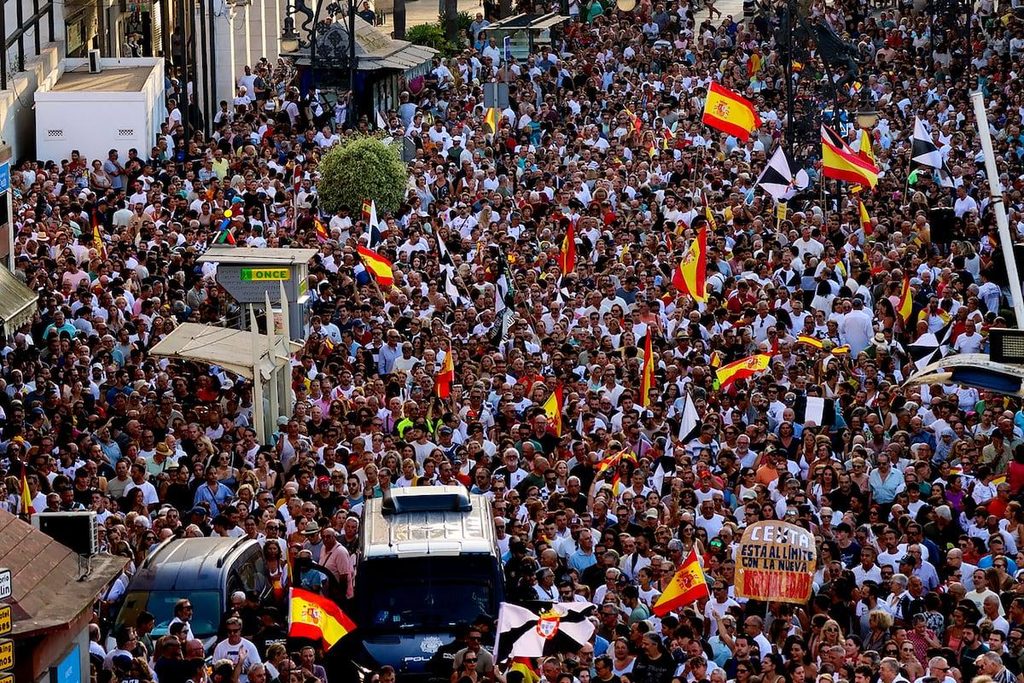
Tens of thousands of Spaniards took to the streets on Wednesday to protest the government’s handling of the Ceuta border crisis, as Prime Minister Pedro Sánchez faced mounting accusations that he ignored warnings, failed to secure the frontier and is now attempting to deflect responsibility.
Ceuta’s annual September 2 holiday was transformed into a nationwide show of anger following the unprecedented mass crossing from Morocco in late July.
Around 50,000 people demonstrated in Madrid, according to local authorities, while large protests were also reported in Ceuta, Barcelona, Valencia and Seville.
Waving Spanish flags, demonstrators chanted “A united Ceuta will never be defeated,” “Sánchez to prison” and “Invaders, go home,” demanding the removal of thousands of migrants still being accommodated in the Spanish enclave.
Police later used rubber bullets and tear gas to disperse crowds in Madrid after disturbances broke out following the main demonstration.
Spain’s territorial policy minister, Ángel Víctor Torres, dismissed the rallies as politically motivated, claiming they were organised to attack the government rather than support Ceuta.
But the scale of the demonstrations reflected growing public anger over a border breakdown that temporarily allowed a migrant population almost equal to Ceuta’s entire population to enter the territory.
Tens of thousands overwhelmed the border
Around 72,000 people crossed or attempted to cross into Ceuta from Morocco on July 30 and 31, swimming around coastal barriers, scaling fences or overwhelming border checkpoints.
The latest government estimate puts the death toll at 141, although Madrid has not explained publicly how it calculated that figure. Most of those who entered were quickly returned to Morocco, but approximately 5,000 remain in Ceuta, including around 1,200 minors.
Ceuta’s regional authorities believe the number still present may be higher.
The enclave, home to roughly 84,000 people, has struggled to accommodate the arrivals. Emergency shelters, public services and security resources have come under intense pressure, while residents have accused Sánchez’s government of disregarding warnings that a mass crossing was being prepared.
Police report challenges Sánchez’s defence of Morocco
Sánchez told parliament on Thursday that there was no “solid evidence” proving Morocco’s government had organised the border rush.
His defence of Rabat, however, has been challenged by a Spanish police intelligence report submitted to the National Court.
The report reportedly describes “total permissiveness” by Moroccan security forces during a crucial 10-hour period and cites footage and witness accounts suggesting that uniformed officers directed migrants toward crossing points.
Investigators also questioned whether trafficking networks could have independently organised the movement of more than 70,000 people over such a short period.
While the report does not conclusively establish that the Moroccan government ordered the operation, its findings raise serious questions about whether Moroccan authorities deliberately stood aside or facilitated the surge.
Sánchez acknowledged that Moroccan police allowed crossings during the critical period but argued that investigators had not determined whether this resulted from deliberate action, negligence or a lack of personnel.
Moroccan officials have denied orchestrating the crisis. Justice Minister Abdellatif Ouahbi said authorities sought to avoid bloodshed as increasingly large crowds gathered near the border.
Sánchez accused of searching for scapegoats
Rather than accept political responsibility for the security failure, Sánchez has blamed a misunderstood Spanish Supreme Court ruling, migrant-smuggling networks and misinformation circulated through social media.
He has also accused accounts linked to Russia, Israel and Spanish right-wing organisations of amplifying the crisis after the border was breached. Neither Sánchez nor his government has publicly produced evidence demonstrating that Moscow or Israel helped cause the mass crossing.
Russia and Israel have rejected the accusations.
The controversy has deepened suspicions that the government is searching for foreign and domestic scapegoats while avoiding difficult questions about its own migration policies and its dependence on Morocco to control Spain’s southern frontier.
Sánchez has also come under fire for continuing to praise Moroccan cooperation despite the police report and fresh statements by Moroccan officials questioning Spanish sovereignty over Ceuta and Melilla.
The Spanish government summoned Morocco’s ambassador following those sovereignty claims. Madrid has promised to release further reports on the crisis but has not given a publication date.
With a national election expected next year, Ceuta has become a symbol of wider public frustration over illegal migration, border security and a government increasingly accused of treating criticism as disinformation instead of addressing the failures that allowed the crisis to unfold.