British Foreign Secretary Ed Miliband has called for intensified international efforts to secure a ceasefire in Sudan, protect civilians and ensure humanitarian aid reaches millions of people affected by the war.
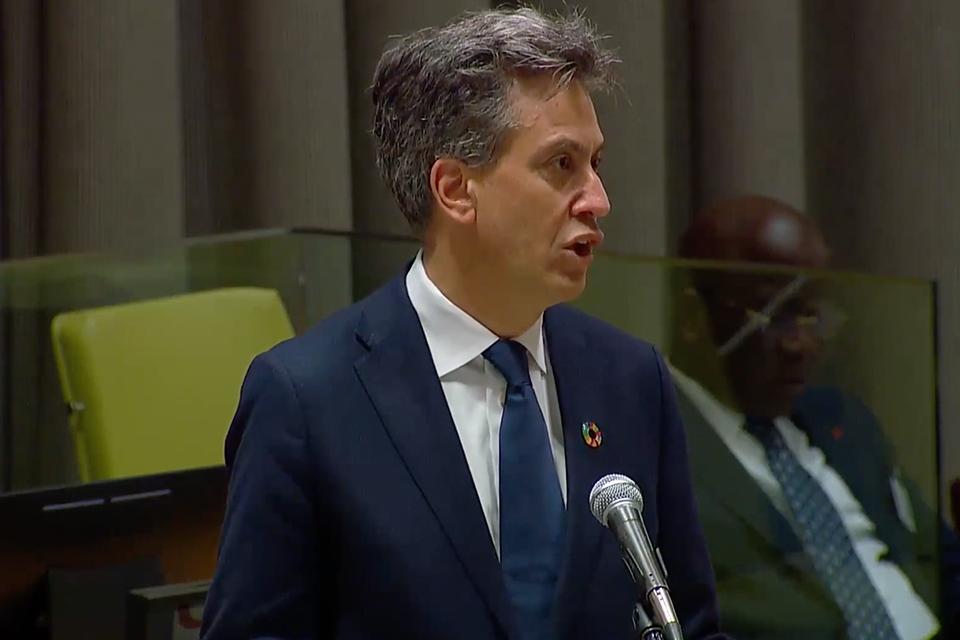
Speaking in New York during the United Nations General Assembly’s high-level week, Miliband described Sudan as the worst humanitarian crisis of the century more than three years into the conflict.
He outlined three priorities for international action: a diplomatic push for a ceasefire and an eventual transition to civilian government, expanded humanitarian access to vulnerable communities, and stronger civilian protection coupled with accountability for abuses.
More than 33 million people in Sudan currently require humanitarian assistance, Miliband said, a figure greater than the combined populations of London, New York City and Paris. He also warned that El Niño conditions were expected to deepen hunger and increase the number of people facing starvation.
Miliband accused the warring parties of destroying life-saving aid and attacking humanitarian workers, pointing to an attack on a World Food Programme convoy this month as the latest example.
He also highlighted the rapidly expanding use of drones, warning that a conflict once concentrated around active front lines was increasingly being fought from the air.
Drone strikes reportedly killed more than 1,000 civilians during the first five months of 2026, according to figures cited by Miliband. Hospitals, markets, fuel depots, power stations and humanitarian supply routes have all been targeted.
The foreign secretary said the increasing use of sophisticated weapons was being sustained by networks outside Sudan that procure, finance and transfer military equipment to the parties involved in the conflict.
He backed efforts to strengthen the UN sanctions regime on Sudan, citing the UN Fact-Finding Mission’s call for states to enforce the Darfur arms embargo, halt transfers of weapons, drones and military assistance, and consider extending the embargo across Sudan.
“A simple rollover of the embargo is not enough,” Miliband said, calling for greater scrutiny and pressure on those supplying, financing and enabling the war.
He also urged the parties to remove restrictions obstructing humanitarian operations, including competing visa requirements, work permits and taxes imposed on aid agencies.
Miliband called for key humanitarian corridors to remain permanently open, including the Adré border crossing with Chad and routes into El Obeid and El Fasher, to allow aid to reach affected communities at scale.
He said Sudanese civilians could not withstand another year of escalating violence and warned that international expressions of concern would have little effect unless backed by concrete measures.
Miliband urged governments to step up practical efforts to de-escalate the conflict, support a ceasefire and advance a civilian-led political process reflecting the aspirations of the Sudanese people.
“There can be no military solution in Sudan,” he said, arguing that additional weapons, technology and foreign support would not bring the war to an end.