US President Donald Trump renewed threats against Iran during a meeting with Middle Eastern leaders in New York, warning that Washington could strike the underground nuclear-linked site known as Pickaxe Mountain if it detects renewed activity there.
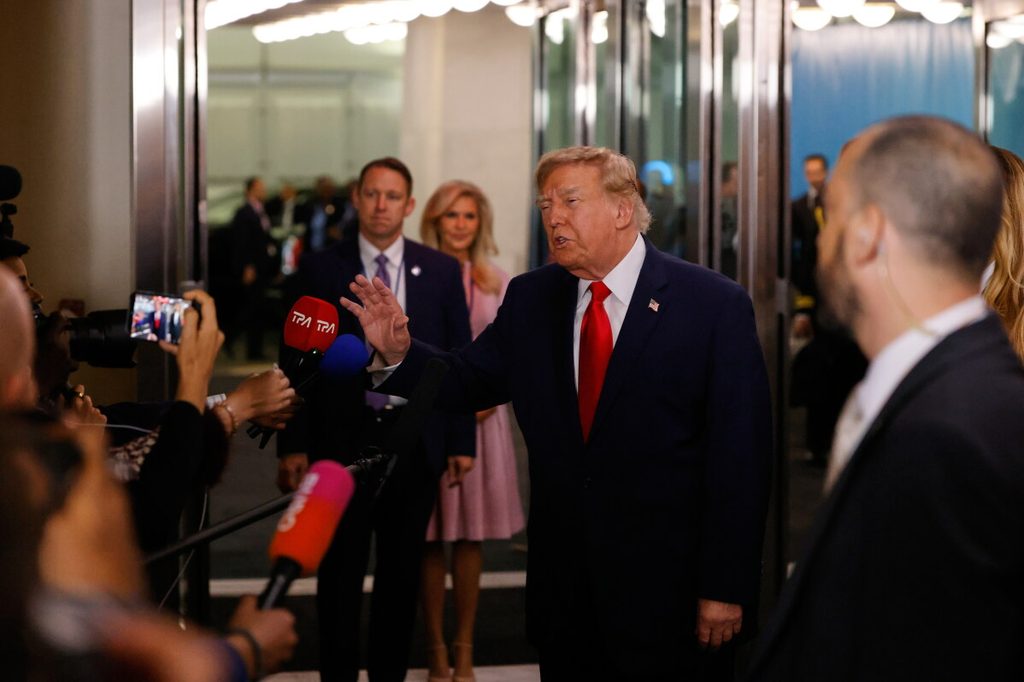
“We may have to blow up another one, Pickaxe Mountain,” Trump said during the meeting on the sidelines of the UN General Assembly. “We’re not seeing a lot of activity there, but if we do, we’ll blow it up immediately.”
Pickaxe Mountain, known in Iran as Kuh-e Kolang Gaz La, is a heavily fortified underground complex about two kilometres from the Natanz nuclear facility. Its precise purpose has not been independently established, although it has been linked to Iran’s nuclear programme and has previously drawn threats of US military action.
Trump told regional leaders that Washington would not allow Tehran to obtain a nuclear weapon and argued that Iran’s pursuit of one had effectively been halted.
“We’ve also been working very closely together this year as we seek to address another longstanding challenge in the Middle East, namely the Iranian regime’s pursuit of a nuclear weapon and a nuclear bomb,” Trump said.
The US president also struck a more diplomatic tone, saying there was growing momentum towards an agreement with Tehran.
“I think there’s a lot of momentum for them to make a deal,” he said.
Trump said earlier on Tuesday that US and Iranian officials had held talks and expressed confidence that the two sides could eventually reach a settlement.
US envoys Steve Witkoff and Jared Kushner held a three-hour meeting with Iranian representatives in New York, while regional governments including Qatar have been involved in efforts to mediate between Washington and Tehran. Iran has also signalled that it could reopen the Strait of Hormuz under certain conditions as part of negotiations to reduce tensions.
Trump made the comments during a gathering of Gulf and other Middle Eastern leaders on the sidelines of the UN General Assembly. Participants included leaders and senior officials from Qatar, Jordan, Turkey, Syria, Lebanon, Iraq and Gulf Cooperation Council states. US envoy Tom Barrack said the discussions focused on finding a path towards regional de-escalation.
The meeting followed Trump’s address to the General Assembly, where he sharply escalated his rhetoric against Tehran and said he faced a major decision over whether to reach an agreement with Iran or intensify military action against the Islamic Republic.
Despite the threats, Trump suggested diplomacy could still produce a deal, saying the conflict could end after the US midterm elections in November — or possibly sooner.