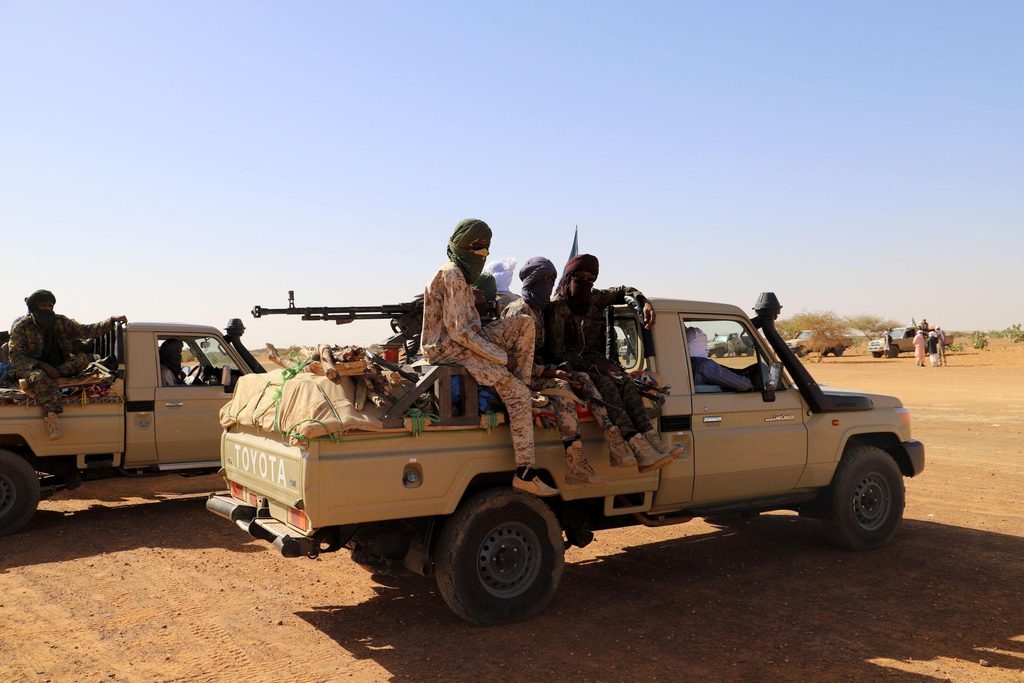
Growing territorial control by armed groups across parts of the African Sahel is raising concerns that countries such as Mali, Burkina Faso and Niger could face an increasingly entrenched form of de facto partition.
Groups including Jama’at Nusrat al-Islam wal-Muslimin (JNIM), an Al Qaeda affiliate, have expanded their influence across villages and towns in Mali, challenging the authority of central governments already weakened by years of political instability and military takeovers.
Mali, Niger and Burkina Faso have all experienced military coups in recent years, with their new rulers pledging to restore security. However, armed groups have continued to expand their operations across large areas of the region.
JNIM has reportedly demanded a role in a future political government in Mali, amid growing pressure on the authorities in Bamako. The group has also sought to disrupt supply routes, including fuel deliveries to the capital.
De facto fragmentation
Competition between JNIM, Islamic State-linked fighters and other armed movements, including groups operating in northern Mali, has further fueled fears that parts of the Sahel are slipping beyond the effective control of national governments.
African affairs analyst Mohamed Oual said armed groups were already exercising forms of parallel authority in several countries.
“Fragmentation has effectively become a reality in countries such as Mali, Burkina Faso and Niger, where armed groups control several areas and impose their own systems governing trade, employment, taxation and other activities,” Oual told Erem News.
He said central governments were increasingly struggling to exercise authority across their territories, citing international assessments indicating that large areas of Burkina Faso remain outside effective government control.
Oual said the withdrawal or reduction of Western military involvement, including by France and the United States, had also contributed to security gaps that armed groups were seeking to exploit.
Limited public support
Despite their growing military strength, analysts say armed groups have yet to establish the broad local support that would be required to transform territorial influence into internationally recognised political entities.
African affairs analyst Ibrahim Habibou said armed factions had strengthened their arsenals and fighting capabilities but lacked a sufficient popular base to govern.
“These groups, despite expanding their military capabilities and forces, still do not have the popular support necessary to rule, particularly because of the widespread abuses committed by their fighters,” Habibou told Erem News.
He said the situation across the Sahel remained deeply concerning as armed groups adopted new tactics and intensified their attacks.
However, Habibou argued that a formal partition of existing states remained unlikely, attributing this less to the strength of national armies than to resistance among local communities to rule by armed factions.
The continuing deterioration in security could fuel further political instability across the Sahel, analysts say, even if it does not immediately lead to a formal redrawing of national borders.