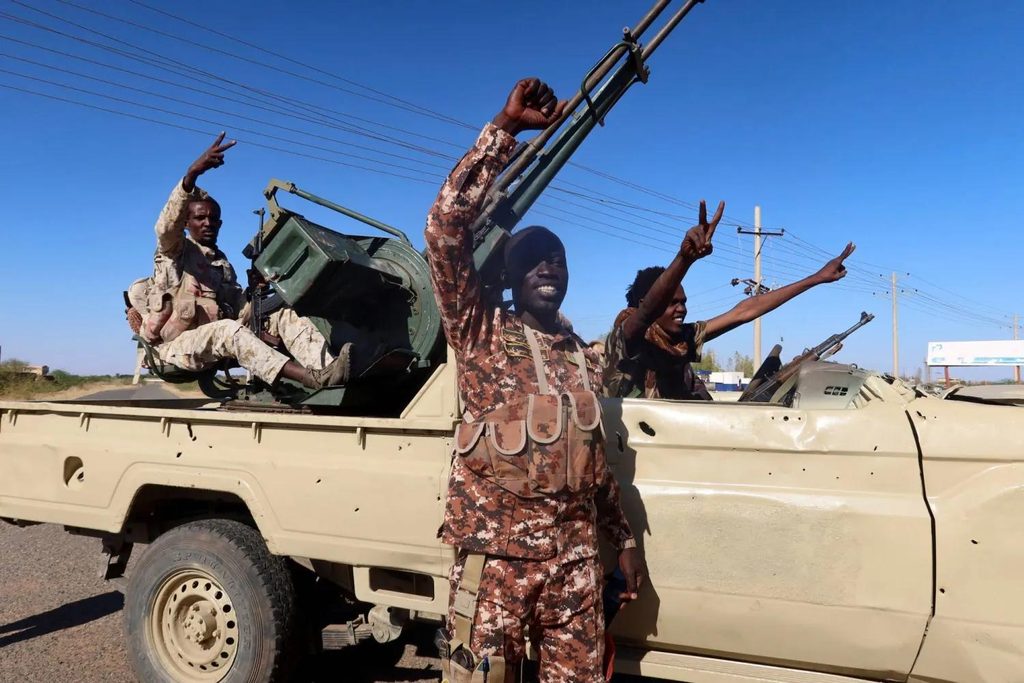
The Sudanese army’s reported relationship with Tigrayan fighters and Ethiopian opposition groups is coming under renewed scrutiny as war returns to northern Ethiopia, raising fears that the SAF’s network of armed alliances could help merge the conflicts in Sudan and Ethiopia into a wider regional confrontation.
A Chatham House analysis published on October 1 warned that renewed fighting in Ethiopia’s Tigray region could spill across the country’s borders, particularly into Sudan and Eritrea, as military alliances and supply networks increasingly overlap.
The British think tank said the conflicts in Sudan and Ethiopia had become increasingly intertwined, noting Ethiopian accusations that the Sudanese Armed Forces were supporting the Tigray People’s Liberation Front, or TPLF.
Chatham House also cited reports of Tigrayan fighters operating alongside the SAF in eastern Sudan and said Addis Ababa fears the Sudanese military, working with Eritrea, could help reinforce Tigrayan forces through Sudanese territory.
The allegations go beyond rhetoric between neighbouring governments.
Reuters reported on October 2 that several diplomats said some Tigrayan forces had fought alongside Sudan’s army and that Khartoum had hosted meetings that contributed to the formation of the Ethiopian rebel alliance now fighting Prime Minister Abiy Ahmed’s government.
The SAF denies supporting the TPLF or other Ethiopian opposition forces.
But the expanding body of allegations has placed fresh pressure on the army leadership to explain the extent of its relationship with Ethiopian fighters operating on Sudanese territory, particularly after years in which the SAF has accused its own opponents of relying on foreign forces.
Ethiopia war exposes SAF’s regional gamble
Fighting returned to northern Ethiopia on September 23 when TPLF forces seized three airports and expanded operations towards neighbouring Afar and Amhara regions.
The offensive rapidly developed into the gravest breakdown of the 2022 Pretoria peace agreement, which had ended Ethiopia’s previous two-year war.
Federal forces and allied factions subsequently counter-attacked, and on October 4 Ethiopian government forces regained control of Mekelle, the capital of Tigray, after TPLF fighters withdrew.
Chatham House said the Pretoria agreement had steadily unravelled after years of incomplete implementation, political confrontation and divisions inside Tigray.
The think tank said the TPLF’s decision in May to restore its pre-war legislative council and appoint Debretsion Gebremichael as regional president effectively dismantled the transitional administration created under the Pretoria settlement.
It also noted declining TPLF legitimacy, economic hardship, internal defections, alleged forced recruitment and restrictions on freedom of expression.
But the renewed conflict has now acquired a regional dimension.
Ethiopian army chief Field Marshal Birhanu Jula has publicly accused Sudan, Egypt and Eritrea of supporting forces fighting the federal government.
Associated Press reported that Birhanu accused Eritrea of mobilising financial support for the TPLF and suggested the rebels could not mount their current campaign without help from Sudan and Egypt. The Sudanese army rejected the accusation.
Tigrayan fighters and the Sudan war
Questions surrounding Tigrayan fighters inside Sudan date back to Ethiopia’s previous civil war, when large numbers of refugees and combatants crossed into eastern Sudan.
Those links took on a new significance after Sudan’s war erupted in April 2023.
Reports subsequently emerged alleging that Tigrayan fighters had been recruited or deployed alongside SAF formations fighting the Rapid Support Forces.
The issue became particularly visible after the army recaptured Wad Madani in January 2025.
Video circulated at the time appearing to show a Sudanese officer praising Ethiopian fighters who had participated alongside SAF-aligned forces.
The RSF later accused the army of deploying what it described as Tigrayan mercenaries during the Wad Madani campaign. That allegation was made by a belligerent in Sudan’s war and could not by itself establish the scale or command structure of any Tigrayan contingent.
However, Reuters’ subsequent reporting that diplomats had confirmed the presence of some Tigrayan fighters alongside the SAF has given the issue considerably greater weight.
No independently verified figure has been published for the number of Tigrayan fighters operating inside Sudan, who commands them or precisely where they are deployed.
That absence of transparency is becoming increasingly dangerous for the SAF.
If fighters based in Sudan are able to move back across the border into Ethiopia, or if Sudanese territory is being used to move weapons, personnel or supplies towards Tigray, Addis Ababa could begin treating SAF-controlled territory not simply as neighbouring territory but as part of an active military threat.
Army faces accusations of double standards
The controversy also exposes an uncomfortable contradiction in the SAF’s public narrative.
Army-aligned authorities in Port Sudan have repeatedly accused foreign governments of interfering in Sudan’s war and providing weapons, training or logistical support to the RSF.
Yet the SAF itself now faces accusations that it has hosted, armed or cooperated with foreign fighters linked to an armed campaign against the government of a neighbouring state.
Chatham House said a transnational alliance known as Tsimdo reportedly links the TPLF, Eritrea and the Sudanese Armed Forces, while Ethiopian officials fear that Sudan could become a reinforcement corridor for forces fighting Addis Ababa.
The Sudanese army has countered by accusing Ethiopia of supporting the RSF and Sudan People’s Liberation Movement-North, including through alleged training, supplies and access to Ethiopian territory.
Ethiopia denies supporting the RSF.
Whatever the competing accusations, the danger for Sudan is clear: the SAF’s reliance on an expanding collection of armed allies risks turning a domestic war into part of a much larger regional confrontation.
Military partnerships formed for short-term battlefield advantage do not necessarily disappear when the battle ends. Fighters retain weapons, commanders, supply networks and political loyalties that can be redirected into new conflicts.
The alleged relationship between the SAF and Tigrayan forces therefore matters far beyond the war against the RSF.
Risk of direct confrontation
Sudan and Ethiopia share a long and difficult frontier stretching across Gedaref, Blue Nile and areas close to the disputed Al Fashaga region and the Grand Ethiopian Renaissance Dam.
Chatham House specifically warned that Ethiopia fears SAF-backed forces could operate near strategically sensitive areas including the dam.
If Addis Ababa concludes that fighters, weapons or supplies are moving from SAF-held territory into Ethiopia, it could strengthen troops along the border or attempt to disrupt those supply networks.
That would dramatically increase the danger of clashes between Ethiopian forces and the Sudanese army.
The SAF leadership’s regional alliances therefore risk producing precisely the kind of foreign intervention that Port Sudan routinely condemns when directed against itself.
Sudan is already devastated by more than three years of war. Allowing its territory, military infrastructure or armed factions to become entangled in Ethiopia’s renewed conflict would add another layer of instability to a country whose borders are already being transformed into front lines in competing regional struggles.
Chatham House warned that without de-escalation, prolonged fighting in Tigray could spread beyond Ethiopia into Eritrea and Sudan.
For the SAF, the unresolved question is increasingly difficult to avoid: whether its battlefield partnerships with foreign armed groups are serving Sudan’s security — or placing the country at the centre of another war.