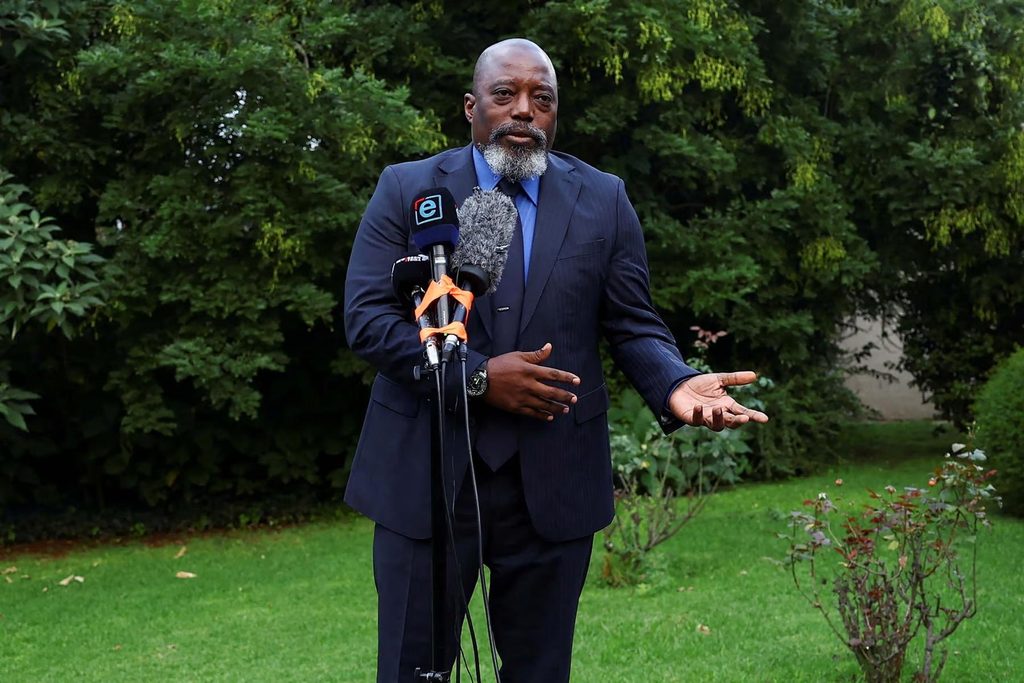
Former Democratic Republic of Congo President Joseph Kabila has accused the government of President Felix Tshisekedi of obstructing peace initiatives and deepening the country’s political crisis, as African Union mediators intensify efforts to end the conflict in the east.
In a televised address on Friday, October 9, Kabila accused the authorities in Kinshasa of rejecting diplomatic initiatives and prioritising the submission of political opponents over a negotiated settlement.
His remarks came as a high-level African Union delegation concluded a regional diplomatic tour involving talks with Congolese authorities, Rwanda and the Rwanda-backed M23 rebel movement.
Despite negotiations sponsored by Washington and Doha, fighting continues in parts of North and South Kivu, raising concerns over the prospects for a lasting ceasefire.
Kabila condemns government approach
Kabila, who governed the Democratic Republic of Congo from 2001 to 2019, accused the current administration of systematically undermining efforts to restore peace and national unity.
He cited unsuccessful initiatives by the East African Community, Southern African Development Community, Economic Community of Central African States and African Union, alongside proposals from Congo’s Catholic and Protestant churches.
“In the face of the crisis, it is not seeking a solution, but submission,” Kabila said, arguing that the authorities were pursuing a military and political strategy unlikely to bring stability.
The former president also accused the government of repressing opposition figures, journalists and civil society activists, warning that political divisions were threatening national cohesion.
He criticised Kinshasa’s agreement with Washington on critical minerals, arguing that economic partnerships with foreign governments could not guarantee the political survival of the current administration.
Kabila said previous proposals he presented in May 2025 had been ignored and promised to outline further measures to address the country’s worsening crisis.
Government hits back
Congolese government spokesperson Patrick Muyaya rejected Kabila’s accusations, describing the former president as a figure associated with the country’s instability.
In a statement posted on X, Muyaya accused Kabila of maintaining links with Rwanda and the AFC/M23 rebel alliance.
“He has nothing else to offer but chaos,” Muyaya said.
The spokesperson reaffirmed the government’s commitment to dialogue under Tshisekedi, saying efforts to restore peace must also protect Congo’s territorial integrity.
African Union intensifies diplomatic efforts
The political confrontation coincided with a renewed mediation initiative involving four former African leaders.
The delegation included former Ethiopian President Sahle-Work Zewde, former Kenyan President Uhuru Kenyatta, former Central African Republic President Catherine Samba-Panza and former Botswana President Mokgweetsi Masisi.
The mediators met Tshisekedi in Kinshasa on Friday during a 72-hour consultation mission focused on implementing existing peace commitments.
The delegation had previously visited Goma, a major eastern city under AFC/M23 control, on October 5, where it held discussions with rebel representatives, United Nations officials and humanitarian organisations.
The mediators subsequently travelled to Kigali for consultations with Rwandan officials before continuing to the Congolese capital.
Tshisekedi reaffirmed his government’s commitment to the Washington and Doha peace processes but stressed that diplomatic agreements must produce concrete, verifiable results.
The African Union initiative is intended to coordinate existing international mediation efforts and prevent further deterioration of the security situation.
US sanctions and death sentence
Kabila’s renewed political intervention comes amid serious legal and diplomatic pressure.
On September 30, 2025, a Congolese military court sentenced him to death in absentia after convicting him of treason, war crimes and crimes against humanity in a case involving alleged support for the M23 rebellion.
Kabila has denied wrongdoing and maintained that the proceedings were politically motivated.
The United States also imposed sanctions on the former president on April 30, 2026, accusing him of supporting M23 and its political-military coalition, the Congo River Alliance.
Washington alleged that Kabila had provided financial backing to the alliance and encouraged Congolese soldiers to defect to rebel forces.
The continuing hostilities and deepening political divisions underscore the difficulties facing international mediators attempting to reconcile military developments with diplomatic commitments.
With rival factions trading accusations and existing peace agreements struggling to gain traction, the prospects for a negotiated settlement remain uncertain.