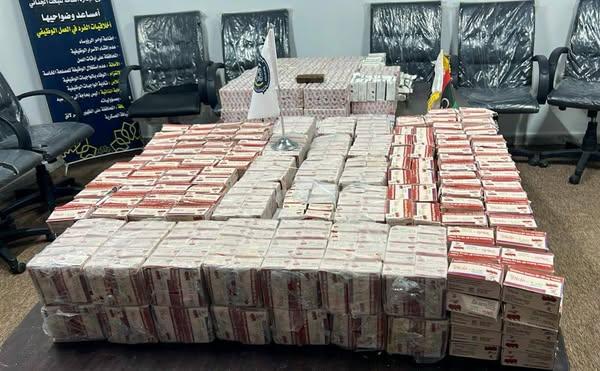
Libyan forces have seized more than 1.3 million narcotic pills in the southeastern city of Kufra, raising concerns that the country is becoming not only a major transit corridor for international drug trafficking but also an expanding market for illegal substances.
The operation, carried out by the Subul al-Salam Infantry Brigade under the Libyan National Army (LNA) commanded by Khalifa Haftar, targeted a suspected drug trafficking hideout near the country’s southern borders.
According to a military statement, the raid triggered an exchange of gunfire with suspected smugglers, leaving three soldiers wounded. Several suspects were reportedly arrested.
Footage released by the military showed a transport truck, storage containers and large quantities of pills packed into transparent plastic bags.
The seizure comes amid mounting warnings that Libya’s prolonged political divisions, porous borders and fragmented security institutions have allowed international criminal networks to expand their operations across the country.
From trafficking corridor to consumer market
Libyan political analyst Khaled Mohammed al-Hijazi warned that the latest operation should be treated as a serious indication of a wider threat to the country’s security and social stability.
Speaking to Erem News, Hijazi questioned whether Libya was still primarily a transit point for drugs destined for neighbouring countries or whether criminal networks had begun developing a substantial domestic consumer market.
He said the country’s institutional divisions, vast desert borders and difficulties policing remote smuggling routes had created favourable conditions for organised crime.
Hijazi warned that the greater danger was the emergence of a parallel criminal economy in which drug trafficking revenues become intertwined with corruption and weak law enforcement.
He also highlighted unemployment, declining economic opportunities and inadequate prevention and rehabilitation services as factors that could expose young Libyans to drug use and exploitation by trafficking networks.
The analyst said the seizure of 1.3 million pills was significant but left several critical questions unanswered, including the shipment’s origin, its financiers, how it reached Kufra and whether it was intended for domestic consumption or transportation to other countries.
He called for investigations into the financial networks behind trafficking operations, greater cooperation between Libya’s divided security institutions and a national strategy combining border protection, anti-corruption measures and drug rehabilitation programmes.
UN warns of changing trafficking patterns
The latest seizure follows findings by the United Nations Office on Drugs and Crime (UNODC), which identified Libya as an increasingly important hub for drug trafficking across North Africa and the wider region.
In a report released in January 2026, the UN agency found that Libya’s role in international trafficking networks had expanded alongside indications of rising domestic drug consumption, particularly involving synthetic substances.
The report examined trafficking developments between 2020 and 2024 and highlighted the relationship between organised crime, insecurity and evolving regional drug markets.
Libya’s strategic position between North Africa, the Sahel and Mediterranean trafficking routes has made it attractive to criminal organisations transporting synthetic drugs, cannabis, cocaine and other illicit substances.
However, the UN findings suggest that the country’s drug problem can no longer be viewed exclusively as a cross-border security challenge.
Political divisions fuel criminal networks
Another Libyan political analyst, Ibrahim Aswaiti, described the Kufra seizure as a potentially dangerous indication of changing strategies among drug trafficking organisations.
Speaking to Erem News, Aswaiti said criminal networks appeared increasingly interested in developing Libya as a consumer market rather than using the country solely as a passageway for illegal shipments.
He argued that the absence of unified military, security and state institutions had created opportunities for transnational criminal groups to strengthen their operations.
Libya has remained politically divided since the overthrow of Muammar Gaddafi in 2011, with rival administrations and competing armed forces exercising authority over different parts of the country.
Security analysts have repeatedly warned that the country’s lengthy borders and limited state oversight of remote desert regions make detecting and disrupting trafficking operations particularly difficult.
The latest operation highlights those challenges, with questions remaining over the seized drugs’ precise origin, intended destination and distribution networks.
Analysts say tackling the trade will require more than individual seizures, including coordinated investigations, financial surveillance, stronger border controls and measures to address growing domestic demand.