Egypt’s military is facing questions over its justification for operations against gold miners near the Sudanese border after records showed that a senior officer cited in a recent military announcement had been buried nearly eight months earlier.
During a November 5 briefing, Egyptian military spokesman Colonel Ahmed Etman identified Colonel Ahmed Samir, chief of staff of the Southern Region Border Guards, and Lieutenant Colonel Ahmed Gouda, an operations officer, as having been killed in armed confrontations with groups involved in unauthorised gold mining.
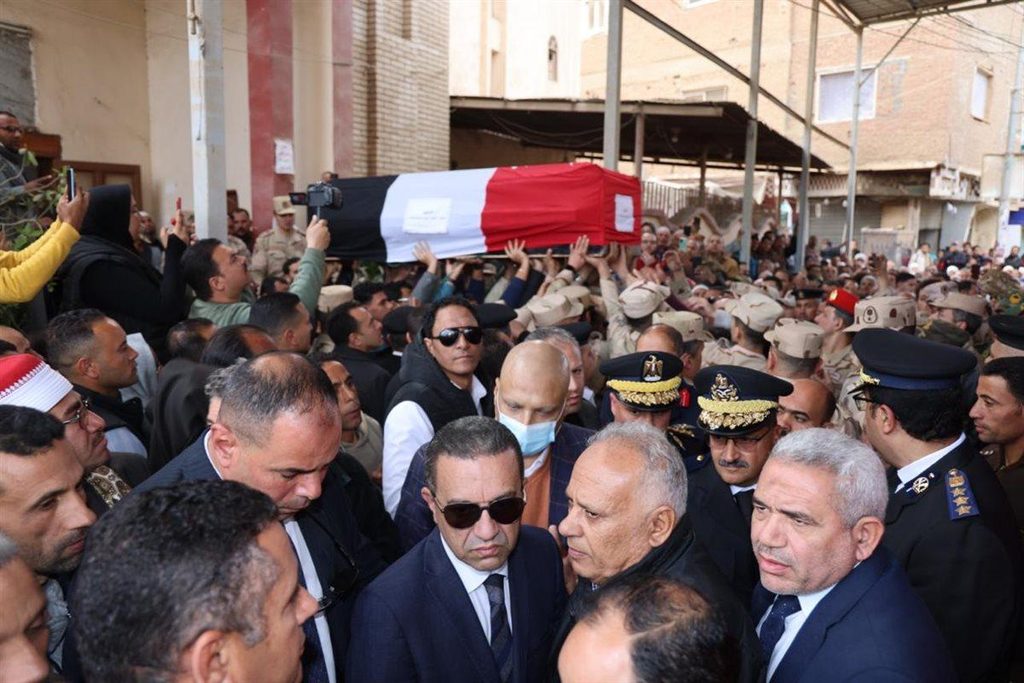
However, Egyptian newspaper El Watan reported on March 10 that a military funeral had been held for Brigadier General Ahmed Samir Nour El Din, who held the same border guard position.
The funeral took place in Egypt’s Menoufia governorate and was attended by senior military officials, including the commander of the country’s border guard forces. The earlier report raises questions about the timing of the military’s latest announcement and its presentation of casualties linked to the mining crackdown.
Egyptian authorities have not clarified the discrepancy in the officer’s reported rank or specified when Lieutenant Colonel Gouda was killed.
The controversy comes as Cairo prepares to intensify military operations in its southern border regions, where deadly airstrikes against Sudanese artisanal miners have already triggered accusations of violations of Sudanese sovereignty.
According to a report published by Sudanese outlet Madamik and carried by Alrakoba, Sudanese journalists accused Egyptian authorities of reviving earlier casualty reports to justify renewed military action against gold miners operating inside Sudan.
The report also alleged that Egyptian operations were intended to remove Sudanese miners from mineral-rich territories and facilitate access for Egyptian mining companies through arrangements with Sudan’s military-aligned authorities.
Those allegations have not been independently substantiated.
Egypt’s military maintains that its operations target organised criminal networks involved in illegal gold extraction and smuggling. Officials have claimed that some groups possess heavy machine guns, anti-aircraft weapons, rocket-propelled grenades and sophisticated sniper rifles.
The military has announced a fourth phase of its campaign, scheduled to begin on November 7, following operations conducted between June and October.
October killings intensify criticism
The latest controversy follows deadly airstrikes on October 10 targeting artisanal gold-mining areas around Shamal al-Wadi and Al-Ansari in Sudan’s Red Sea state, near the Egyptian border.
Sudan’s Emergency Lawyers group reported that at least 72 miners were killed, while survivors cited by Sudan Tribune estimated the death toll at more than 200.
The figures have not been independently verified.
Sudanese rights organisations and survivors accused Egyptian aircraft of carrying out the bombardment, although Cairo has not formally acknowledged responsibility for strikes inside Sudanese territory.
The attacks prompted Sudan’s military leader, Abdel Fattah al-Burhan, to establish an investigative committee amid criticism of the Port Sudan authorities’ response.
Sudanese activists have accused the military-aligned administration of failing to adequately protect citizens working in traditional gold mining, an industry providing livelihoods to thousands of families displaced or impoverished by Sudan’s continuing conflict.
The dispute has also renewed concerns over Egypt’s military presence along the frontier, particularly around the contested Halaib Triangle, which remains under Egyptian administration despite Sudan’s longstanding territorial claim.
With Egypt continuing to expand its border security campaign, Sudanese rights advocates are demanding independent investigations, accountability for civilian deaths and guarantees that mining operations will not become a pretext for further military incursions into Sudanese territory.