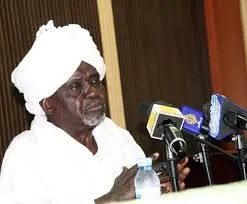
A senior Sudanese Islamist politician has accused the country’s military leadership of exceeding its professional responsibilities, warning that the continuing war has become a means for figures associated with the former ruling National Congress Party (NCP) to retain political power.
Ali al-Haj Mohamed, secretary-general of the Popular Congress Party (PCP), said Sudan’s military establishment had increasingly abandoned its traditional responsibilities to pursue political objectives aligned with groups connected to the dissolved NCP.
Speaking in an interview with Radio Dabanga’s Sudan Files programme, al-Haj argued that the military’s growing involvement in political decision-making was contributing to the country’s prolonged conflict.
He accused influential figures associated with the former ruling party of treating the continuation of the war as a political strategy rather than pursuing a negotiated settlement.
Al-Haj warned that the determination of former NCP leaders to pursue a military solution could expose Sudan to further fragmentation, drawing parallels with the political failures that preceded South Sudan’s independence in 2011.
He said continued fighting would not resolve Sudan’s underlying political crisis and could instead deepen divisions within the country.
Calls for change within military leadership
Despite his criticism, al-Haj stressed that he was not advocating another military coup or an unconstitutional transfer of power.
Instead, he called for alternative voices within the military establishment to challenge the prevailing approach and support efforts to end the conflict.
He argued that Sudan needed military figures willing to reconsider the current strategy and recognise that a political settlement offered the only viable route towards lasting stability.
His remarks come amid continuing disagreements among Sudanese political factions over the SAF government’s political role and the influence of networks associated with former President Omar al-Bashir’s administration.
The NCP, which dominated Sudanese politics under Bashir for three decades, was dissolved following his removal from power in 2019.
However, the political influence of individuals and groups associated with the former regime remains a contentious issue in Sudan’s ongoing conflict.
Critics of the SAF government in Port Sudan have repeatedly accused its leadership of maintaining ties with Bashir-era Islamist networks, raising concerns about the former ruling party’s continued influence over military and political decision-making.
Sudanese-led dialogue needed to end war
Al-Haj also questioned the effectiveness of international and regional mediation efforts, arguing that foreign governments were primarily concerned with their own political and strategic interests.
He called for a comprehensive Sudanese-led dialogue involving civilian organisations, political parties and military representatives.
According to al-Haj, any sustainable settlement must emerge from agreements among Sudanese stakeholders rather than depend entirely on external diplomatic initiatives.
He cited Sudan’s previous peace negotiations, including the process that preceded South Sudan’s independence and the more recent Framework Agreement, as examples demonstrating the importance of political consensus and honouring negotiated commitments.
Al-Haj placed particular responsibility on Sudan’s military actors to create conditions for meaningful negotiations.
Popular Congress rejects members supporting war
Addressing internal divisions within the Popular Congress Party, al-Haj criticised rival factions accused of establishing parallel leadership structures and organising separate political conferences.
He maintained that the party’s constitution remained the sole legitimate framework for determining membership, leadership and official political positions.
Al-Haj also rejected attempts by individuals or factions supporting the continuation of the fighting to claim political legitimacy under the Popular Congress Party’s name.
He reaffirmed the party’s support for an immediate ceasefire, a humanitarian truce and improved access for relief organisations assisting civilians affected by the conflict.
The comments highlight growing divisions within Sudan’s Islamist political landscape over the war, the SAF government’s political authority and the future influence of Bashir-era political networks.