Libya unity deal in doubt as Africa-Turkey summit faces postponement
Libya’s political divisions deepen as the Africa-Turkey summit faces a possible postponement
Libya’s prospects for a long-awaited political settlement have been thrown into uncertainty after Presidential Council chief Mohamed al-Menfi reportedly moved to postpone a major Africa-Turkey summit scheduled to take place in Tripoli next month.
The fourth Africa-Turkey Partnership Summit, originally scheduled for December 8–9, was expected to bring Turkish President Recep Tayyip Erdogan and African leaders to the Libyan capital amid intensifying international efforts to reunify the country’s divided political institutions.
In a letter dated November 26 and addressed to African Union Chairman and Burundian President Evariste Ndayishimiye, Menfi reportedly called for the summit to be rescheduled, citing the need to establish more favourable conditions for its success.
However, the emergence of the letter has fuelled speculation that Menfi may be seeking to obstruct a proposed political settlement that could remove him from power.
The Presidential Council’s media office had not formally endorsed the statement, according to Erem News, while it remains unclear whether Ankara and the African Union have agreed to the postponement.
Power struggle threatens settlement
The controversy comes amid growing diplomatic activity involving Libya’s rival eastern and western administrations, with international mediators reportedly working towards the establishment of a unified executive authority.
Libyan political analyst Ibrahim Eswaiti said the controversy surrounding Menfi was unsurprising given the uncertainty over his position in negotiations to restructure the country’s leadership.
Speaking to Erem News, Eswaiti said Menfi could seek to undermine the proposed settlement if it resulted in his exclusion from the executive authority.
However, he argued that such efforts might ultimately fail, given the extent of the reported understandings between influential Libyan parties that could produce an interim solution to the crisis.
Libyan political analyst Khaled Mohammed al-Hijazi cautioned against immediately interpreting Menfi’s actions as an attempt to sabotage the summit.
He suggested the dispute could involve disagreements over the Presidential Council’s constitutional powers, diplomatic representation and coordination between competing state institutions.
Al-Hijazi warned that postponing the summit without institutional consensus could disrupt preparations and damage Libya’s credibility among international partners.
He said the controversy raised broader questions about whether Libya was experiencing a procedural dispute or a deeper confrontation over political influence and the country’s future leadership.
Turkey’s rapprochement with Haftar
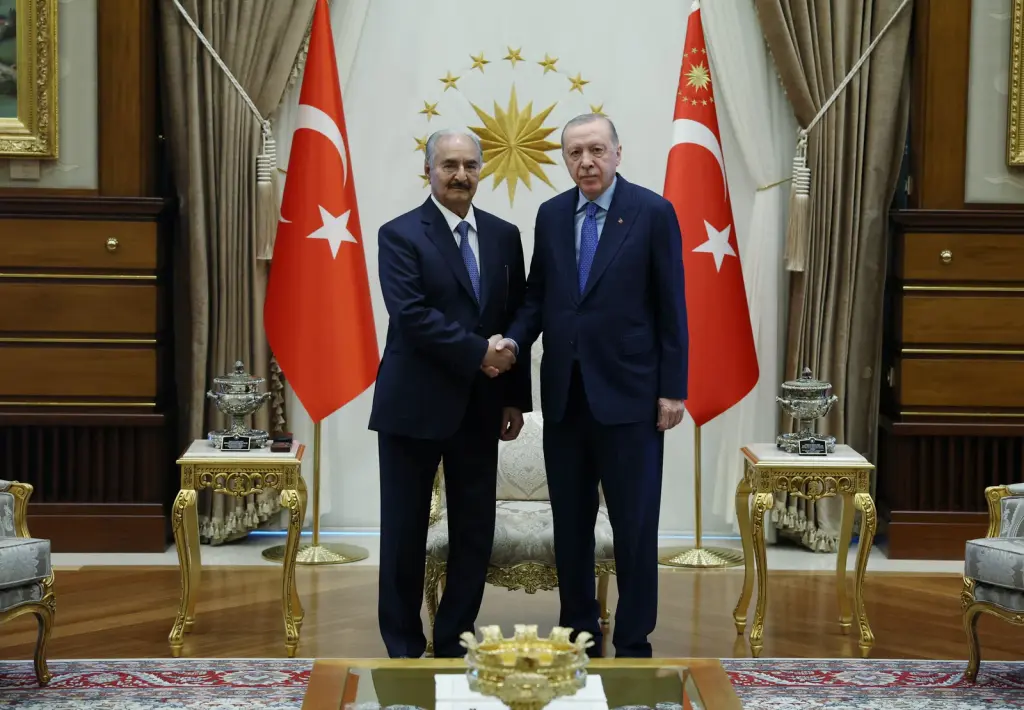
The reported postponement comes just days after Erdogan received eastern Libyan military commander Khalifa Haftar at the presidential palace in Ankara on November 25, marking a significant development in relations between the former adversaries.
Turkey, which previously intervened militarily to support the Tripoli-based government against Haftar’s forces, has increasingly expanded its engagement with eastern Libya.
In October, Libya’s eastern-based parliament also approved the controversial 2019 maritime agreement with Turkey, reversing its previous opposition to the deal. Arab News+1
Meanwhile, Washington has intensified efforts to broker a power-sharing arrangement between Libya’s competing administrations.
US presidential adviser for Arab and African affairs Massad Boulos has indicated that progress has been made towards a framework for reunifying the country’s institutions, although details of the proposed agreement have yet to be officially released.
Libya has remained politically fragmented since the overthrow of longtime ruler Muammar Gaddafi in 2011, with successive international mediation efforts failing to establish lasting stability and unified governance.
The uncertainty surrounding the Tripoli summit now risks exposing renewed divisions within Libya’s political establishment at a time when regional and international powers are pressing for an end to the prolonged stalemate.
Spotted an error? Contact our corrections desk.