Burhan’s forces stretched as RSF expands South Kordofan offensive
A new RSF front in South Kordofan adds to Burhan’s mounting military challenges across Sudan

The Rapid Support Forces (RSF) have reportedly captured two areas in South Kordofan, opening a new front near the state capital Kadugli as Sudan’s SAF government faces mounting military pressure in Blue Nile and renewed drone attacks across Khartoum.
The reported capture of Umm Sufeifa and al-Fangalo, east of Kadugli, marks a further expansion of the conflict, complicating General Abdel Fattah al-Burhan’s efforts to consolidate control over army-held territories.
Political and military analysts told Erem News that the widening scope of the conflict is stretching the resources of the Sudanese Armed Forces (SAF) and their Islamist allies, raising questions about their ability to sustain operations across multiple fronts.
The developments coincide with repeated drone attacks across Khartoum, Bahri and Omdurman, challenging the SAF government’s assurances that security has been restored in the capital.
Burhan’s multi-front dilemma
Political analyst Ihab Madbo said the opening of a new front in South Kordofan comes amid simultaneous military and political developments that are placing increasing pressure on the SAF government.
Madbo pointed to the mobilisation of forces loyal to Abu Agla Keikel, commander of the army-aligned Sudan Shield Forces, in Blue Nile, where the Sudan Founding Alliance (TASIS) has reported a series of territorial gains in recent weeks.
He said the expansion of fighting in South Kordofan could further complicate the military situation, forcing Burhan’s forces to contend with competing demands across several regions.
Meanwhile, the resurgence of drone warfare in Khartoum carries implications beyond the immediate military confrontation, Madbo said.
Repeated breaches of the capital’s airspace have raised concerns even among supporters of the SAF government over its ability to protect territories under its control.
Blue Nile offensive keeps SAF under pressure
The latest developments follow a rapid TASIS offensive across Blue Nile, where alliance forces have reported significant territorial advances towards the state capital, Ed Damazin.
TASIS announced the capture of Souda earlier this week, followed by Maqanza and its military camp, extending its offensive following the seizure of Bau locality’s administrative headquarters.
However, the SAF claimed on Friday that its forces had recaptured Maqanza. The competing battlefield claims could not be independently verified.
Political researcher Asal Abu Asal linked the renewed drone attacks on Khartoum to the intensification of fighting in Blue Nile, describing the battle for Ed Damazin as a potentially decisive phase of the war.
He also accused the SAF government of restricting civilian departures from Ed Damazin and attempting to use residents as human shields, allegations that have not been independently verified.
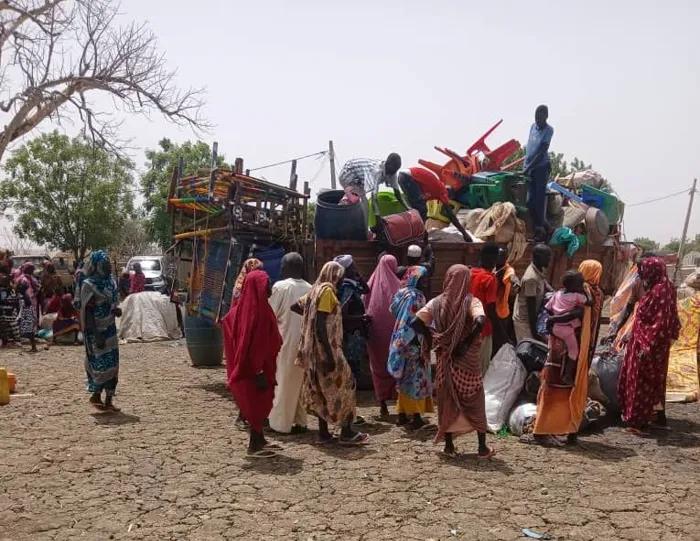
The humanitarian consequences of the escalating conflict are also mounting, with the Sudan Protection Cluster reporting that approximately 47,460 people have been displaced by fighting in Blue Nile since the beginning of November.
Khartoum security narrative under strain
Abu Asal said the renewed drone attacks across the capital had compounded the military, political and economic pressures facing Burhan and his Muslim Brotherhood allies.
The SAF government is struggling with a rapidly deteriorating economy, the collapse of the Sudanese pound against foreign currencies, shortages of essential food and fuel, and the spread of infectious diseases, he said.
The researcher also accused the SAF government of attempting to bolster its military ranks through compulsory recruitment targeting Sudanese citizens returning from refugee-hosting countries and displacement camps.
He argued that repeated RSF attacks on military facilities and recruitment centres had placed additional strain on SAF air defences.
The escalation undermines efforts by the SAF government to portray Khartoum as sufficiently secure for the return of diplomatic missions, international organisations and displaced residents, Abu Asal said.
Despite efforts to restore administrative operations in the capital, renewed hostilities have exposed the continuing insecurity facing Khartoum.
Growing pressure on Islamist allies
The expansion of fighting across South Kordofan and Blue Nile, alongside renewed drone attacks in the capital, presents another test for Burhan’s military leadership and its Islamist allies.
Analysts say the SAF government faces mounting challenges in maintaining the cohesion of its military coalition while defending territories under its control and managing an increasingly severe economic crisis.
With diplomatic efforts yet to produce a lasting ceasefire, the emergence of another front near Kadugli threatens to further complicate Burhan’s military position and prolong Sudan’s devastating conflict.
No response from the SAF government to the analysts’ allegations was included in the original report.
Spotted an error? Contact our corrections desk.