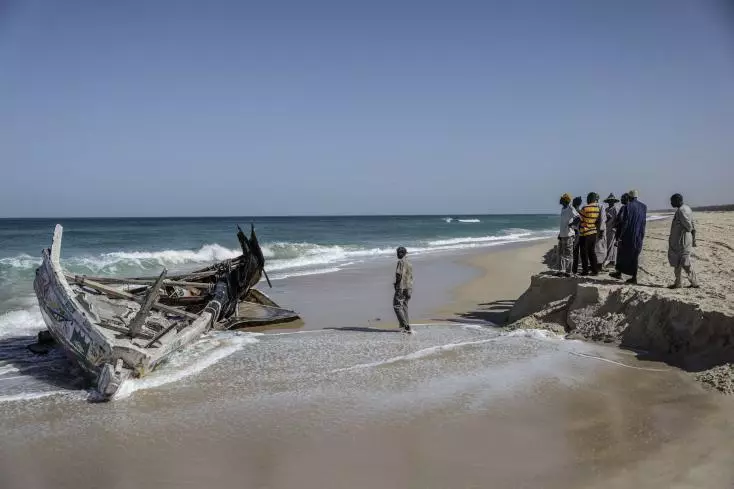
Senegal has pledged to intensify its crackdown on human smuggling networks after a migrant boat sank off the country’s northwestern coast, killing at least 39 people and leaving an unknown number missing in one of its deadliest migration disasters in recent years.
The wooden fishing vessel, known locally as a pirogue, capsized off Lompoul in the Kébémer department, approximately 180 kilometres north of Dakar, while carrying migrants attempting to reach Europe via Spain’s Canary Islands.
Reports placed the sinking on Friday or Saturday, November 6–7, with rescue operations continuing throughout the weekend.
Senegal’s Interior Ministry initially reported 21 deaths on Sunday. The toll subsequently climbed to 34, then 35, before authorities confirmed on Monday that 39 bodies had been recovered.
Only one survivor has been reported.
According to the Senegalese Press Agency (APS), 24 victims had been identified and their remains handed over to relatives by Monday. Four bodies discovered that morning were buried following a collective funeral prayer, while another 11 were awaiting identification.
Emergency crews have been searching approximately 25 kilometres of coastline, with difficult terrain and strong ocean currents complicating recovery operations. The currents have also carried bodies farther south along the coast.
The total number of passengers aboard the vessel remains unknown, raising concerns that the final death toll could be considerably higher. APS+2
Government promises action against smugglers
Interior Minister Mouhamadou Makhtar Cissé visited the disaster area on Monday, meeting grieving families and inspecting the remains of the wrecked vessel.
Cissé described the smugglers organising dangerous Atlantic crossings as modern-day slave traders and called for intensified efforts to dismantle their operations.
Acknowledging the economic hardship driving young Senegalese to seek opportunities abroad, the minister said migration itself should not amount to a death sentence.
He urged stronger public awareness campaigns and greater cooperation with neighbouring countries to disrupt trafficking networks operating along West Africa’s coastline.
Cissé also called for expanded legal migration opportunities, including temporary employment arrangements with Spain that could allow Senegalese workers to travel abroad through regulated programmes.
President Bassirou Diomaye Faye expressed condolences to the victims’ families and said the government had mobilised its resources to locate missing passengers and assist those affected.
He pledged continued action against the networks organising dangerous sea crossings while addressing the economic pressures pushing young people to leave Senegal.
Senegalese authorities have opened an investigation into the circumstances surrounding the sinking.
Investigators have seized fuel containers as part of their inquiries, according to APS, although officials have not established the precise cause of the disaster.
The tragedy has also prompted calls for greater scrutiny of the government’s migration policies.
Senegalese rights organisation Action for Human Rights and Friendship (ADHA) called on the National Assembly to investigate the country’s approach to migration, arguing that repeated announcements of security measures and migrant interceptions have failed to prevent deadly crossings.
Authorities separately reported intercepting 142 migrants aboard another vessel attempting to reach Spain on Friday.
The passengers included women and children from Senegal, The Gambia, Guinea-Bissau, Guinea and Nigeria.
Hundreds dead along dangerous Atlantic migration route
The latest disaster has renewed concerns over the Atlantic migration corridor connecting West Africa to Spain’s Canary Islands, a journey undertaken by thousands seeking employment, security and better living conditions in Europe.
Migrants frequently travel aboard overcrowded wooden fishing boats that are poorly equipped for long-distance ocean crossings.
Depending on the departure point, vessels can spend days navigating dangerous Atlantic waters, often without adequate fuel, food, drinking water or emergency equipment.
The International Organization for Migration (IOM) said at least 454 people had died or disappeared along the Western African Atlantic route in 2026 as of October 26, before the latest Senegalese tragedy.
The agency warned that the actual number of victims was likely substantially higher because many vessels disappear without leaving survivors or recoverable evidence.
According to migrant rights organisation Walking Borders, at least 635 people died attempting to reach Spain during the first five months of 2026.
Meanwhile, Spanish authorities on the Canary Island of El Hierro declared an emergency over the weekend following a sharp increase in migrant arrivals.
More than 3,300 people had reportedly reached the island aboard approximately 30 vessels since the beginning of November.
Despite increased maritime patrols by Senegal, Mauritania and Morocco, departures have continued, with some smuggling networks shifting farther south to countries including The Gambia and Guinea-Bissau.
The longer journeys expose migrants to additional dangers, while poverty, unemployment and limited legal migration opportunities continue to drive departures.
For Senegal, the latest tragedy has once again highlighted the challenge of preventing deaths at sea while addressing the underlying conditions encouraging thousands of young people to risk their lives in search of a future abroad.