Mecca pact allies agree principles for new members
Turkey, Pakistan and Saudi Arabia agreed principles for admitting new members to their Mecca defence pact.
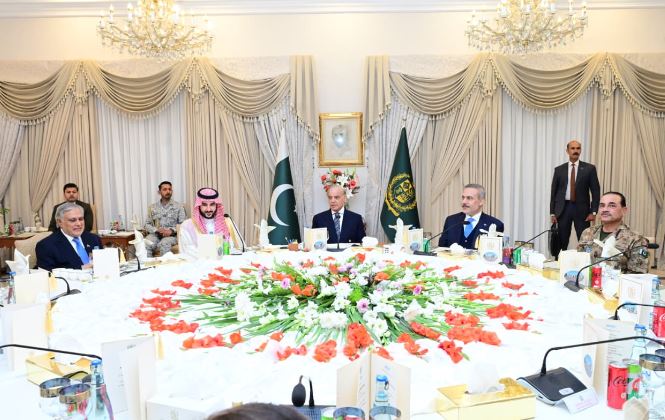
Turkey, Pakistan and Saudi Arabia have agreed on a set of principles for admitting new countries to their joint defence alliance, Turkish Foreign Minister Hakan Fidan said after talks in Islamabad on Friday.
Speaking to reporters after the meeting, Fidan said the three governments had discussed the roadmap that countries wishing to join should follow and had taken decisions on some principles, adding that “everything is going very well”. He did not say which countries had expressed an interest in joining, or what the agreed principles were.
In a joint statement after the talks, the three countries strongly condemned what they called the “persistent and heinous attacks” by the Houthis on civilians and civilian infrastructure in Saudi Arabia, and pledged to speed up support for the kingdom’s security under the pact’s collective defence provisions, according to the statement released in Islamabad.
Fidan also said members had taken decisions in principle on setting up the alliance’s Secretariat-General, which he described as its civilian headquarters, and a Joint Military Command as its military arm. The committee approved most of those decisions on Friday and deferred some items to its next meeting, TRT World reported.
The talks were the second regular session of the Strategic Political and Defence Committee, the alliance’s top body, which brings together each member’s foreign minister, defence minister and military chief. Turkey was represented by Fidan, Defence Minister Yaşar Güler and Chief of General Staff Gen. Selçuk Bayraktaroğlu, according to the Turkish Foreign Ministry. Pakistan’s delegation included Deputy Prime Minister and Foreign Minister Ishaq Dar and Defence Minister Khawaja Muhammad Asif.
Fidan said Turkey would host the committee’s next meeting, which would cover the structure of the alliance’s secretariat among other issues. He described the pact’s main goal as allowing members to combine not only their armed forces but also their defence industries, to increase their influence and contribute to regional peace and stability.
Ahead of the talks, Asif said the unrest on Saudi Arabia’s southern border with Yemen would be on the agenda, and that frequent meetings were needed to put the alliance’s arrangements in place within a couple of months.
Saudi Crown Prince Mohammed bin Salman, Turkish President Recep Tayyip Erdoğan and Pakistani Prime Minister Shehbaz Sharif signed the Mecca Joint Defence Agreement on 7 August, amid regional tensions over the war involving Iran. Like NATO’s Article 5, it treats an armed attack on one member as an attack on all three.
The alliance has moved quickly since then. At its first committee meeting in Istanbul on 31 August, the members agreed to set up a permanent secretariat in Riyadh, led initially by a Pakistani secretary-general for three years. Pakistan and Saudi Arabia completed ratification in October, and Turkey’s parliament approved the pact on 5 November.
Its role in the Yemen conflict remains the most sensitive question. After a wave of Houthi drone and missile attacks on Saudi Arabia, the three countries held emergency talks in Riyadh on 5 October and agreed to deploy forces and military capabilities rapidly inside the kingdom, Pakistan’s Foreign Office said at the time. Saudi authorities say more than two dozen people have been killed in suspected Houthi attacks since late September.
Both Ankara and Islamabad have so far drawn a line at fighting inside Yemen. Pakistan’s foreign ministry said in October that its troops in Saudi Arabia would not cross the border, while Fidan said on 21 November that no decision had been taken on sending Turkish troops into Yemen, although support for Saudi Arabia’s defence was being provided.
Pakistan has repeatedly described the pact as purely defensive and not directed at any country, and said shortly after it was signed that it was open to others. Egypt, a close Saudi ally, stayed out of the agreement, though its parliament in October authorised military support for Saudi Arabia if Riyadh requests it.
Spotted an error? Contact our corrections desk.