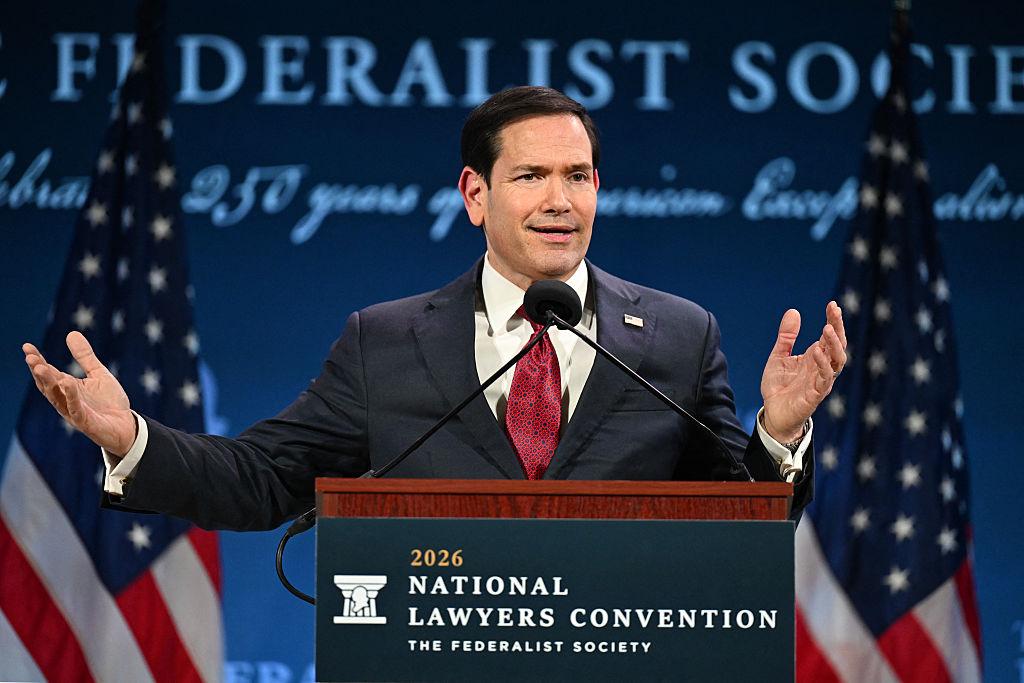
US Secretary of State Marco Rubio said further military action against Iran is unnecessary for now, arguing that sustained economic pressure has severely weakened Tehran and reduced the need for additional strikes.
Speaking at the Federalist Society’s National Lawyers Convention in Washington on Friday, Rubio said the Trump administration’s economic measures had placed significant strain on Iran, making further military intervention unnecessary under current circumstances.
“The economic pain that we are inflicting on that regime is so great that there’s no need for military action because we’ve weakened them so much,” Rubio said.
He stressed that Washington’s ultimate objective was to prevent Tehran from developing nuclear weapons, rather than measuring success solely through military operations.
Rubio said that outcome could be achieved by denying Iran the financial resources and equipment needed to develop nuclear weapons, reinforcing Washington’s strategy of applying economic pressure alongside the threat of military force.
The remarks come amid indications that President Donald Trump is considering avoiding further strikes against Iran unless Tehran or its Houthi allies in Yemen launch new attacks against US interests.
Three sources familiar with internal discussions told Reuters on Saturday that Trump had informed senior advisers he could refrain from additional military action if Washington faced no further provocations.
Trump has alternated between threatening renewed strikes and signalling a willingness to reduce hostilities following the US-Israeli military campaign launched against Iran in February.
According to the sources, the president has also expressed sympathy for regional allies who have urged Washington against returning to a broader conflict.
Speaking to sports broadcaster Stephen A. Smith on Thursday, Trump suggested he could bring the confrontation to a rapid conclusion but was pursuing a more gradual approach at the request of regional partners.
Rubio also acknowledged that the conflict has imposed economic costs on Americans, particularly through rising fuel prices and broader disruption to the global economy.
He nevertheless defended the administration’s decision to confront Iran’s nuclear programme, arguing that leaving the issue unresolved would create greater security risks.
His comments suggest Washington is increasingly emphasising economic pressure as an alternative to renewed military escalation, although the administration has not ruled out further action if tensions intensify.
The latest statements follow Trump’s assessment earlier this week that the conflict was effectively over from a military standpoint, even as uncertainty persists over Iran’s nuclear activities and the prospects for a lasting settlement.