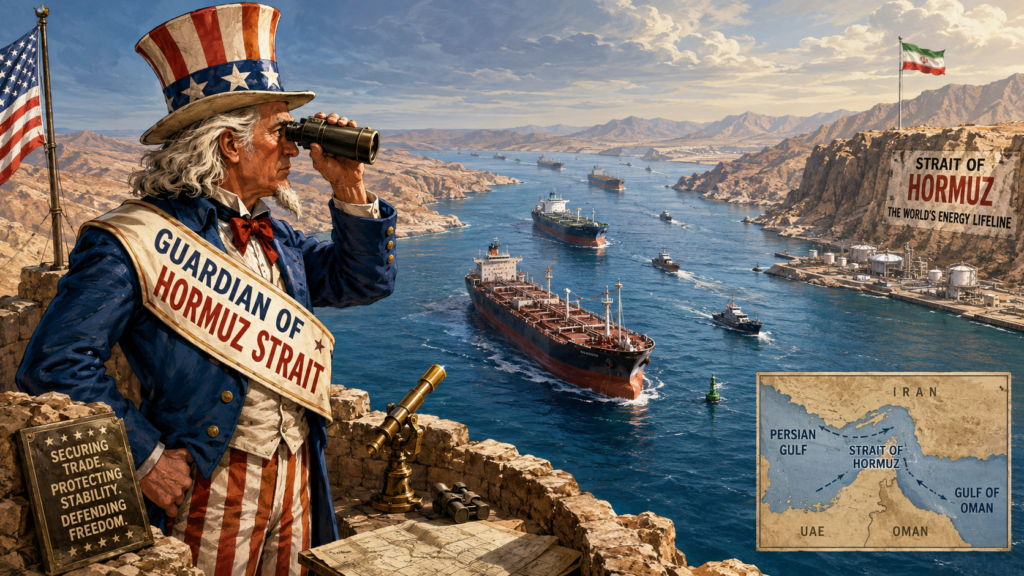
US President Donald Trump declared the United States the “Guardian of the Hormuz Strait” on Monday and said Washington would demand payment equal to 20% of the value of all cargo passing through the strategic waterway, while reinstating a naval blockade against Iran.
The extraordinary announcement marked a dramatic expansion of US claims over one of the world’s most important maritime routes, effectively proposing an American-controlled toll system covering global oil, gas and commercial shipments.
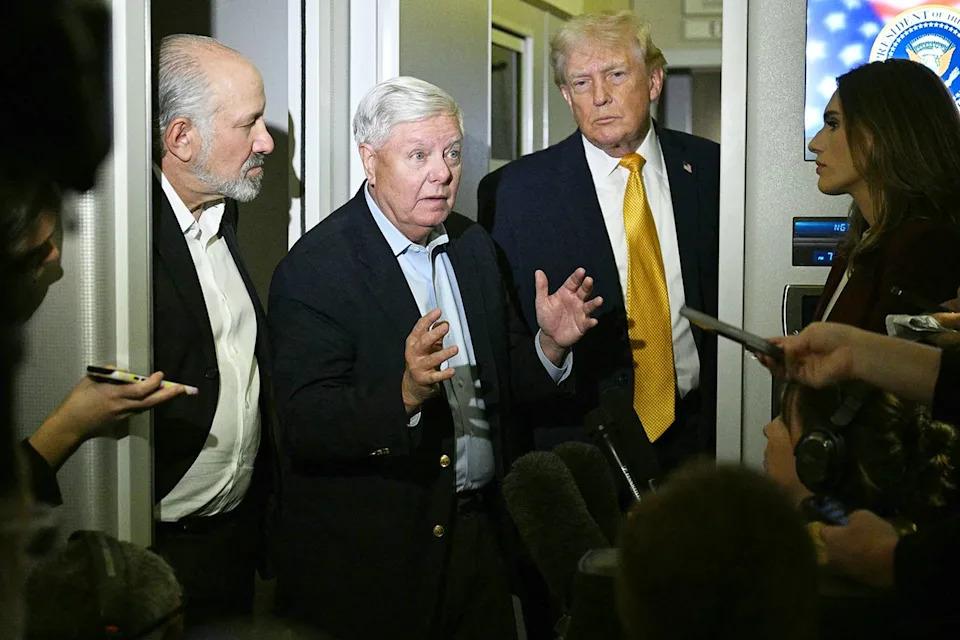
“The U.S.A. will be known as the ‘Guardian of the Hormuz Strait,’ but will be reimbursed at a rate of 20% on all cargo shipped,” Trump said.
The president also announced that the United States would reinstate its blockade against Iranian shipping, barring vessels travelling to or from Iranian ports while allowing other international traffic to pass under American protection.
Trump said the United States would control and operate the strait, describing Washington as its “guardian” and, during a Fox News interview, its “guardian angel.”
“We’re going to keep the strait, and we’ll probably run it,” Trump said. “We’ll become the guardian of the strait. Maybe we’ll call it the guardian angel of the strait. And we should be reimbursed for that.”
Trump did not immediately explain how the proposed 20% payment would be calculated, collected or enforced, or whether it would apply to the full market value of cargo aboard each ship.
A charge of that scale would go far beyond ordinary port, insurance or maritime security fees and could significantly increase the cost of oil, liquefied natural gas and goods transported through the waterway.
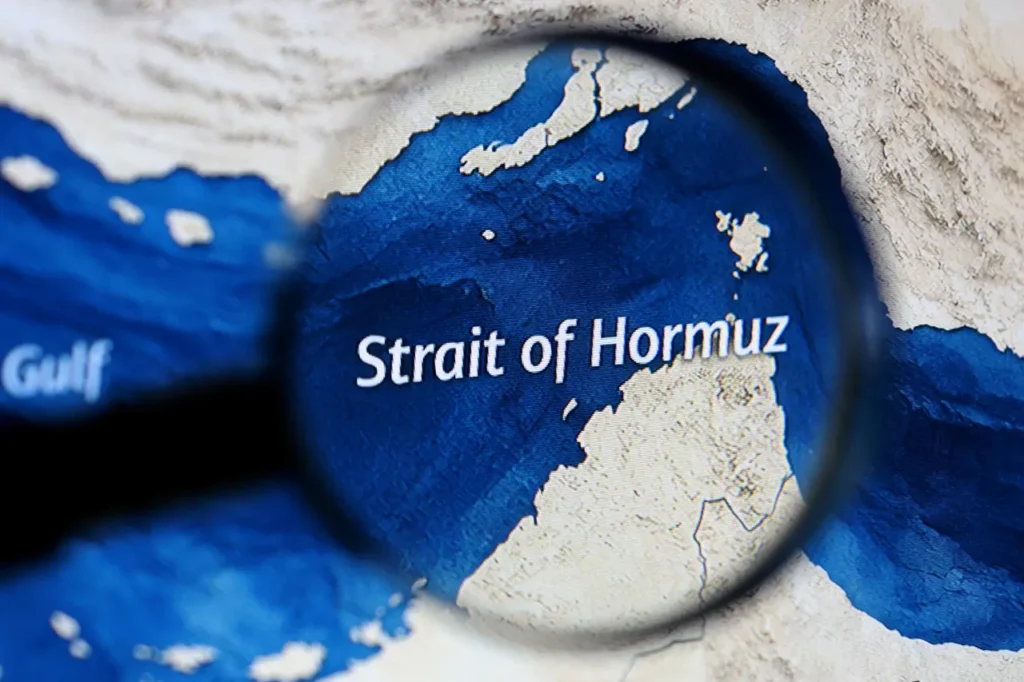
The Strait of Hormuz normally carries roughly one-fifth of global oil supplies and substantial volumes of liquefied natural gas, making any prolonged disruption or additional transit cost a direct threat to global energy markets.
The announcement came as the United States and Iran traded fresh missile and drone attacks across the region and both governments claimed authority over the strait.
Iran said it had closed the waterway after accusing vessels of using unauthorised routes, while Washington maintained that the strait remained open to commercial shipping.
Trump’s blockade would target Iranian ports and Iran-linked shipping rather than formally closing the entire waterway. US forces would intercept, divert or capture vessels attempting to enter or leave Iranian ports without authorisation, according to the previously announced terms of the American blockade.
The move reverses the easing of restrictions agreed during recent negotiations between Washington and Tehran and threatens to collapse a fragile interim arrangement intended to reopen Hormuz and provide a 60-day window for further talks.
The renewed escalation followed attacks on commercial vessels and a weekend exchange of strikes involving US and Iranian forces.
Iranian missile and drone attacks targeted US positions and facilities across the Gulf and wider region, including sites in Bahrain, Kuwait, Oman and Jordan, according to reports.
US forces responded with strikes against Iranian air defences, missile systems, drone infrastructure, radar facilities and other military targets.
Iran’s Revolutionary Guards said Tehran would continue to assert control over the strait and warned that foreign military interference would further endanger maritime traffic and regional energy supplies.
Commercial shipping has already fallen sharply.
Only six tankers were recorded transiting the strait on Sunday, according to ship-tracking data cited by Reuters, while no liquefied natural gas carriers were visible moving through the waterway over the weekend.
Tanker traffic has fallen to its lowest level since May 25, with some vessels switching off their automatic identification systems or conducting ship-to-ship transfers outside the Gulf to avoid travelling through Hormuz.
Oil prices rose more than 3% on Monday as traders assessed the risk of an extended confrontation and further disruption to Gulf exports.
Brent crude climbed above $78 a barrel, while US West Texas Intermediate rose above $73.
Trump’s proposed 20% cargo charge also represents a sharp reversal of Washington’s previous demand that shipping through Hormuz remain free of tolls.
US officials said last week that Iran must allow all shipping lanes to remain open without fees as part of any diplomatic arrangement.
Trump is now proposing that the United States impose its own far larger charge in return for military protection and guaranteed passage.
The president did not say whether foreign governments, shipping companies, cargo owners or energy producers would be responsible for paying the fee.
Iran has rejected American claims of authority over the waterway and accused Washington of attempting to seize control of an international shipping route through military force.
The latest escalation has left the United States and Iran simultaneously claiming to control Hormuz, with Tehran threatening vessels that reject its transit rules and Washington promising to blockade Iranian trade while charging other ships for protection.
Mediation efforts involving Oman, Pakistan, Qatar and Egypt have continued, but Monday’s announcement further reduced expectations that negotiations could quickly restore the previous ceasefire arrangement.
With military strikes continuing, tanker traffic collapsing and the United States now demanding a percentage of all cargo crossing the strait, the confrontation has moved beyond a dispute over freedom of navigation into an open struggle over who controls—and profits from—one of the world’s most valuable waterways.