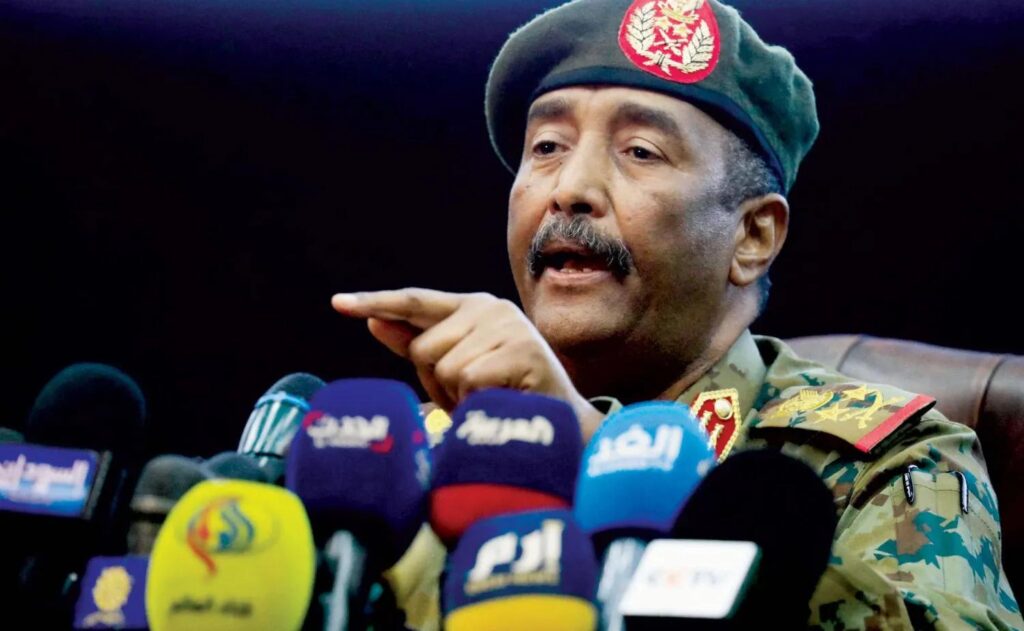
Khalid Omar Youssef, a senior figure in Sudan’s Somoud alliance, has accused SAF chief Abdel Fattah al-Burhan of obstructing peace efforts, saying his reported response to a US humanitarian truce proposal demonstrates a lack of seriousness about ending the war.
In a social media post, Youssef said details reported by Reuters showed that the SAF had accepted most elements of the US proposal while rejecting a clause calling for a limited withdrawal.
Instead, the SAF reportedly demanded that the Rapid Support Forces withdraw from all areas it has controlled since May 11, 2023.
Youssef argued that the response proves the military leadership remains engaged in negotiations through US mediation, despite its public rhetoric rejecting talks.
He said Burhan’s position reflected an effort to prolong the conflict for political purposes and preserve his hold on power.
According to Youssef, Burhan has sought to consolidate his rule since the overthrow of former president Omar al-Bashir, citing the transitional period, the October 25, 2021 coup, the November 21 agreement, the Framework Agreement and the outbreak of war on April 15, 2023.
He said each stage had been shaped by attempts to maintain military control over the country’s political system.
Youssef also argued that the Quad’s roadmap, issued in September 2025, and subsequent US pressure had pushed Burhan to adopt what he described as a strategy of delay and “buying time” in the hope that regional and international conditions would shift in his favour.
He accused the SAF chief of repeating Bashir-era policies by expanding the number of armed groups aligned with the military and exploiting regional and international rivalries in ways that weakened Sudan’s sovereignty and deepened the crisis.
Youssef said some regional and international positions had also contributed, directly or indirectly, to prolonging the war because of what he described as an incomplete understanding of the nature of Sudan’s conflict.
He concluded by saying that most Sudanese now want the war to end.
Citing a study conducted by the Sudan Peace Appeal initiative, Youssef said 93.2 percent of participants supported ending the conflict and establishing peace.
He said achieving that goal would require direct pressure on those obstructing peace efforts, accusing Burhan and Sudan’s Islamist movement of bearing responsibility for the continuation of the war.