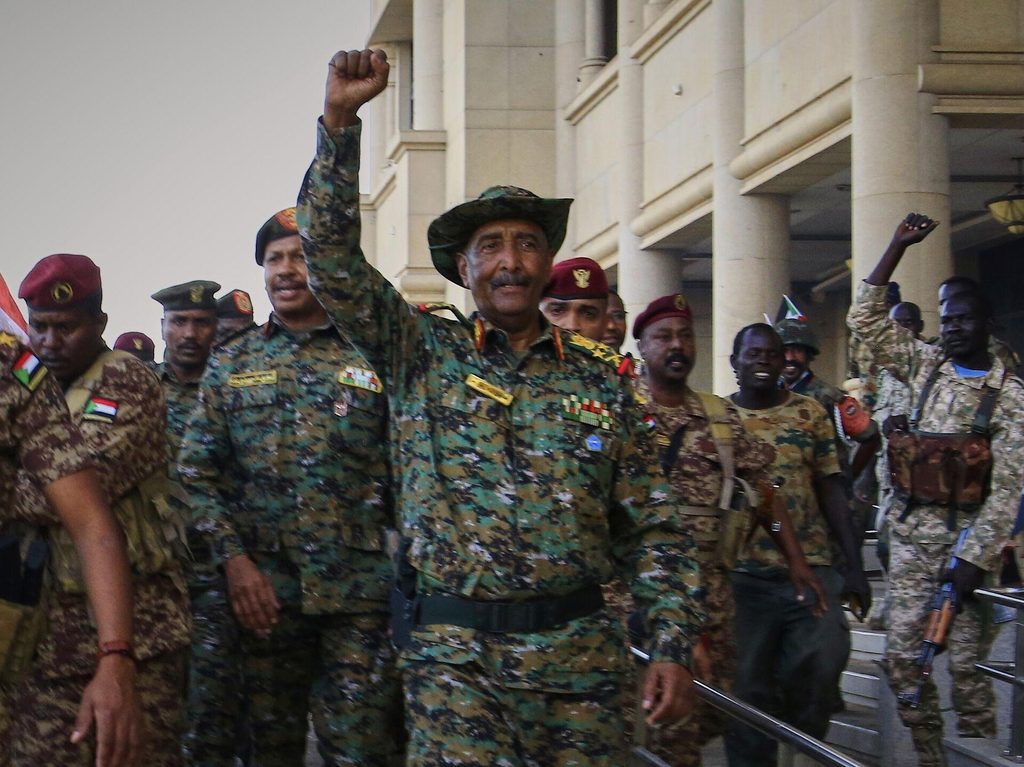
Relations between Sudanese army chief Abdel Fattah al-Burhan and his longtime Islamist allies are showing signs of increasing strain, as reported closed-door discussions in Turkey reveal growing fears within the Muslim Brotherhood-linked movement that its political and military influence could be sacrificed to secure Burhan’s survival in power.
Senior Islamist figures are reportedly seeking guarantees that their positions within Sudan’s military and political institutions will be protected amid mounting international pressure on the SAF government and renewed demands for accountability over the country’s prolonged conflict.
According to political analysts interviewed by Erem News, Islamist leaders are increasingly concerned that Burhan could seek to reshape his political alliances, distance himself from factions associated with former president Omar al-Bashir and pursue accommodation with international mediators.
Such a shift could threaten the influence Islamist networks have maintained within military structures, security institutions and armed formations fighting alongside the Sudanese Armed Forces (SAF).
The reported discussions have exposed a widening crisis of confidence between Burhan and elements of the Islamic Movement, whose leaders fear becoming bargaining chips in negotiations aimed at easing diplomatic isolation and securing a political settlement.
Divisions within the Islamist movement
Sudanese international law expert and human rights advocate Al-Muizz Hadra said the Islamic Movement has been deeply divided since its historic split in 1999, with competing factions attempting to preserve their influence over successive political and military administrations.
Speaking to Erem News, Hadra identified several groups associated with prominent Islamist figures, including Ali Karti, Osama Abdallah and Ahmed Haroun, alongside networks operating in eastern Sudan and Darfur.
He argued that Burhan has exploited these internal divisions by maintaining relationships with rival factions while preventing any single group from dominating his political calculations.
According to Hadra, Burhan’s relationship with the Islamist movement extends beyond a temporary alliance forged during the current war.
He alleged that the army chief had previously pledged loyalty to the movement and that Islamist support was instrumental in consolidating his position within Sudan’s military leadership.
Hadra said competing Islamist factions are now seeking to protect their respective interests through Burhan, even as uncertainty grows over his willingness to maintain their influence.
Their concerns have intensified as international pressure increases over Sudan’s humanitarian catastrophe, the role of Islamist-linked armed groups and demands for the surrender of individuals wanted by the International Criminal Court.
The movement’s internal divisions, Hadra suggested, have made it increasingly difficult for Islamist leaders to present a unified political position or secure binding assurances about their future.
Islamist battalions emerge as potential leverage
One of the most significant sources of tension involves Islamist-linked fighting formations that have supported the SAF during the conflict.
Hadra said some Islamist figures fear Burhan could agree to weaken their political and military positions in exchange for reduced international pressure, broader diplomatic recognition or arrangements that would allow him to remain influential in a future political settlement.
He suggested that Islamist leaders could respond by withdrawing political support or instructing affiliated battalions to stop fighting alongside the army.
Such a move, if carried out, could create additional complications for the SAF, which has relied on a variety of armed groups and allied formations during the war.
However, the extent to which Islamist political leaders could coordinate or enforce such a withdrawal remains unclear.
Hadra argued that Islamist figures involved in the discussions want direct assurances from Burhan concerning their continued influence over military and political institutions.
He also accused the army chief of relying on political manoeuvres that have failed to address Sudan’s deteriorating economic and humanitarian conditions.
According to Hadra, Islamist leaders both inside Sudan and in Turkey are increasingly uncertain about the next phase of the conflict and are seeking guarantees before any major political realignment takes place.
Search for alternative political alliances
Political analyst Ihab Madbo said the reported Turkey discussions reflect deeper concerns within the Muslim Brotherhood-linked movement that Burhan could eventually attempt to replace his Islamist support base with alternative civilian partners.
Madbo told Erem News that mounting international pressure on the SAF government has increased speculation about whether Burhan might seek new political arrangements capable of providing greater international legitimacy.
He pointed to international engagement with Sudanese civilian political groupings, including the Somoud coalition and the Sudan Founding Alliance (TASIS), as part of a changing diplomatic environment.
According to Madbo, Islamist leaders fear these developments could encourage Burhan to explore arrangements that reduce his dependence on the Islamic Movement.
However, neither Somoud nor TASIS has been shown to have agreed to become an alternative political support base for Burhan.
The two alliances occupy distinct positions within Sudan’s political landscape, and engagement with international mediators does not necessarily imply support for the SAF government.
Nevertheless, Madbo argued that Islamist leaders increasingly perceive the emergence of alternative political channels as a threat to their longstanding influence.
He said the movement is attempting to secure its interests before mounting diplomatic and political pressure forces significant changes within the SAF government’s governing arrangements.
Fears of confrontation between former allies
Madbo warned that unresolved disagreements could eventually trigger a direct confrontation between Burhan and Islamist factions that have supported him.
He argued that disputes within Sudan’s Islamist movement have historically involved bitter internal struggles, citing earlier episodes of factional confrontation and violence.
According to Madbo, the present uncertainty has encouraged competing groups to strengthen their positions and prepare for possible changes in the military leadership’s political calculations.
He suggested that either Burhan could move to marginalise influential Islamist figures or those factions could attempt to challenge his authority if they believed their interests were being abandoned.
Madbo said Burhan may be seeking to gain time while signalling to international actors that he is capable of distancing himself from Islamist networks.
The analysis remains speculative, and there has been no independently verified indication that either side has decided to end the alliance.
Nevertheless, the reported discussions illustrate growing uncertainty over the relationship between the SAF leadership and Islamist political networks as Sudan’s war continues.
International pressure complicates Burhan’s calculations
The tensions have emerged as international diplomatic initiatives continue to seek an end to the war, which began in April 2023 and has devastated large parts of Sudan.
Burhan’s position has come under increasing scrutiny over the SAF government’s political alliances, military operations and relationship with figures associated with Bashir’s former ruling establishment.
Questions surrounding the influence of Islamist networks have also become a significant feature of debates about Sudan’s political future.
For Islamist leaders, the central concern is whether a future settlement could exclude them from military command structures and state institutions while preserving Burhan’s position.
For Burhan, continued reliance on Islamist-linked factions could complicate attempts to secure international support for any negotiated transition.
The resulting tension has created a political dilemma for both sides, according to the analysts.
Although Burhan and Islamist factions retain overlapping interests in the continuation of the SAF’s military campaign, their longer-term political objectives may no longer be fully aligned.
The reported Turkey discussions suggest that Islamist leaders are increasingly focused on protecting their institutional positions rather than relying solely on their historical relationship with the army chief.
Whether these disagreements lead to a formal rupture or another temporary accommodation remains uncertain.
For now, the reported demand for guarantees reflects growing distrust within an alliance that has played a significant role in Sudan’s political and military landscape.